Haze is not hurting palm oil demand — but it is reviving an old reputational problem
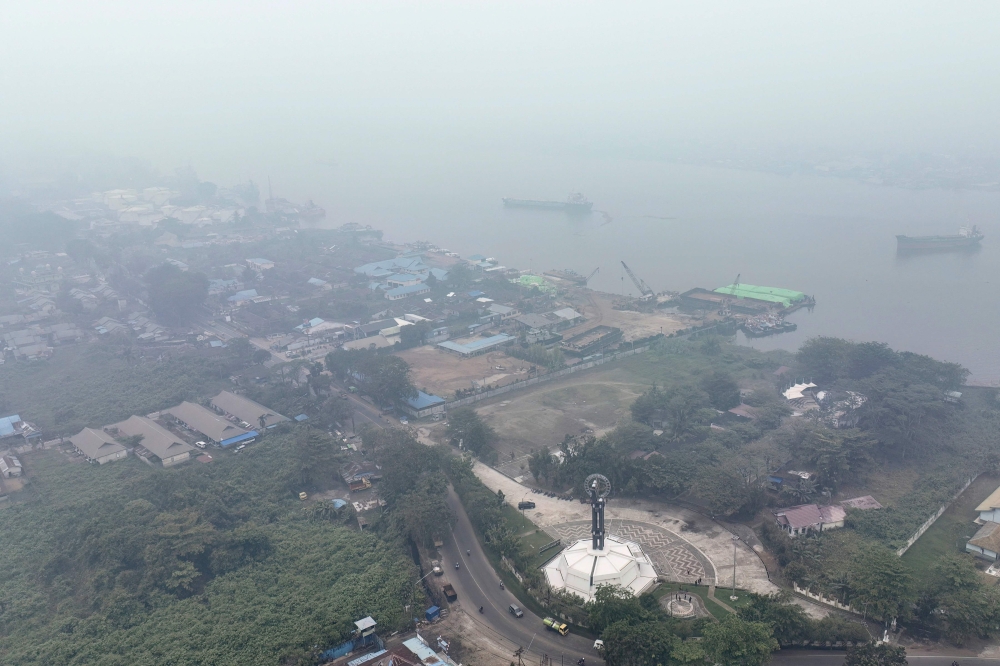

This aerial picture shows smoke shrouding the Equator Monument and the city of Pontianak in West Kalimantan September 17, 2026. Regional haze has again raised questions over the environmental reputation of palm oil, although industry data does not point to an immediate commercial impact. — AFP pic
First Published: Wednesday, 23 Sep 2026 7:00 AM MYT
PUTRAJAYA, Sept 23 — For Malaysia’s palm oil industry, the latest haze episode has again raised questions about the link between regional fires and how the commodity is perceived environmentally.
According to the United States Department of Agriculture, Malaysia and Indonesia dominate global palm oil production with a combined output projected at 66.7 million tonnes in the 2025/26 marketing year, or about 83 per cent of the global total.
Indonesia is expected to produce 47.5 million tonnes while Malaysia 19.2 million tonnes, and that dominance means environmental controversies in the region can quickly feed into the wider debate surrounding palm oil.
However, no evidence establishes a direct economic link between the current haze and weaker demand or lower palm oil prices.
The more immediate concern may be the scrutiny that comes with recurring fires, particularly from buyers, consumers and other stakeholders looking at sustainability and responsible production.
Fastmarkets Palm Oil Analytics senior analyst Dr Sathia Varqa said palm oil remained an essential commodity for Malaysia while describing it as the “DNA of Malaysia’s agri sector” because of its contribution to jobs, income and livelihoods.
He said recurring haze could reignite scrutiny over the industry’s sustainability and environmental record, including the long-running debate over food versus fuel.
At the same time, Sathia did not see a direct link between haze and higher costs of doing business for Malaysian palm oil exporters.
“There will definitely be more questions and scrutiny over the commodity,” he told Bernama, adding that companies with sustainability certification could use it to demonstrate their environmental commitments.
Nevertheless, he cautioned that it was not always clear whether the forest fires were linked to oil palm or other activities.
That question has become particularly relevant with the return of the haze.
Similarly, the Malaysian Palm Oil Board (MPOB) has said regional forest and peat fires cannot be attributed primarily to oil palm cultivation, with satellite mapping showing hotspots across multiple land uses, including unmanaged areas, pulpwood plantations and small-scale farming plots.
Its director-general Datuk Badrul Hisham Mohd also stressed that a satellite hotspot is an indicator of possible fire, rather than proof of open burning or evidence of its cause.
For the industry, this puts greater emphasis on being able to show where Malaysian palm oil is produced, how it is produced and whether those supply chains can be independently verified.
The traceability question
Badrul Hisham said Malaysia’s oil palm industry operates under a comprehensive regulatory and sustainability framework, enforced by verifiable institutional data rather than voluntary corporate promises.
This includes mandatory zero-burning requirements and the Malaysian Sustainable Palm Oil (MSPO) 2.0 certification standard.
Furthermore, the nationwide adoption of No Deforestation, No Peat, and No Exploitation commitments has significantly curbed deforestation in Malaysian oil palm industry supply chains.
MSPO 2.0, he said, applies to all growers, including smallholders, and includes a forest-conversion cut-off date of Dec 31, 2019, alongside requirements covering zero burning, peat management, biodiversity and greenhouse gas emissions.
He also said that the industry regulator introduced the GeoSAWIT geospatial platform and Sawit Intelligent Management System, which combine supply-chain transaction monitoring with the digital geolocation of oil palm cultivation areas.
Rather than merely providing evidence, this advanced tracking allows MPOB to definitively verify that licensed estates operate under strict, fire-free protocols.
In addition, it indicates that seasonal fire risks are predominantly concentrated on unmanaged, neglected lands that fall entirely outside the oil palm industry’s regulatory jurisdiction.
“Such systems allow the industry to provide evidence about where oil palm is cultivated and how supply chains are managed.
“That evidence could become more important whenever regional environmental events lead to broader questions about palm oil,” he said.
Meanwhile, Sathia said palm oil would continue to face competition from soybean oil and other vegetable oils, but remains the most competitively priced vegetable oil.
He said the negative perception of palm oil as the “bad boy” of the agricultural market has softened following years of education and awareness efforts by agencies such as the Malaysian Palm Oil Council, Malaysian Sustainable Palm Oil Council, as well as MPOB itself.
He also said palm oil has continued to expand into new markets despite trade barriers and compliance requirements, suggesting that environmental scrutiny has not prevented the sector from growing so far.
The industry’s current commercial performance also does not point to an immediate impact from the haze.
To recap, palm oil exports increased 10.4 per cent year-on-year to 7.68 million tonnes in the first half of 2026, while crude palm oil (CPO) production rose 0.6 per cent to 9.02 million tonnes.
The average CPO price remained above RM4,300 per tonne, while palm oil stocks stood at 2.54 million tonnes at the end of June, compared with 2.03 million tonnes a year earlier.
The figures point to continued demand for Malaysian palm oil even as environmental concerns remain.
But the haze is not the only climate-related issue facing the industry.
Climate’s delayed cost
For the hundreds of thousands of smallholders and plantation workers whose livelihoods depend on the crop, these climate extremes are creating a “double risk” situation.
Badrul Hisham highlighted that on one hand the industry faces immediate, unjust reputational damage from transboundary haze caused by external fires.
On the other hand, the very same severe heat threatens their future harvests. He noted that drought and extreme heat could reduce photosynthesis and interfere with reproductive development in oil palm, affecting bunch and fruit formation.
The effects, however, are not necessarily immediate.
Because oil palm has a long reproductive cycle, severe drought can result in lower fresh fruit bunch (FFB) production many months later, with production effects potentially persisting for up to two years.
This means relatively resilient production figures in the first half of 2026 do not necessarily remove the risk posed by current weather conditions.
According to the MPOB data, it said the average FFB yield fell 1.4 per cent to 7.72 tonnes per hectare in the first six months of the year, mainly due to weaker performance in Peninsular Malaysia and changes in the age profile of oil-palm areas.
Improved yields in Sabah and Sarawak and a higher national oil extraction rate of 20.08 per cent helped offset the decline and support the marginal increase in CPO production.
Meanwhile, the board expects production to increase seasonally in the second half of the year, although output is projected to be 4.7 to 7.3 per cent lower than in the corresponding period last year, partly due to a biological yield adjustment following strong production in 2025.
For the full year, CPO production is projected at between 19.50 million and 19.80 million tonnes, compared with 20.28 million tonnes in 2025.
“There were currently no indications warranting a revision to the forecast and the overall industry outlook remains positive and year-end stocks are expected to be around 2.5 million tonnes.
“Demand is expected to remain firm, supported by Indonesia’s B50 biodiesel programme and Malaysia’s B15 programme, although weaker global economic growth, lower crude oil prices, competition from other vegetable oils and policy changes in major importing countries remain uncertainties (that can affect demand),” Badrul Hisham said.
Beyond the smoke
The haze puts the palm oil industry in a familiar position.
The issue is twofold: whether individual fires can be linked to oil palm cultivation and how repeated environmental incidents may affect perceptions of the commodity. The available evidence does not suggest that the current haze has had a direct commercial impact on Malaysian palm oil demand or prices.
But environmental scrutiny is unlikely to disappear.
For an industry that has spent years addressing concerns over deforestation, land use and sustainability, being able to provide verifiable information on where and how palm oil is produced will remain important.
Regional fires may involve different types of land and different causes and a satellite hotspot alone cannot establish who started a fire or what land use was involved.
So, for the palm oil industry, the task is therefore not only to explain what the hotspot data shows, but also to provide evidence about its own supply chains.
That may matter most when the smoke clears and the questions begin. — Bernama
KioskNews shows a cleaned-up reading view extracted from the publisher’s page — the original always lives on their site, not ours.