At least 126 Taiwanese targeted in China’s transnational repression
By Chen Yu-fu / Staff reporter


At least 126 Taiwanese in 140 cases have been subjected to Chinese transnational repression, the Mainland Affairs Council said yesterday, following news reports of the arrest of a woman who was accused of spying for China on President William Lai’s (賴清德) son and his family in the US.
China has repeatedly threatened the safety of those targeted and their families, the council said, adding that such efforts are aimed not only at Taiwan’s president and government officials, but at Taiwanese as a whole to intimidate them and create a chilling effect.
Taiwanese firmly oppose such actions, it said.
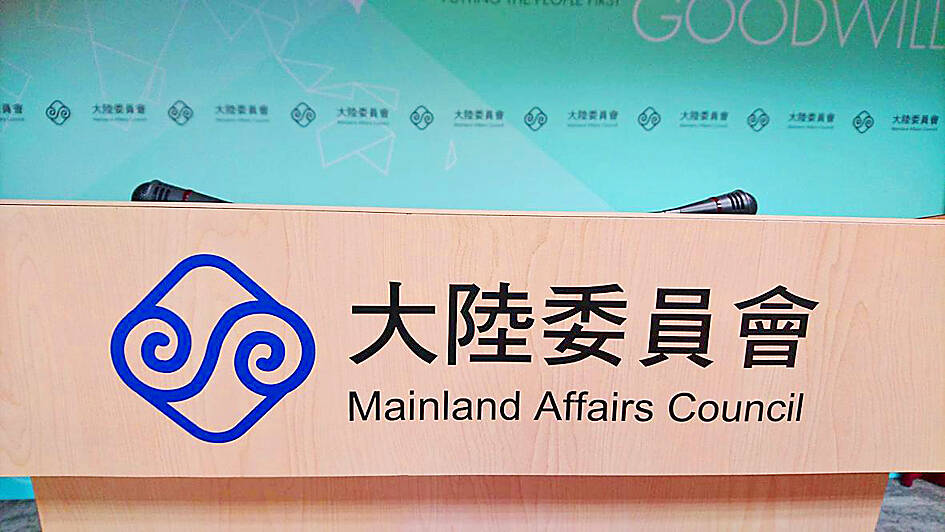
The Mainland Affairs Council logo adorns a podium at the council’s offices in Taipei in an undated photograph.
Photo: Chung Li-hua, Taipei Times
The surveillance and following of people by local collaborators at China’s direction, such as the targeting of Lai’s son, are federal felony in the US.
However, similar conduct in Taiwan would not be punishable under current law, highlighting gaps in the nation’s legal framework for countering the various forms of transnational repression Taiwanese face, it said.
The government is working to revise the Anti-Infiltration Act (反滲透法) and hopes people will pay greater attention to and support the effort, it said.
Tunghai University Center for Mainland China and Regional Development Research deputy director Hung Pu-chao (洪浦釗) said that for the intelligence agencies of any country, prominent political figures and their family members can be valuable sources of intelligence.
For Taiwan and US national security and protective services, safeguarding the president’s immediate family, assessing potential risks and monitoring unusual contacts are already part of their security responsibilities, he said.
The US decision to arrest the suspect involved and bring criminal charges indicates that China’s surveillance of Lai’s family crossed a red line for US law enforcement and national security, Hung said.
The US arrests and criminal charges were a clear warning to the Chinese government through the judicial system, he added.
If surveillance of the president’s family is not stopped, it would be difficult to predict what kind of security threat it could eventually pose, he said.
By taking action now, the US is signaling to Beijing that Chinese Communist Party cannot simply extend the intelligence-gathering and surveillance methods it uses inside China to other countries, he said.
KioskNews shows a cleaned-up reading view extracted from the publisher’s page — the original always lives on their site, not ours.