I love a drink in the stands, but Burnham’s beer proposal feels out of step with modern football | Marva Kreel

Andy Burnham is right that football fans have historically been treated differently from other sports fans. But if we’re going to talk about discrimination in football, the ban on drinking at your seat feels like a strange place to start.
The rule may have its roots in a very different era of football, but for many fans today, being able to take a pint to your seat may not be top of their list of changes they’d like to see in the game. Especially at a time when discrimination is very much present elsewhere in football.
The legislation, introduced under Margaret Thatcher in the 1980s as part of a crackdown on football hooliganism, was rooted in the idea that football fans needed to be treated differently from the supposedly better-behaved crowds at rugby and cricket – which smacks of classism and the stereotyping of working-class fans. But football has changed since then, and so has drinking culture. Fans have adapted to the restrictions and built a matchday ritual around them. A good fan concourse pint is up there with an airport pint or a beer-garden pint on the first day of summer.
Fans have got used to this routine, and one of the biggest concerns of lifting this ban now seems to be the Boxpark-ification of football: the dreaded performative beer throw when anything good happens.
Even when it’s not performative, it does raise a problem of logistics. With no cup holders, when a 95th-minute winner goes in and you’re suddenly off your seat with your limbs in the air, a pint is unlikely to remain where you left it. There will be people walking back and forth from the concourse during the game for another pint or the toilet, too. It used to happen before, of course, but it would still be a new irritation that fans would have to adapt to. And, most importantly, it isn’t a change many fans seem to have been asking for.
As a fan of both men’s and women’s football, I’ve experienced the Women’s Super League’s successful trial of beer at your seats, as well as drinking at non-league games, and it was a nice change. It has even become a distinct part of the matchday experience in leagues where the atmosphere is different and the crowds are smaller. But the women’s game is not simply the men’s game with fewer people in the stands. The matchday experience is different – and that’s important when we talk about what works.
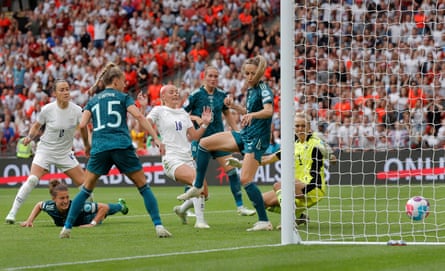
Watching Everton Women with a beer in hand can be lovely. So can spending a long day at the cricket with a pint. But I was also at the game in which Chloe Kelly scored the winner for England against Germany at Euro 2022, and was immediately swallowed up in the chaos of the celebrations, being thrown around by the people around me. Having a pint in my hand in that moment would have been less than ideal. Beer and football can clearly coexist, but what works at one level of the game, or in one kind of crowd, doesn’t necessarily translate neatly to another.
But this is where Burnham’s argument starts to feel out of step with the reality of football now. At a time when working-class fans are being priced out of their season tickets, racist, sexist, homophobic online abuse is ever-present, and figures at the very top of the game – such as Jim Ratcliffe – use their platform to push deeply divisive politics, it feels out of touch to make the right to drink a pint in your seat a headline example of football discrimination.
And that’s not to deny discrimination of working-class fans, but this is a problem that runs much deeper in the game. And if the old assumption is that football fans are uniquely likely to cause trouble when alcohol is involved, lifting the ban doesn’t automatically remove that belief. It’s possible these biases will show up in how games are policed, with a heavy pre-emptive police and security presence.
If the ban is lifted, there’ll be teething problems, there will be beer showers, complaints and no doubt a bunch of stories in the press making an example of any issues of violence held up as evidence that football fans can’t be trusted with a pint. Eventually, though, fans will adapt, security will relax and, for the most part, it will probably become normal.
after newsletter promotion
But that’s precisely why Burnham’s argument feels like such an odd intervention. There are serious questions about class and access in football that deserve to be scrutinised as discrimination. If Burnham wants to tackle the ways football fans are treated unfairly, there are plenty of other places to start.
Football fans have every right to drink their beer wherever the rules allow. But sometimes a pint is just a pint – and football has bigger battles to fight.
KioskNews shows a cleaned-up reading view extracted from the publisher’s page — the original always lives on their site, not ours.