Milei’s US trade deal is under threat as Argentina demands better terms
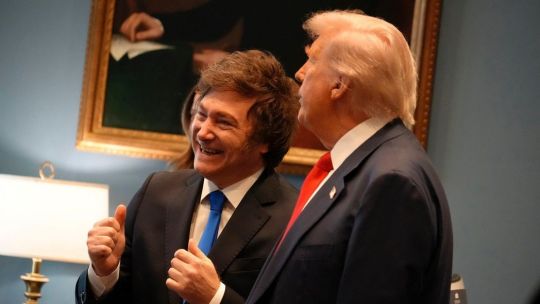
President Javier Milei’s advisers in Argentina have told US President Donald Trump's administration they don’t have the votes in the nation’s Congress to ratify the bilateral trade agreement they signed last February, according to people familiar with the matter.
Milei’s government wants to renegotiate the terms because of the US Supreme Court’s ruling on President Donald Trump’s global tariffs, according to the people, who asked not to be named discussing private talks.
Although Trump has called Milei “my favourite president,” his policymakers flew to Buenos Aires in recent weeks to deliver a clear message: Renegotiation is off the table, as it would set a precedent for other countries to seek sweeter conditions. They’re urging Argentina to ratify the deal, and they don’t see a coherent legislative strategy or timeline by Milei’s government, people familiar with the situation said.
The clock is ticking as Argentina’s legislative year ends in November. Milei is prioritising other high-stakes legislation and his 2027 re-election bid will likely make ambitious reforms like this one too risky to pass.
Argentina’s Foreign Ministry and the US Trade Representative didn’t respond to requests for comment.
Argentina’s dollar bonds are underperforming emerging-market peers on Tuesday, with the country’s benchmark 2035 notes down almost half a cent on the dollar to 73.7 cents. The yield climbed nine basis points to 10.54 percent.
Still, people familiar with the matter in Washington and Buenos Aires said the delay isn’t straining the broader relationship. If Trump and Milei happen to speak on the sidelines of the United Nations General Assembly in New York this week, they could get the deal back on track.
For now, disagreement over a path forward contrasts with their ideological affinity and comes after the US provided Argentina with a US$20-billion currency swap line a year ago to fend off a market sell-off ahead of the country’s midterm elections. Both sides also celebrated the trade agreement in February as a landmark achievement that cemented the budding bilateral ties marked by more than a dozen trips by Milei to the US to meet with Trump, Elon Musk and others.
It also reflects how Milei’s momentum has faded. Trump’s assistance succeeded in helping the libertarian’s party pull off a comeback and more than double its standing in Congress in the midterm election. That political strength helped Milei sign the trade deal and pass a major labour reform, while fuelling optimism that Argentina was poised for strong growth ahead. US officials saw ratification as a formality at the time, not a genuine hurdle, people said.
Since then, however, a corruption scandal and sluggish growth have lowered Milei’s approval ratings to near the lowest levels of his Presidency. His reform agenda has suffered setbacks in Congress, a landscape that has revived US concerns about how and when he’ll ratify the trade agreement.
US officials argue they’ve done plenty to grant Milei favourable trade benefits – including an 80,000 ton boost to Argentina’s beef export quota, along with more than 1,600 tariff exemptions in the deal – and that his government must now keep up its end of the bargain, the people said.
Jeff Goettman, a deputy US trade representative, visited Buenos Aires in August and met with Argentina’s top trade official, Foreign Minister Pablo Quirno.
“Ambassador Goettman also underscored the importance of ratification of the Agreement on Reciprocal Trade and Investment (ARTI), which was concluded earlier this year, in order to fulfill our shared economic vision,” the USTR posted on X.
Argentine officials point to the US Supreme Court’s decision to strike down Trump’s global tariffs to justify new terms since the agreement was signed just weeks before the ruling. They say they can’t ratify an agreement based on an outdated legal framework.
To be sure, Milei’s government has begun implementing some of the regulatory and intellectual-property commitments in the deal, even as the core tariff provisions remain stalled. In March, Argentina’s patent office, INPI, scrapped rules dating from 2012 that restricted the patentability of pharmaceuticals. Argentina also liberated some imports.
Beyond political opposition in the historically protectionist nation, Argentina’s pharmaceutical companies are strongly lobbying the government against implementing other aspects of IP rules that are included in the agreement, according to multiple people.
That legislation, known as PCT, is still waiting approval in the senate after it passed the lower house with revisions.
In a signal of how charged the issue has become, the pact didn’t come up during an event last week focused on bilateral trade at the US Embassy with Quirno, according to multiple people present at the meeting, who were surprised by its absence.
KioskNews shows a cleaned-up reading view extracted from the publisher’s page — the original always lives on their site, not ours.