‘Hardships never last’: Jenn Lichter’s path from Colombian orphanage to ultrarunning records

On 27 June, Jenn Lichter lined up for her first 100-mile race, the Western States 100. The oldest and most prestigious 100-miler in the world, Western States attracts a highly competitive field from around the globe – the athletes run across the Sierra Nevada from Olympic Valley to Auburn, California. Despite 18,000ft of climbing and daytime temperatures often flirting with triple digits, Lichter went in confident. “I wanted to win, there was no secret to that,” she says. “That’s just who I am.”
The race remained close for the first half, until the 30-year-old made a move on the climb to Devil’s Thumb. The gap grew and at the final aid station, Lichter had a sizable lead over the athlete in second place. A mile from the finish, Nick Cornell, Lichter’s fiance, told her she was just ahead of the course record. “That was the first I had heard about it,” Lichter says. “He knew my competitive side would jump at the challenge.”
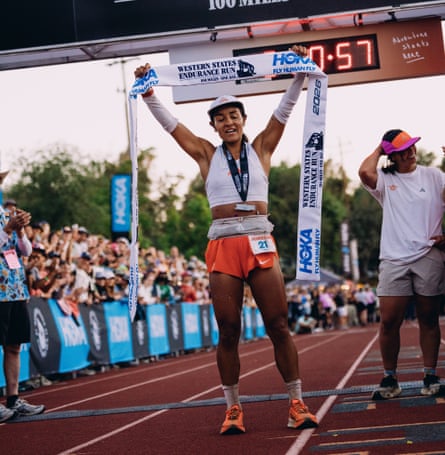
Lichter sprinted the final mile down the streets of Auburn and on to the Placer High track, breaking the tape in 15 hours 28 minutes 5 seconds, 88 seconds faster than Courtney Dauwalter’s previous course record. Before 2026, only one woman had come within 50 minutes of Dauwalter’s time, making the record seem nearly unbreakable to most fans. Two months later, Lichter is only just putting that moment into perspective.
“It took a while to process,” Lichter says. “It’s only hitting as I’m wrapping up the season and have the time to look back and realize what I did. It’s like summiting one of the most beautiful peaks in the world and at first you can’t fully understand what you’re seeing.”
Lichter’s road to that record-shattering win was far from traditional. She was born in Bogotá, Colombia, and at two years old she was picked up by childcare services and placed in an orphanage, along with her older brother and younger sister. Her father had been shot and killed while involved with drug cartels and her mother struggled with addiction, leaving the children to fend for themselves on the streets.
“Life in the orphanage was very regimented,” Lichter says. “Breakfast, lunch, dinner, and recess were always at the same time, but ignorance is bliss. When you’re a kid, you don’t know better.” Lichter’s mom would visit on the weekends, while trying to get back on her feet. When Lichter was seven, she and her siblings, Harold and Kim, were moved to an orphanage that worked to get them adopted together.
“Despite the circumstances, we were happy and a big reason for that is we had each other,” she says. “That kept our mental state intact and made the whole experience less frightening. From birth, we’ve felt attached at the hip. Like twins, we can feel each other’s emotions. Our souls are intertwined.”
Through those years, Lichter also learned how to rely on herself to get through challenges. “If shit ever hits the fan, I just pick myself up and dust myself off and continue on,” she says. “Life can be hard but it doesn’t mean you have to succumb to it. Hardships never last for ever.”
When she was nine, Lichter and her siblings were adopted by a family in La Crosse, Wisconsin, on the banks of the Mississippi. She only knew a handful of English words – hello and goodbye, water, a few colors – so her adopted parents hired a bilingual nanny to help translate, carried a dictionary everywhere they went and covered the house in sticky notes with Spanish words and their English equivalent together, to help the kids learn the new language.
The biggest culture shock for Lichter was the freedom she suddenly had. “I remember thinking, what do you mean we can have a snack whenever we want? Go outside whenever we want? Have a toy that’s not communal? Have seconds at dinner? The little, simple things that most people take for granted were everything to us.”
Her new life was much more freeing than her time in the orphanage – going out to restaurants, road trips, and meeting new friends – but it came with challenges. “The language was hard at first, but I trusted that the longer I was in it, the better I would get,” Lichter says. “After a year I was fluent, happy and felt secure.”
In elementary school Lichter played basketball and enjoyed it, but in middle school she stopped growing and felt out of place. Her mom suggested cross-country running, which Lichter had never heard of. “I tried it out and thought it was the most uncomfortable thing in the world,” she says, “but I also had a sense that I could keep going.”
Lichter stuck it out for a season, mostly out of curiosity. She found success and was recruited by the high school team, but the sport soon turned dark for her. “I liked the competition,” Lichter says, “but truly I like it because it was just something I could control. It’s just you, your body and your thoughts. That’s where the obsession started.”
Running brought up the trauma around leaving Colombia that Lichter had repressed for years. She wrestled with the feeling of abandonment and used running as an outlet, driven by a search for control. At 12, Lichter was diagnosed with anorexia and for the next three years was in and out of treatment centers, working through the emotions of leaving her birth mother and loving her adopted mother.
As a senior in high school, Lichter started winning races, sometimes by minutes. She received offers from a number of Division III and Division II schools, but instead opted for a walk-on scholarship from University of Toledo, her only Division I offer. “I felt like working for my spot would bring out the best in me,” Lichter says. “I had a fantastic freshman year, then dealt with RED-S [relative energy deficiency in sport] the rest of college. After that, I didn’t think running was meant to be in my life.”
After graduating, Lichter packed up her car and roadtripped west with her mother, with plans to land in Portland, Oregon. Along the way they visited Montana’s Glacier national park and Lichter immediately fell in love. After the trip, Lichter stayed in Portland just 10 days before packing up again and driving back to Montana. “I had this moment when I realized I was a grown adult and I could do what I want,” she says, “so I drove back to Kalispell and the rest is history.”
She started working as a hiking guide, living out of her tent for much of the summer. “I was 23 and felt so alive,” Lichter says. “I thought I’d hit the apex of my life, found my dream job.”
That’s where Lichter met Cornell, who also worked as a guide. On their days off, they would go on trail runs together, and the joy of running slowly came back to Lichter. In the fall of 2021, Cornell suggested they race The Rut 50k in Big Sky, Montana.
“I didn’t realize I still had the competitive spirit in me until we were driving to the race and I told Nick I wanted to win,” says Lichter, who went on to run the third fastest time in course history. After the race, The North Face offered Lichter her first professional trail running contract, and she jumped at the opportunity.
Lichter recommitted to running, but planned to do it differently this time around. “In middle school and high school and college I had snippets of potential, but kept getting in my own way,” she says Licht. “Now I’m focused on taking care of myself first … actually taking easy runs easy, and not running myself into the ground. My sense of control is a lot different than it used to be.”
That refreshed mentality has paid dividends. Lichter has won some of the most competitive 50k races around the United States – The Rut twice more, Broken Arrow Skyrace twice, Speedgoat and Gorge Waterfalls. Last year she decided to bump up in distance and told her team manager that her goal was to win Western States. To do that, she first had to qualify.
Lichter lined up for the Black Canyon 100k in February, surrounded by a stacked field all wanting to earn a golden ticket to Western States. She won by mere seconds. After four more months of training, Lichter did the unthinkable, breaking Dauwalter’s record at the country’s most competitive 100-mile race.
With months to reflect, Lichter says very little has changed after stunning the trail running world. “I feel more confident, but truthfully, my life is still the same,” she says. “I just keep putting in the work and being willing to take shots at new things. With my two feet on the ground, I have a sense of safety and control I used to not have, which gives me the confidence to try just about anything.”
KioskNews shows a cleaned-up reading view extracted from the publisher’s page — the original always lives on their site, not ours.