More than half of households that left ComCare assistance in 2022 returned within 3 years: MSF
SINGAPORE: More than half of households that stopped receiving short-to-medium-term assistance (SMTA) under ComCare in 2022 returned to the scheme within three years, a report released by the Ministry of Social and Family Development (MSF) on Monday (Nov 16) showed.
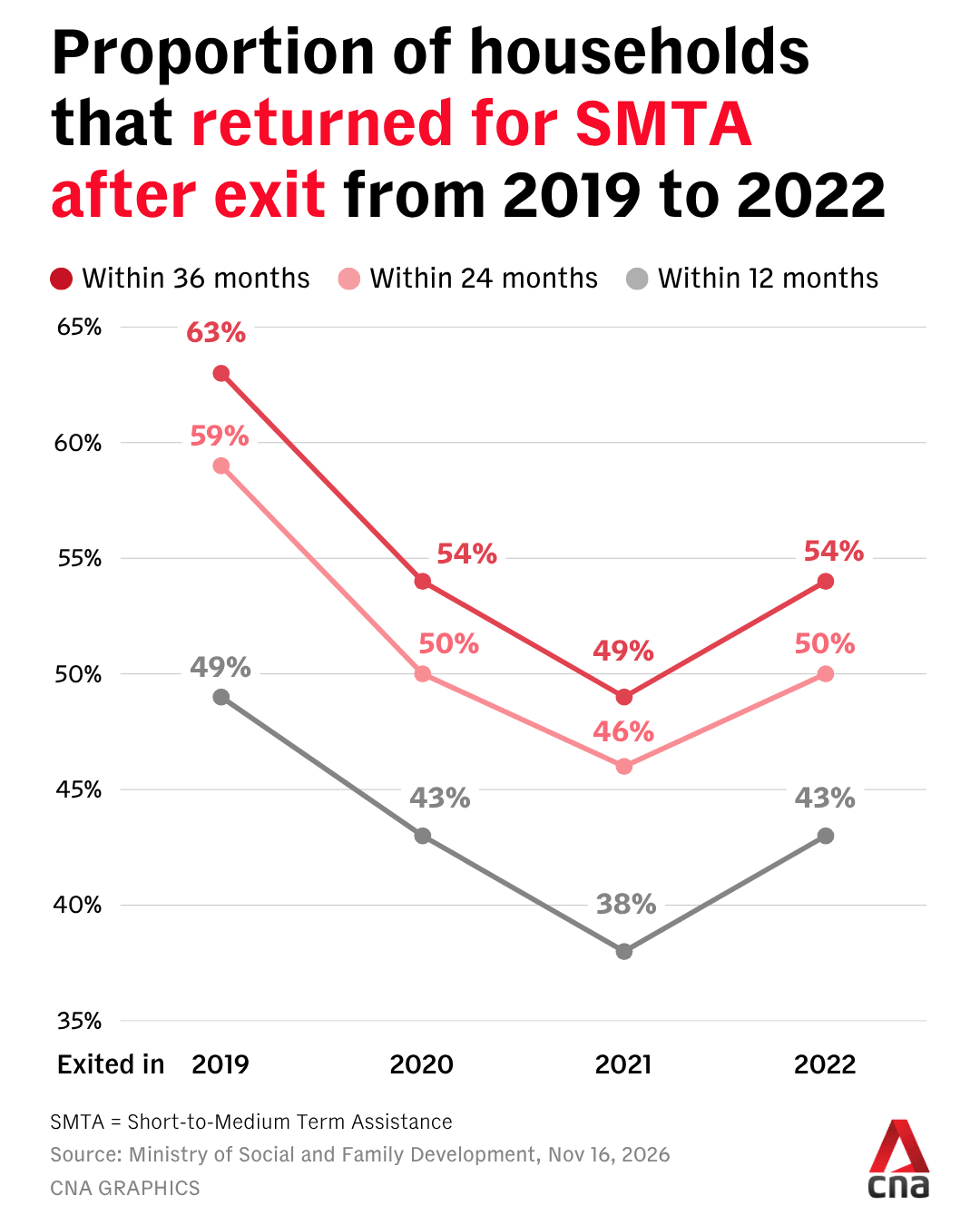
The return rate rose to 54 per cent for the 2022 cohort, up from 49 per cent the previous year, according to the supporting lower-income households trends report.
ComCare's SMTA scheme supports households with temporary financial assistance to meet a family’s basic living expenses.
The increase likely reflects a shift back towards pre-COVID-19 patterns, MSF said. During the pandemic, the ministry had “exercised flexibility to support more households that experienced temporary shocks to their financial circumstances”.
Some households that stopped receiving assistance in 2021 may therefore have needed support only during the pandemic, making them less likely to return.
Despite the increase, the proportion of households returning within three years remained below the 63 per cent recorded among those that left the scheme in 2019, before the pandemic.
The increase was also seen over shorter periods.
Half of the households that stopped receiving assistance in 2022 returned within two years, compared with 46 per cent of the 2021 cohort. The proportion returning within a year also rose, from 38 per cent to 43 per cent.
The report found that most households that returned to ComCare within three years did so in the first year after leaving the scheme. This suggests that households are most vulnerable to changes in their financial circumstances during this period, MSF said.
Responding to queries from CNA, MSF said achieving sustained financial stability can take time, particularly for households facing multiple and sometimes overlapping challenges.
“A household returning to SMTA could have been ready to exit assistance earlier but had a change in circumstances later, for example due to changes in employment, health or caregiving responsibilities,” it said.
“ComCare therefore remains available as a social safety net when families need support.”
STABLE EMPLOYMENT LINKED TO LOWER RETURN RATES
The report also found that households with stronger employment outcomes after exiting SMTA were more likely to stay off ComCare assistance.
Among households that stopped receiving the assistance in 2022, 46 per cent of those that did not return within three years had at least one member in stable employment in 2023.
The figure was lower, at 35 per cent, among households that returned to the scheme.
Stable employment is defined as working for at least six consecutive months in a year.
Households that did not return also had a higher median number of months worked over the three years after leaving the scheme – 17 months, compared with 11 months among those who returned.
“Employment support can help household members build skills, confidence, and job readiness,” said MSF.
“Social service offices therefore work with other government agencies, family service centres and community partners to coordinate support and help households stabilise their circumstances as they work towards greater self-reliance.”
However, caregiving responsibilities and health issues remained barriers to securing and sustaining employment.
Among households that returned to SMTA within three years, 23 per cent had at least one child beneficiary aged six or younger when they left the scheme, compared with 16 per cent of those that did not return.
Households that returned to assistance were also more likely to have primary applicants who were medically unfit for work at the time of assessment – 18 per cent, compared with 13 per cent among those that stayed off assistance.
“These findings point to the importance of addressing practical barriers, such as caregiving and health-related needs, alongside employment support,” MSF said.
FEWER HOUSEHOLDS ON COMCARE, BUT PAYOUTS RISE
While return rates increased, the overall number of households receiving ComCare assistance continued to fall.
The number of households receiving SMTA declined to 19,473 last year, from 20,825 in 2024, according to the report.
But the total amount disbursed rose to S$95.8 million (US$75 million) in 2025, from S$94 million in 2024.
A similar trend was seen under ComCare’s long-term assistance, which supports people who are permanently unable to work due to old age, illness or disability and have little or no family support.
The number of households receiving this form of assistance fell to 2,997 last year, from 3,240 in 2024. The amount disbursed increased to S$22.4 million, from S$21.4 million.
MSF attributed the higher disbursements to enhancements to assistance rates in 2025 to help households better meet their basic living needs.
MORE COMLINK+ FAMILIES MAKE PROGRESS
Separately, the report found improvements in employment and preschool education outcomes among lower-income families supported by ComLink+.
The initiative provides support to lower-income families through family coaches, social service agencies and community partners, with the aim of helping them achieve stability, self-reliance and social mobility.
As at December 2025, 11,006 families had agreed to join ComLink+, up from 10,219 a year earlier.
The report tracks the progress of ComLink+ families across six domains: income security, children’s development and education, housing, family functioning, financial resilience and health.
The proportion of ComLink+ families that had achieved stability increased to 49 per cent in 2025 from 44 per cent in 2024, said the report. This meant they met all the relevant stability indicators, including having stable employment, access to housing and children enrolled in school.
ACHIEVING SELF-RELIANCE
For Ms Syafawani Yazid, balancing work and caregiving responsibilities has been a challenge as she raises her two-year-old daughter in a one-room rental flat.
With support from ComLink+, the 28-year-old is working to clear her S$15,000 debt by March 2027, using an Excel spreadsheet to track her expenses and identify areas where she can cut back.
In September, the single mother moved to a more flexible job as a food and beverage service crew member, allowing her to take her daughter to and from preschool regularly. She believes this has helped her daughter become more confident and develop her social skills.
Ms Syafawani also hopes to own a home where her daughter can have a bedroom of her own.
"I just want her to have her own space growing up because that's what I had when I grew up," she said.
Ms Syafawani’s family coach, Mr Zulhakim Mustar, has seen her grow more confident and independent since they began working together last year.
"One thing I like about her is that she continues to stay positive despite her situation," Mr Mustar, who is the manager for ComLink Regional Services at the Social Service Office in Jalan Besar, said.
He encouraged families facing similar challenges to seek guidance from family coaches, who can help them identify suitable support.
“Having a family coach doesn't mean we will solve the problem, but I think it's more about guiding you to address the challenges that you have,” he said.
Collapse Expand
FINANCIAL RESILIENCE REMAINS A CONCERN
Income security was one of the domains that saw an improvement.
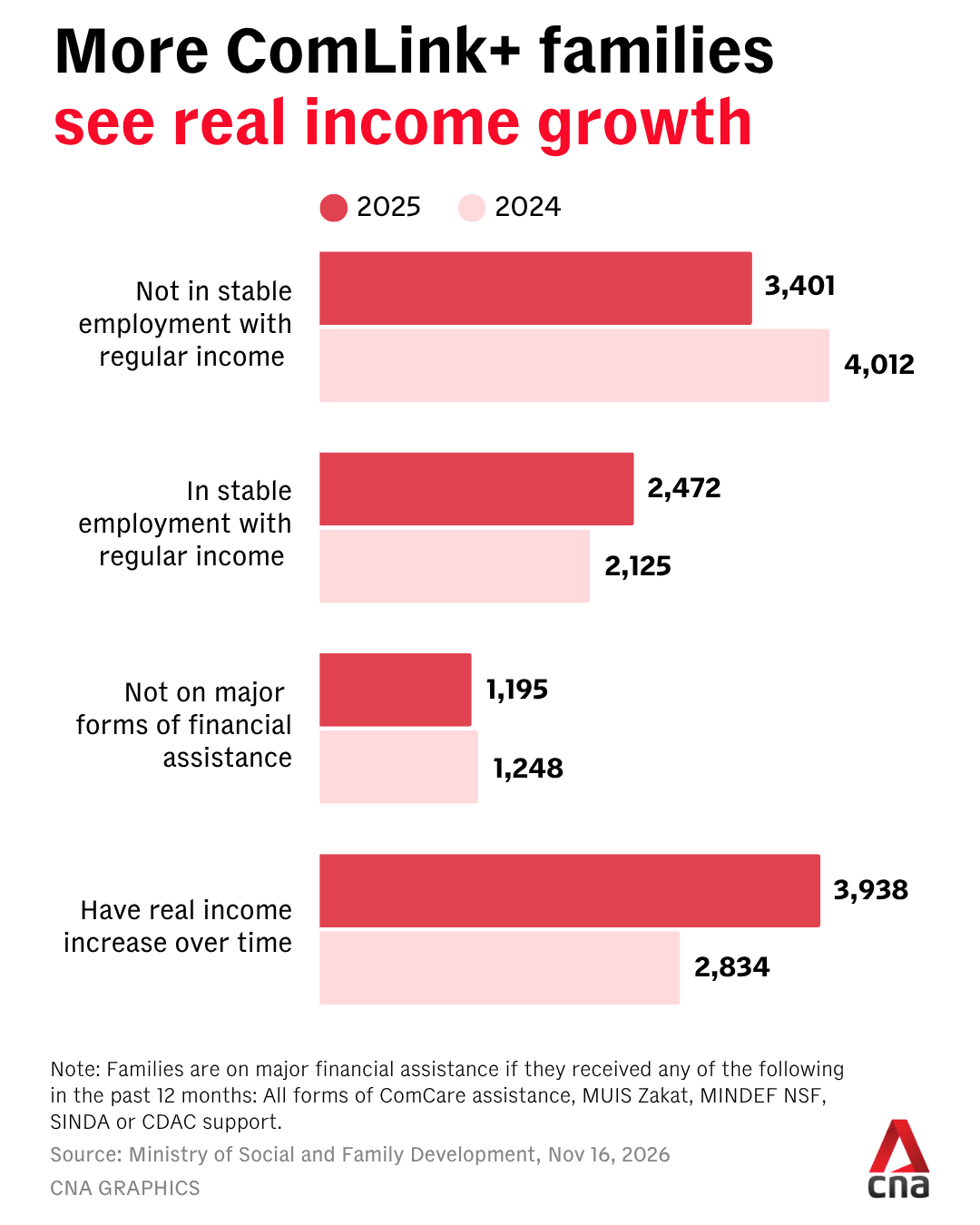
The proportion of ComLink+ families achieving social mobility in this domain rose from 28 per cent in 2024 to 36 per cent in 2025, said the report. This meant that they had stable employment, were no longer receiving major forms of financial assistance and had real income growth over time.
But part of the improvement in employment outcomes was due to the inclusion of platform work income in CPF records from 2025, which allowed more families to meet the income criteria.
The report also found that the median real household income of ComLink+ families also increased by 31 per cent in 2025 compared with 2024.
“This reflects their efforts to strengthen their financial circumstances and build a better future for themselves and their children,” the ministry said.
Yet some households continued to face difficulties securing and sustaining stable employment.
Among families that joined ComLink+ in 2023, 21 per cent had no member in stable employment with regular income from 2023 to 2025.
“These families were more likely to face multiple and interrelated barriers, such as poor health, caregiving responsibilities, family functioning concerns, lower educational qualifications, or difficulties finding jobs that matched their circumstances and skills,” said MSF.
Financial resilience also remained a concern.
An MSF longitudinal survey launched in 2022 found that only one in six ComLink+ families had sufficient savings to cover at least three months of household expenses.
“Some families face challenges such as irregular income, caregiving responsibilities, health issues and debts that make it harder to build savings consistently,” said the ministry.
“Families whose expenses outstrip their income may also face difficulties in accumulating savings. These families are also more likely to have fewer working members or include members with medical conditions.”
MORE FAMILIES MEET PRESCHOOL MILESTONES
In the children's development and education domain, the MSF report found improvements in preschool education outcomes among ComLink+ families.
The proportion of families with preschool-aged children achieving self-reliance in this domain increased to 31 per cent last year, from 28 per cent in 2024. This meant all preschool-aged Singaporean children in these families were enrolled in preschool, had completed mandatory vaccinations and were attending preschool regularly.
MSF told CNA that barriers to regular preschool attendance can include children's health issues, parents juggling work and caregiving responsibilities, and difficulties establishing consistent routines, such as managing separation anxiety.
“Some families may also prefer alternative caregiving arrangements or have other immediate priorities, such as employment, caregiving for other family members, or changes in family circumstances,” the ministry said.
It added that family coaches and case workers from family service centres work with families to understand these barriers and provide practical support.
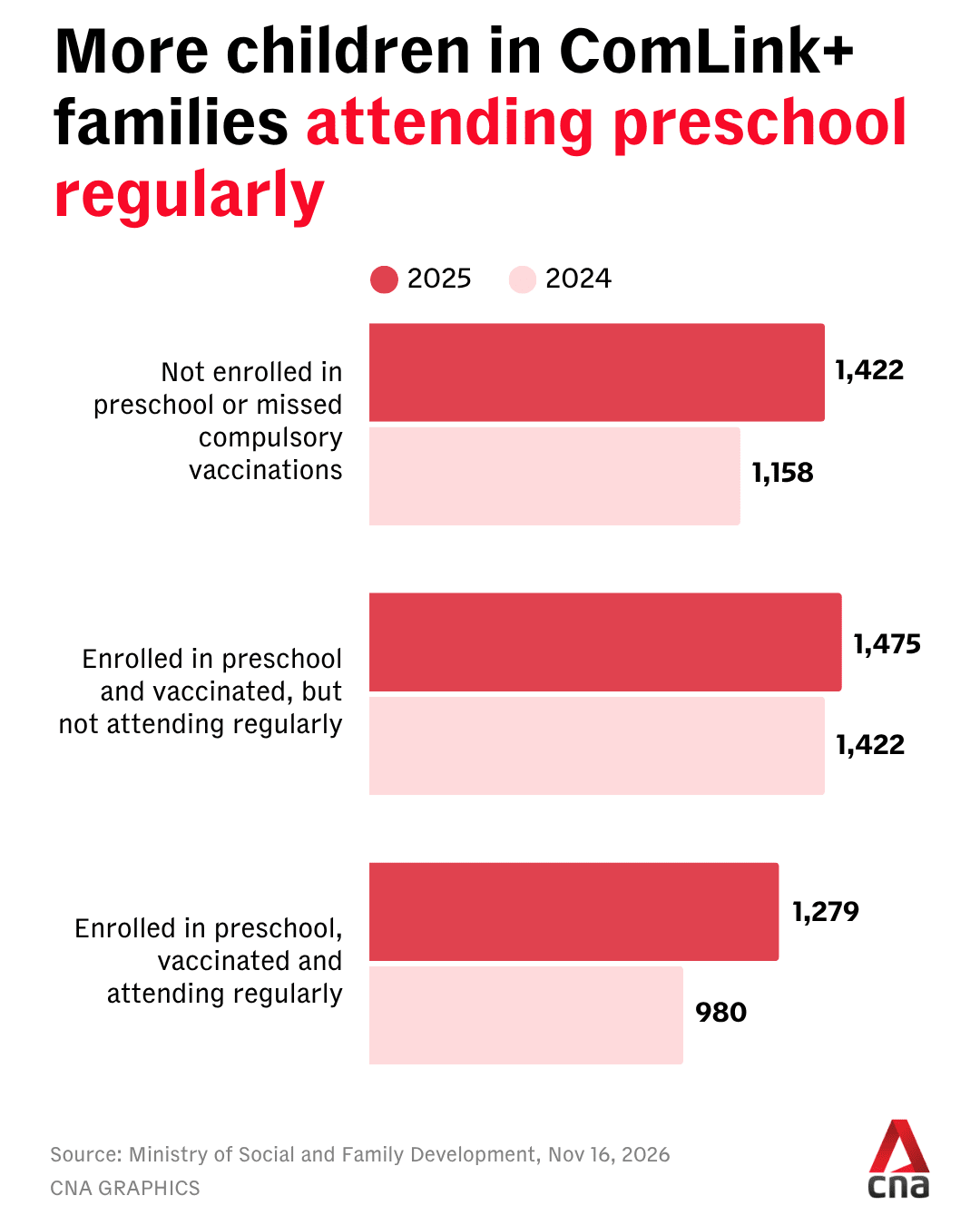
The report also showed that the share of families whose enrolled preschool children attended regularly rose from 38 per cent to 44 per cent.
But the proportion of families whose preschool-aged children were enrolled in preschool fell slightly from 89 per cent to 87 per cent.
Senior Parliamentary Secretary for Social and Family Development and Law Eric Chua said that progress takes time and it looks different for every family.
“We’ll continue to help families build more stable lives and hopefully become more self-reliant over time,” he said.
“When life is a little bit more settled, parents have more room to plan ahead and give their children more choices as they grow up.”
Separately, among ComLink+ families with school-going children, 72 per cent achieved self-reliance in education in 2025, compared with 71 per cent a year earlier.

OUTCOMES IN OTHER DOMAINS
Outcomes in the other four domains remained largely stable.
In the housing domain, the proportion of families living in public rental housing who moved into purchased homes remained at 2 per cent.
MSF said moving from renting to owning a home is a significant milestone for ComLink+ families.
“Home ownership is a major and long-term financial commitment, and families have different starting points and circumstances. Meaningful and sustained progress takes time,” it added.
For the health domain, 88 per cent of families achieved stability, similar to 2024.
This meant that no family members had been hospitalised or visited an emergency department in the previous 12 months, and children had completed their mandatory vaccinations by age three.
Meanwhile, 88 per cent of families achieved stability in the family functioning domain, down slightly from 89 per cent in 2024.
The remaining 12 per cent had cases involving domestic violence, child protection or other protection concerns, according to the report.
KioskNews shows a cleaned-up reading view extracted from the publisher’s page — the original always lives on their site, not ours.