Complete works of Taiwanese Hakka writer Wu Zhuo-liu released
The complete works of late Taiwanese writer Wu Zhuo-liu (吳濁流), whose writings explored Taiwan’s identity and political struggles under Japanese colonial rule and the postwar Kuomintang (KMT) government, were published yesterday.
The 23-volume collection, comprising 4 million characters, was jointly published by Hakka Affairs Council, the Wu Zhuo-liu Literary Award Foundation and the Hsinchu County government.
Wu Zhuo-liu (1900-1976), born Ng Gien-Tien (吳建 田), was a Hakka writer from Hsinchu best known for Orphan of Asia (亞細亞的孤兒), which follows a Taiwanese man under Japanese rule as he struggles with his identity and faces rejection in Taiwan, Japan and China, ultimately suffering a mental breakdown.
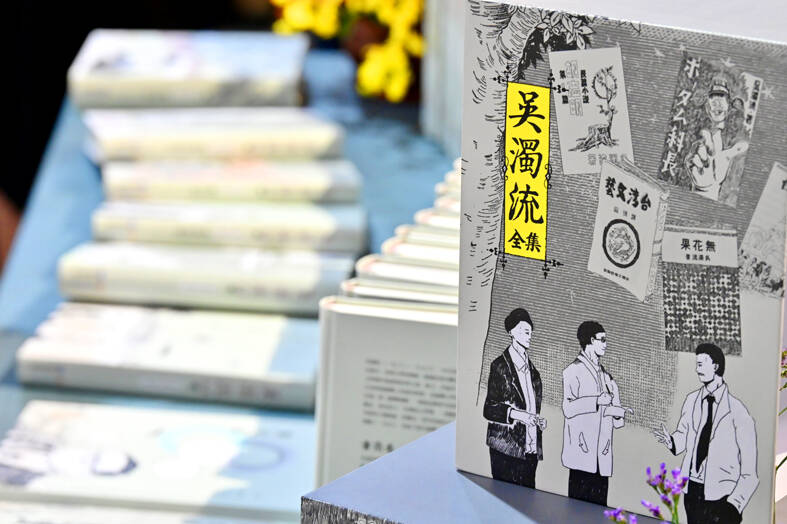
The complete works of late Taiwanese writer Wu Zhuo-liu are on display ina book launch event in Taipei yesterday.
Photo: George Tsorng, Taipei Times
Premier Cho Jung-tai (卓榮泰) said at the launch that Wu was among a few writers willing to address the 228 Incident, the KMT government’s bloody crackdown on protesters and dissenters in 1947, through his literary works and public commentary during the martial law era.
Cho said Wu’s literary works, his decades-long publication of now-defunct Taiwan Literary Arts (台灣文 藝) and the Wu Zhuo-liu Literary Award he established in 1964, which continues today, laid a solid foundation for Taiwanese literature.
Wu’s granddaughter, Wu Hsing-tsun (吳杏村), said that as a child, she would help bind and pack copies of her grandfather’s publication whenever a new issue came out, but she did not understand his work at the time.
Only later in life did she realize the ink-stained pages represented her grandfather’s tireless efforts to keep the publication going despite difficulties, said Wu, who is now in her 70s.
The collection includes Wu’s works written in Japanese during the Japanese colonial period, as well as those he later wrote in Chinese after World War II, according to Hsinchu County Magistrate Yang Wen-ke (楊文科), who was also present at the event.
KioskNews shows a cleaned-up reading view extracted from the publisher’s page — the original always lives on their site, not ours.