Sujeet Kalkal’s unconventional path to Asian Games gold
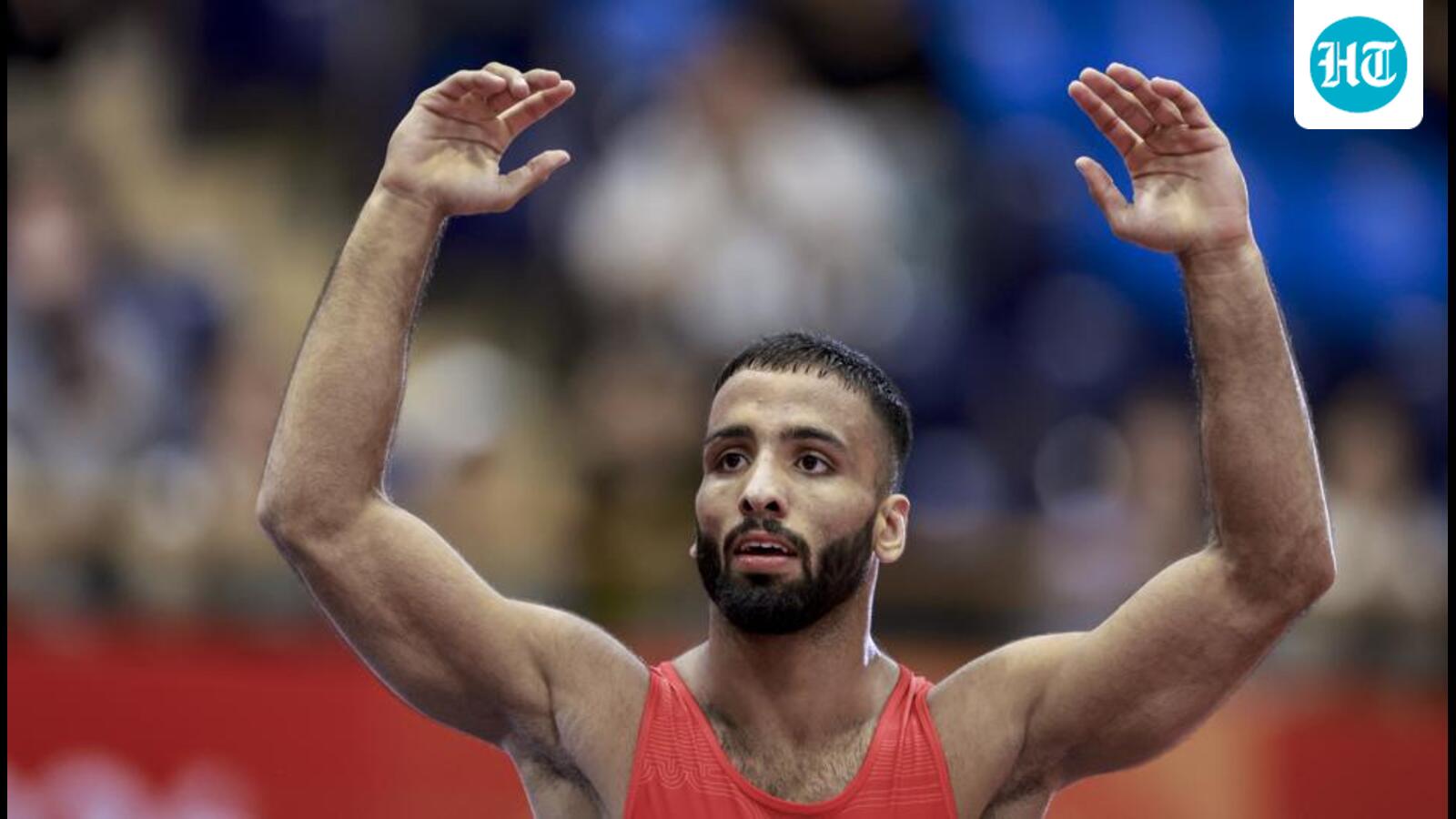
New Delhi: Sujeet Kalkal was brought up in an unconventional way on the mat. As a child, he loved football, and his father Dayanand, an Olympian wrestler, didn’t mind at all because he was charting a training course for his son that was different from the traditional Indian wrestling (pehalwani).
Sujeet’s initial years were about playing different sports, learning mat techniques, footwork and balancing skills, working on his fast-twitch muscles, and quick responses. Later, it was about building explosive strength. It was because Dayanand, a Greco Roman wrestler who represented India at the 2005 World Championships, believed India could produce much better wrestlers if the initial training is focussed more on technique instead of the obsession with developing strength and endurance. He had absorbed this while training and seeing Japanese and other country wrestlers.
His peers would smirk. “Sujeet mein to zor hi nahin hai, kaise ladega? (he doesn’t have any strength, how will he fight?” he would often hear other coaches say.
“I would tell them, ‘let me train him my way’. I didn’t make Sujeet do hundreds of dand-baithaks, or rassa (push-ups, squats, rope climbing) from an early age. My focus was to teach him techniques, tactics, footwork and fast movement. If your fundamentals on the mat are good, everything will fall in place,” Dayanand, a former national champion in 66kg (GR), told HT.
Sujeet, 23, showed all of that in winning three high-quality bouts against tough opponents in Aichi-Nagoya en route to winning the gold medal in the 65kg freestyle class. It was India’s first wrestling gold after the 2018 Asian Games where Bajrang Punia, who once dominated 65kg, won.
Their styles are different but Sujeet’s sensational comebacks—one after another—
especially in the dramatic final against Abdulmazhid Kudiev of Tajikistan where he overturned a huge 2-9 deficit brought back memories of Punia, who would go all out in attacks to cover big margins. Sujeet found himself in similar territory.
The Tajikistan wrestler dominated the first period to go 9-2 up with takedowns and pushouts. He was quick with his leg attacks. In the second period, however, Sujeet was a different beast. He started collecting points through takedowns, and a flurry of attacks proved too much for Kudiev to defend. With seconds remaining and still covering for the deficit, Sujeet made one last attack giving his all to bring Kudiev down for a famous victory (10-9).
Having stunned Paris Olympics champion Kitoro Kiyooka of Japan in the semi-finals, Sujeet showed the hunger to win gold. He was facing Kiyooka, a worlds silver medallist, for the first time in competition but had trained with him in Japan two years ago. Kiyooka scored with a stepout and point on activity clock. Sujeet came back through a fast takedown. He was strong in his leg defence when Kiyooka attacked and then added a stepout through a last-moment counter. In the end, Sujeet won the close 3-3 bout on criteria (takedown).
In his first bout, Sujeet beat Afghanistan’s Sayed Omar Zazai by technical superiority and then won his quarter-final against Iran’s Abbas Ebrahimzadehsavadkouhi 10-0. Foreign coach Shako Bentinidis, Punia’s coach in 2018, is now in Sujeet’s corner. Bentinidis wanted Sujeet to step up his attacks which he did against Abbas and Kudiev.
At home, Dayanand was celebrating his son’s success. He had turned a part of his house in Imlota village of Charkhi Dadri district into a training centre, with a mat on which a 10-year-old Sujeet trained.
“He has had a very tough life as a child,” Dayanand said. “He didn’t want to be a wrestler. I made him one. And I never wanted his studies to suffer, so he also completed his graduation (BA). As a boy he would go to school, comeback, train on the mat and then complete homework at night.”
Dayanand didn’t make him compete in age-group tournaments at home as he thought it would wear him out. “I didn’t want to put him under the pressure of winning at that point.” He has also not competed in dangals.
Still, till 2022 Sujeet was not serious about wrestling. It was only when he won bronze in under-20 World Championships, followed by titles in Asian U-20 and World U-23 that he thought he can win at world level. Sujeet was still losing at home where wrestlers of his age had more power. “We had to be patient with him, for the body to naturally grow and take the workload of strength training,” says the SAI coach.
Dayanand’s friend and Greco Roman coach Kuldeep Singh has also contributed to Sujeet’s success. Unable to qualify for the Paris Olympics made Sujeet mentally tougher. He missed an Olympic qualifier in Bishkek because he was stuck at the Dubai Airport during intense flooding there. In a tougher field at the World qualifiers, he lost in the semis. He has been on a roll this season, winning two international ranking series and the Senior Asian Championships title. The Asian Games title will put him in a select bracket in one of the toughest divisions.
KioskNews shows a cleaned-up reading view extracted from the publisher’s page — the original always lives on their site, not ours.