Aichi-Nagoya Asian Games officially open after troubled start
SINGAPORE – As the Asian Games return to Japan for the first time in 32 years, it has not been the happy homecoming that organisers had hoped for.
Even before the Aichi-Nagoya Games officially opened, the event was beset by a host of logistical issues, ranging from a shortage of accommodation to unsatisfactory living conditions on the cruise ship and in the temporary wooden containers and hotels housing athletes.
Severe weather also threatens to disrupt the Sept 19 to Oct 4 event. On Sept 8, Nagoya experienced record rainfall, while organisers are bracing themselves for the possibility of a typhoon hitting the Aichi-Nagoya coast.
But Nagoya will hope to put its troubled start behind it after staging an opening ceremony centred on unity and togetherness on Sept 19.
Perhaps no other venue would have been more fitting for the city looking for a fresh start than the Paloma Mizuho Stadium, which re-opened in April after five years of renovation work.
Built in 1941, the venue was originally intended to serve as part of Nagoya’s bid to host the 1988 Olympic Games, which were eventually awarded to Seoul, South Korea.
The stadium has nevertheless remained a major part of the city’s sporting landscape, having been home to J.League team Nagoya Grampus since 1993.
But it underwent a major overhaul to meet the requirements for hosting the Asian Games opening and closing ceremonies, including 30,000 fixed seats and 5,000 temporary ones.
Designed around the concept “Harmonic Heart Beat”, the ceremony’s central symbol was a heart, representing athletes and spectators coming together as one while reflecting the diversity and solidarity of Asia.
With Emperor Naruhito and Empress Masako, Crown Prince Akishino and Crown Princess Kiko, Olympic Council of Asia (OCA) president Sheikh Joaan Hamad Al Thani and International Olympic Committee president Kirsty Coventry watching on, the ceremony unfolded on a large, heart-shaped stage at the centre of the 30,000-capacity stadium.
Heralding the start of the Games, the night began with a dance performance and Japanese musician Taro Hakase’s violin solo to welcome Asia.
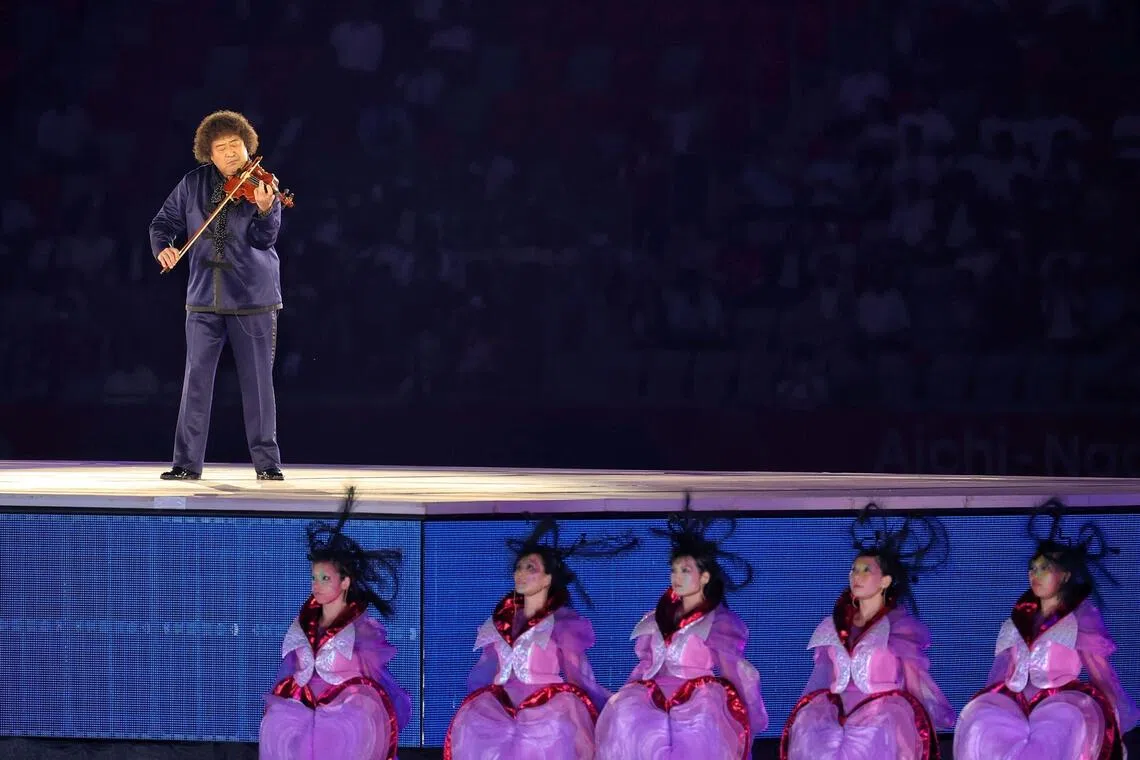
A performance titled Welcome Aichi-Nagoya: Awakening of the Space and The Resonating Heart Beat, featuring violinist Taro Hakase (pictured on platform).
ST PHOTO: KEVIN LIM
Over the next 16 days, about 11,000 athletes from 45 countries and territories across 43 sports are set to compete in Japan.
As Japan hosts the Games for the third time after 1958 and 1994 in Tokyo and Hiroshima respectively, members of the Japan Self-Defence Forces raised the national flag as local singer and actress Keiko Toda performed Kimigayo, the national anthem.
Led by volunteers carrying heart-shaped placards, the athletes and officials then entered the stadium.
The loudest cheers were unsurprisingly reserved for Japan, led by flagbearer Akari Fujinami, a Paris Olympics wrestling gold medallist.
The hosts are fielding their largest-ever contingent of about 930 athletes as they aim to surpass their record medal haul of 218, including 64 golds, attained at their last home Games in 1994.
Carrying the flag for Singapore’s contingent of 304 athletes and officials, who are competing across 27 sports, were epee fencer Kiria Tikanah and kayaker Brandon Ooi.
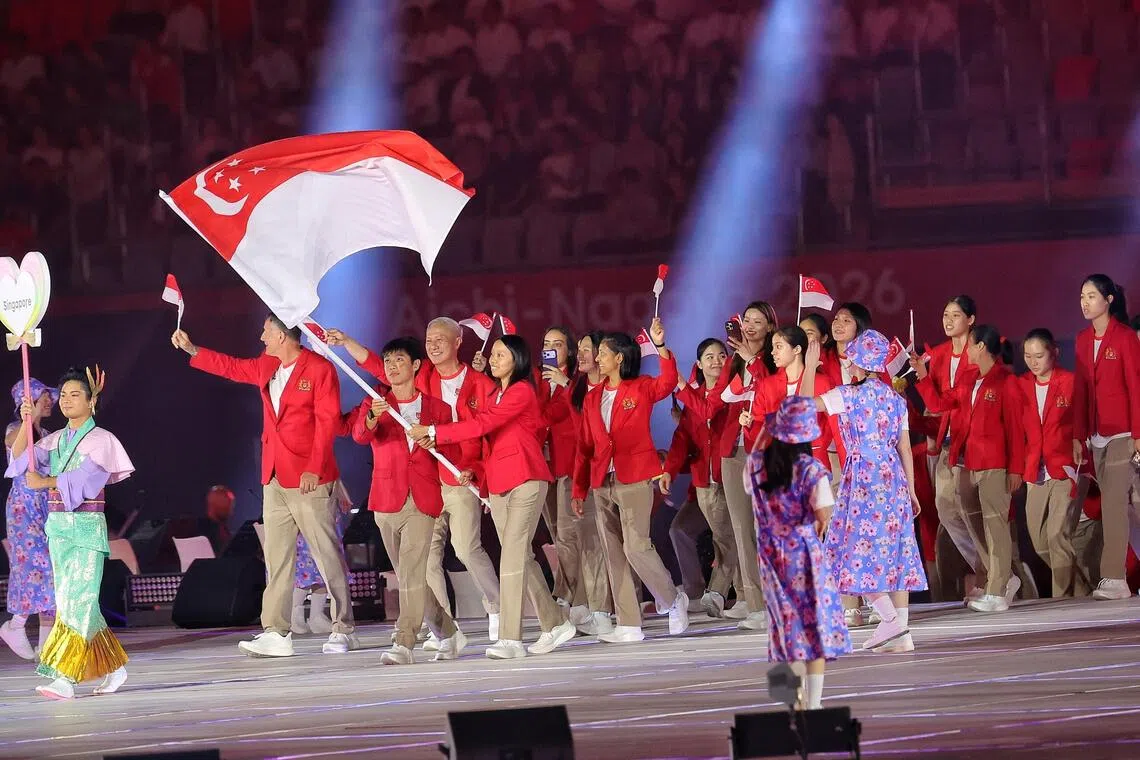
Team Singapore, led by flag bearers Brandon Ooi (left) from kayaking and Kiria Tikanah (right) from fencing, on stage for the athletes parade.
ST PHOTO: KEVIN LIM
At the previous edition of the Games in Hangzhou three years ago, the Republic won three golds, six silvers and seven bronzes.
Spearheading the nation’s medal charge this time are sprinter Shanti Pereira and sailor Ryan Lo, who are defending their 200m and men’s ILCA 7 titles respectively.
Walking into the stadium with the Singapore flag was an emotional experience for Kiria, who admitted feeling slightly nervous.
“It made everything feel very real and that we’re finally here,” said the 26-year-old, who is making her third Asiad appearance.
“To be able to carry the flag for Singapore is something I feel incredibly grateful for, and it made me even more excited to compete here in Nagoya.”
Ooi also relished the chance to lead the contingent out, especially since the last time he marched out at the opening ceremony of a major Games was in 2014.
The 32-year-old said: “I’m feeling confident, the team and I are starting to come into our stride. Of course there are nerves, but we are used to it and hopefully it will translate into a good result for team Singapore.”
Echoing the ceremony’s theme of harmony, OCA president Joaan said: “Tonight, the eyes of Asia and the rest of the world turn to Japan.
“What we will see will inspire us, it will move us and remind us of what we are capable of as we come together as one Asia.”
Emperor Naruhito then declared the Games open, before Japanese Olympic medallists Ayumi Tanimoto, Naoko Takahashi, Kosuke Hagino, Takuya Haneda, Saori Yoshida and Maki Takada carried the OCA flag out.
The ceremony also paid tribute to Nagoya’s heritage, culture and history, with a giant balloon structure of Nagoya Castle brought on to the stage as 30 geisha and Japanese-style dancers performed a routine around it.
It also honoured Nagoya and Aichi’s status as a manufacturing hub, with the prefecture home to big companies such as Toyota Motor Corporation.
As the ceremony drew to a close, the Asian Games torch finally arrived at the stadium after travelling through 40 municipalities, including all 16 wards of Nagoya.
The relay reached a heart-warming conclusion as Olympic hammer throw champion Koji Murofushi and his father Shigenobu, a five-time Asian Games hammer throw champion, lit the cauldron together as the last of seven torchbearers in the stadium.
The ceremony, which took place amid a relatively muted atmosphere despite the stadium being decently full, came to a close with a firework display, signalling a fresh start for the Games.
Dive into all the sporting action and trends in Singapore with ST’s weekly newsletter.
KioskNews shows a cleaned-up reading view extracted from the publisher’s page — the original always lives on their site, not ours.