Zaki Naguib Mahmoud’s Work Rethought Religion and Modernity
Before Arab intellectuals were arguing whether Islam and modern science could coexist, Egyptian philosopher Zaki Naguib Mahmoud made his case in Cairo newspapers that they must. Thirty-three years after his death, his argument still frames debates over religion, science and tradition across the Arab world.
Mahmoud, born on 1 February 1905 in Egypt’s Damietta governorate, lived to 88 and died in Cairo on 8 September 1993. He was one of the most widely read philosophers in the modern Arab world. He translated the work of the English philosopher Bertrand Russell and the Greek philosopher Plato and, across six decades of essays and books, tried to integrate the rigor of Western logical positivism, a 20th-century philosophical movement, into Egypt’s intellectual heritage.
The Egyptian writer Abbas Mahmoud al-Akkad called him “the philosopher of authors and author of philosophers.”
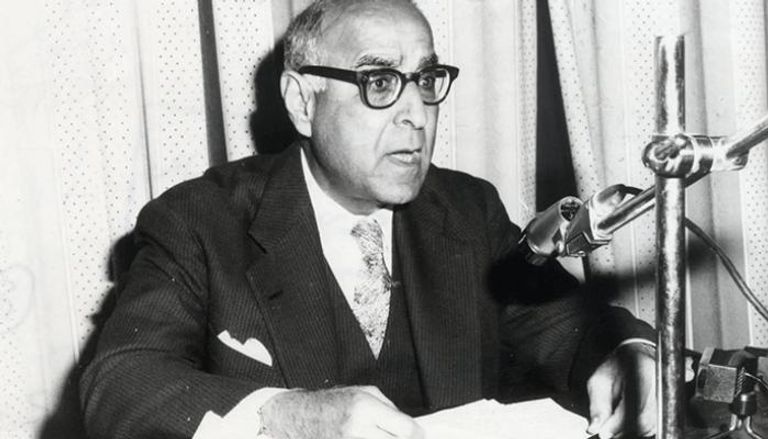
As a young child, Mahmoud memorized parts of the Quran at a traditional kuttab school before his family moved to Sudan, where he attended Gordon Memorial College in Khartoum. He returned to Egypt, trained as a teacher, and by 1930 had graduated from what is now Ain Shams University.
His early writing defended religious miracles and metaphysical free will, a body of thought scholars describe as his first, Sufi-inflected phase. While he was trained in Sufi mysticism, he converted into one of the Arab world’s fiercest champions of scientific empiricism — only to spend his final decades trying to reconcile the two, arguing that Arab societies could modernize without discarding their heritage.
However, his philosophy changed in London, when the Egyptian government sent him abroad to pursue a doctorate at King’s College London. Mahmoud fell under the influence of Bertrand Russell and took an interest in logical positivism, the school that held that only scientifically verifiable statements carry objective meaning. He earned his doctorate in 1947 with a dissertation on self-determination and returned to Cairo University, where he rose to a full professorship of philosophy.
The books that followed made him famous and, briefly, notorious. In Khorafet El Metaphysia (The Myth of Metaphysics, 1953), Mahmoud argued that any statement immune to empirical verification, which is a category into which much theology fell, was effectively meaningless.
Many readers took the book as a veiled attack on religion itself. The backlash was fierce enough that he reissued the book under a softened title, Mawqef Men El Metaphysia (A Stance Toward Metaphysics, 1984).
By the time he moved to Kuwait University in 1968, Mahmoud had entered what scholars call his third and final phase, turning his positivist tools toward the Arab-Islamic heritage itself, asking which parts of it were rational and worth preserving.
Books such as ‘The Rational and the Irrational in Our Intellectual Heritage,’ published in 1975, and ‘An Islamic Vision,’ published in 1987, argued that Arab societies did not need to choose between authenticity and modernity, only to sift their own past for its usable, reasoned core.
His efforts to reconcile modernity with Arab-Islamic heritage placed him alongside a cohort of Arab thinkers debating how to handle heritage, including the Egyptian philosopher Hassan Hanafi, who called for reinterpreting Islamic theology as a tool of liberation. Scholars have noted Mahmoud’s role in an Arab tradition of self-critique that predated the more famous soul-searching that followed the 1967 war.
He received wide recognition for his work over the years and won Egypt’s State Incentive Award in 1960, its Order of Merit in 1970, and, in 1991, the Sultan Al Owais Prize, one of the Arab world’s highest cultural honors from the United Arab Emirates, awarded the year before his death.
Mahmoud’s central question of whether a society can modernize its methods of thinking without severing itself from its own past has outlived the Cold War-era debates that shaped it.
As Arab publics today argue over secularism, religious authority, and the place of scientific reasoning in public life, his answer that heritage is not an obstacle to reason but raw material for it remains one of the more durable proposals on offer.
KioskNews shows a cleaned-up reading view extracted from the publisher’s page — the original always lives on their site, not ours.