India's Gold Rush Gets A Reality Check As Prices Fall 20% From Record High
Gold Price Today: India's love affair with gold reached a new high over the past year. Investors poured a record amount of money into gold ETFs as the precious metal delivered spectacular returns.
Then came the correction.
Spot gold is now trading near $4,400 an ounce. While that is still more than 21 per cent higher than a year ago, it is about 21 per cent below its record high of $5,595 touched in late January.
Also Read | Layoffs Are Rising In Tech, But These Skills Are Helping People Unlock Better Pay
For Indian investors, the fall has been particularly important because many entered the market after the rally had already gathered pace.
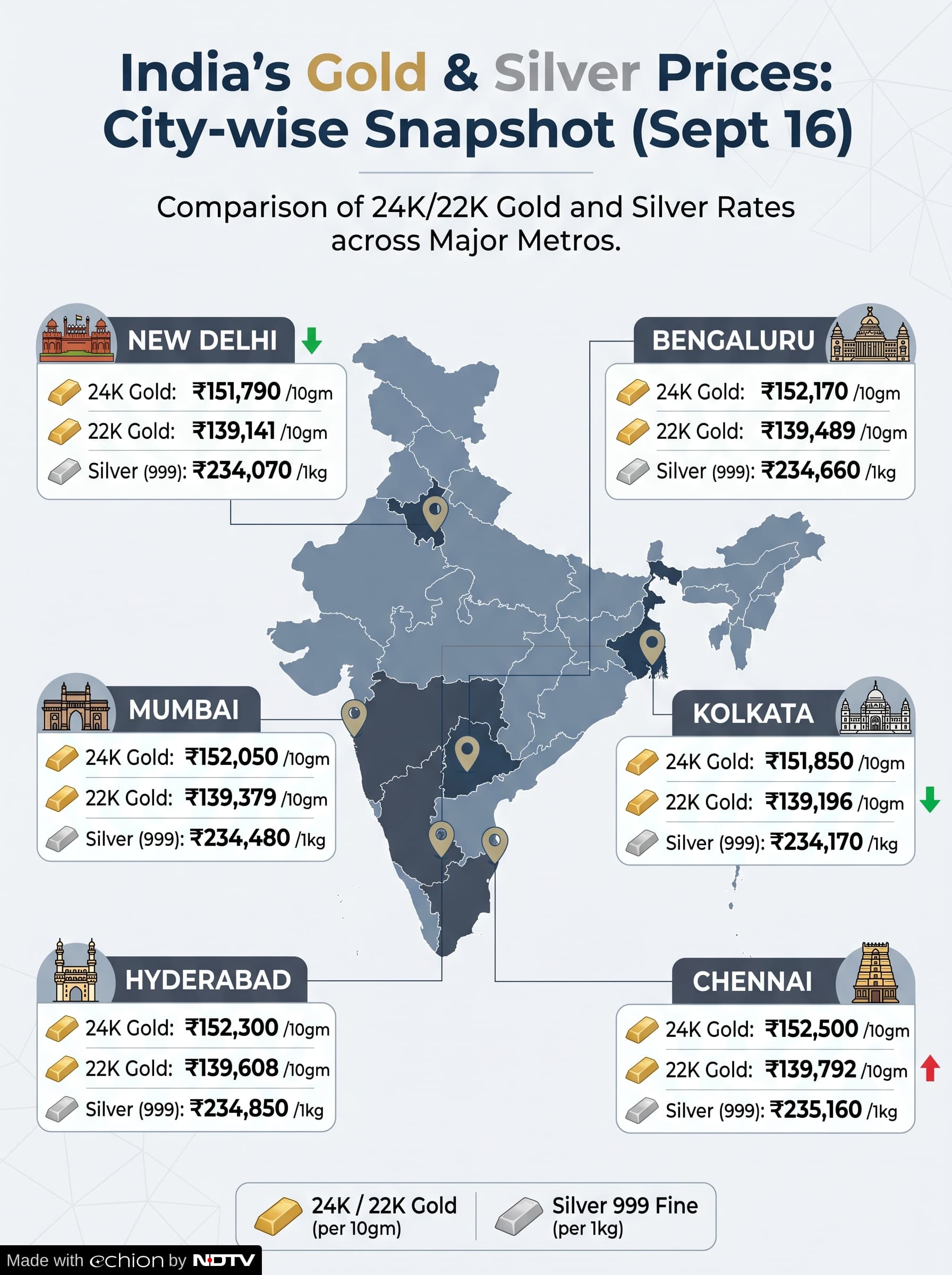
On the Multi Commodity Exchange (MCX), gold had climbed to a record Rs 1,69,349 per 10 grams on March 2. By early July, it had fallen to around Rs 1,34,500. It has since recovered to nearly Rs 1.52 lakh per 10 grams.
This recovery may offer some comfort to investors. But for those who bought close to the peak, the episode is a reminder that even gold can deliver painful short-term losses.
Investors Poured Record Money Into Gold
The scale of India's gold rush is striking. Gold ETFs attracted net inflows of Rs 68,868 crore in FY26. This was more than twice the combined inflows recorded by the category during the previous five financial years.
January alone saw Rs 24,040 crore flow into gold ETFs. That was broadly comparable with the inflows into equity mutual funds during the month.
As money poured in, assets under management in gold ETFs jumped 191 per cent to Rs 1.71 lakh crore.
The problem is that a large part of this money arrived after gold had already delivered a huge rally.
This creates an uncomfortable situation for investors. Gold can post excellent returns over a long period, while an investor who buys near a peak can still find themselves sitting on losses.
"Gold has delivered a 21 per cent twelve-month return and still managed to disappoint most people who own it. That tells you the problem was never the asset, it was when they bought it," Prashant Mishra, founder and CEO, Agnam Advisors, told NDTV.
The Real Problem May Be When You Bought Gold
Gold's traditional role in a portfolio is not necessarily to be the biggest return generator.
It is generally used as a diversifier and a hedge against inflation, currency weakness and periods of economic uncertainty.
But a sharp rally can change investor behaviour.
When prices keep rising, investors can start treating gold as a momentum trade rather than as one part of a diversified portfolio. That can lead to allocations that are much higher than what an investor's overall financial plan requires.
And that is where the risk increases.
For someone with a modest allocation to gold, a systematic investment approach may still make sense. But investors who increased their exposure substantially during the rally may need to ask a different question.
Not whether gold will rise next month, but whether they have too much of it in their portfolio.
Prashant Mishra said the recent episode highlights the importance of separating an asset's long-term performance from the experience of investors who enter at different points in the cycle.
What Happens To Gold From Here?
The next move in gold will depend on several global factors, including interest rates, economic growth, central-bank purchases and currency movements.
The World Gold Council's base case sees gold trading within 5 per cent of $4,100 an ounce during the second half of the year. A sharper deterioration in global growth, however, could push prices above $4,500.
Interest rates remain particularly important.
Gold does not generate interest income. As a result, higher real interest rates can make the metal less attractive compared with interest-bearing assets.
Central-bank buying, meanwhile, remains an important source of support. Purchases have stayed close to 1,000 tonnes a year, providing structural demand for the metal.
Indian investors also have another factor to consider: the rupee.
The Indian currency has weakened by around 10 per cent against the US dollar over the past year. That has provided some support to domestic gold prices even when international gold prices have corrected.
India's increase in the import duty on gold, from 6 per cent to 15 per cent, is another factor affecting domestic prices.
But currency weakness should not automatically be seen as a reason to increase gold exposure.
Gold's Biggest Lesson For Investors
The gold rally offers a lesson that applies well beyond gold.
Strong past returns often attract investors at precisely the point when an asset has become more expensive and the risk of a sharp correction has increased.
That does not make gold a bad investment. It simply means investors need to decide how much gold they actually need.
For someone who bought gold as a small part of a diversified portfolio, a correction may not fundamentally change the investment strategy.
But someone who dramatically increased their gold allocation after seeing its returns may now have to reassess the decision.
Gold can still provide protection against inflation, currency depreciation and economic uncertainty. But the recent correction shows that a traditionally defensive asset can also be highly volatile when investors rush into it after a major rally.
For Indian investors, the question is therefore no longer simply whether gold is a good investment.
The more important question is: how much gold is enough?
Gold Loans Add Another Layer To The Gold Story
Gold is not only an investment asset for Indian households. It is also increasingly being used as collateral for borrowing.
The gold loan market has expanded rapidly, making the way lenders value, hold and eventually release or auction pledged gold increasingly important.
Yatin Pednekar, Co-Founder & Chief of Products, Mobicule Technologies, said the 3.8X increase in the gold loan portfolio has exposed the limitations of fragmented systems used by lenders.
"With the new lending guidelines introduced by the Reserve Bank of India, compliance has gone beyond a top-level guideline. Banks must ensure a dynamic LTV cap based on spot price volatility, a strict collateral release clock, and full auditability of the default auction process," Pednekar told NDTV.
He added that the challenge is not necessarily the intent of lenders but the fragmentation between systems handling appraisals, vaults, margining and auctions.
As gold loan books grow, this becomes more important. A regulatory rule written in a branch manual is not enough if the underlying processes cannot consistently demonstrate compliance.
Rajat Deshpande, CEO and co-founder, FinBox, told NDTV that lenders will increasingly need to prove compliance at the individual loan level rather than simply rely on broad branch-level processes.
"Most lenders are responding to RBI's gold loan directions with circulars and branch training. That will not survive an inspection, because the regulator is no longer asking whether you got it right on average. It's asking you to prove it, loan by loan," Deshpande said.
He said lenders need centralised valuation, automated LTV and policy rules, and a timestamped trail covering custody, release and auction processes.
KioskNews shows a cleaned-up reading view extracted from the publisher’s page — the original always lives on their site, not ours.