On board an epic, 6200-kilometre luxury train through travel’s new frontier
I’m sitting on the shores of Lake Issyk Kul in Kyrgyzstan when three men on horseback thunder past with golden eagles flapping atop their raised right arms. The scene is so striking, it could have been painted on silk. Soon after, a furry missile appears on the sand.
“We play football by riding a horse,” says our female Kyrgyz guide, Aisuluu. “But instead of a ball, we are using a dead goat without a head.”
I’m among a small group of transfixed spectators to this exclusive private taster of the traditional nomad games of the Kyrgyz people, commonly known as the Olympic Games of Central Asia.
The official World Nomad Games festival is held every two years on the shores of the eighth-deepest lake in the world. Kokburu, or horseback polo, is one of the main sports, alongside horseback archery, horseback wrestling and falconry. It’s a remarkably skilful demonstration featuring both men and women, and culminates in a fiery finish for one brave athlete, his fireproof suit set alight as he canters out of sight.
Horses are the main mode of transport in Kyrgyzstan, but I have arrived at this emerging destination in considerable comfort. I’m on a 14-day Republics of the Silk Road rail itinerary to Tashkent, which departs from Almaty in Kazakhstan and takes in four of the five Stans. The journey, with Golden Eagle Luxury Trains, is along the former trade routes of the ancient Silk Road, with visits in Uzbekistan, Kazakhstan, Tajikistan and Kyrgyzstan. Sadly, Turkmenistan, which is notoriously isolated, has declined visas for Golden Eagle train passengers since 2024.
Sign up for the Traveller Deals newsletter
Get exclusive travel deals delivered straight to your inbox. Sign up now.
Since the Ukraine-Russia war, the luxury operator has pivoted with new routes, and in September 2026 will relaunch its 22-day The Grand Silk Road itinerary from Beijing to Tashkent on board a luxury new sleeper train, the Golden Eagle Silk Road Express.
Our journey is fully escorted, with experienced Russian-Siberian tour leader Tatiana at the helm, alongside Russian guides Anna and Yana. Each has been working with the company for nearly two decades.
Founded by former British wine merchant Tim Littler in 1989 (and recently sold to Italy’s luxury Arsenale Group, which owns La Dolce Vita Orient Express), the company pioneered high-end train travel in Crimea, the Caucasus, and Russia via the Trans-Siberian Railway.
Knowledgeable local guides and comfortable buses accompany us at each destination. On-board expert, British journalist Liam Halligan, who lived and worked in Moscow for many years, provides a series of fascinating talks about geopolitics in the region.
Luxury train travel is experiencing a resurgence, with a number of operators launching new trains and itineraries in the past few years. And while many of our fellow passengers are much older than me, Littler says there’s been a significant shift in demographic.
“When we started out, our average age was about 66. We never had anybody below 40, but now we have travellers in their 20s,” he says. “Slow travel is in vogue and somehow, there seems to be an awful lot more money around for experiential travel,” says Littler.
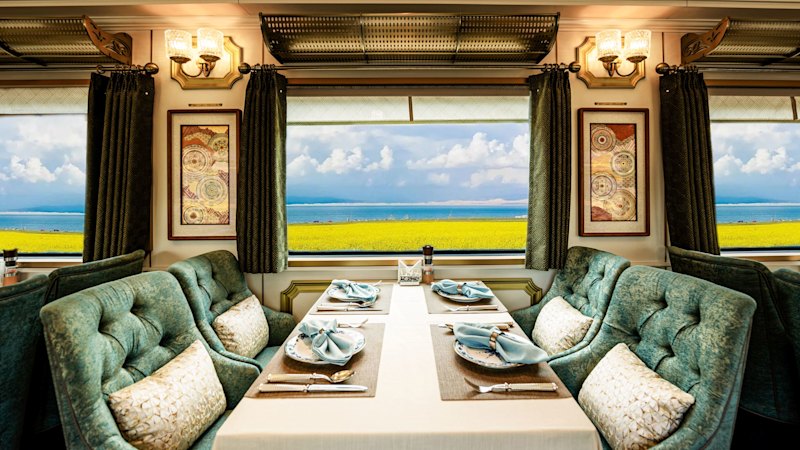
This is one of the world’s more luxurious train journeys, and it comes with plenty of bells and whistles. A resident pianist plays every evening in the bar car, and table settings sparkle with crystal glassware and porcelain tableware.
Meals strike a balance between fussy and rustic: fine dining aboard the train and authentic lunches at local restaurants at most of our stops. One night we’re treated to Russian caviar and vodka tastings, the next we’re rugging up for a barbecue on the train platform.
I’m in a Gold Class cabin with an en-suite. While compact, it is comfortable, although once the bunk beds are out, navigating the space with your travelling companion can feel like an awkward first dance.
A topic of conversation among the 50 passengers is the temperamental showers, which struggle to get hot throughout the trip. Our Russian attendants Christina and Nikita are pure sunshine, offering tea and coffee every morning, greeting us with a blue carpet (to match the train’s livery) after each stop, and eagerly bridging language barriers via the use of a smartphone.
A television in our cabin has an archive of documentaries about the ancient Silk Road and the broader region, which provides additional context to the complex history of this part of the world, including the conquerors that invaded the region, and the roughly 70-year period under Soviet control.
It feels almost surreal to be travelling along this major trading route that began about 2150 years ago and ran from China’s ancient capital of Xi’an to the souks of Istanbul and merchants of Venice. What started out with the trade of silk eventually led to the exchange of ideas, technology and arts that revolutionised Europe.
In Uzbekistan, which we enter multiple times, we tour the souks of Bukhara and the ancient fortified city of Khiva, which served as a significant caravan stop during the time of the Silk Road, and is heaving with tourists. Many of the cities are resplendent with blue and turquoise Persian architecture and tile work dating back to the 14th-century rule of Islamic conqueror Amir Temur.
It can be easy to grow weary of the many mosques, mausoleums and minarets. But every now and then, the itinerary throws a curveball to reignite our attention. After rolling past desolate rural villages in Tajikistan, the poorest country in Central Asia, we arrive in the capital Dushanbe and tour the ostentatious Kohi Navruz Palace, whose sole purpose is to chest-thump at visiting heads of state: floral parquetry, a six-tonne Swarovski chandelier and a hall adorned entirely with 15,000 kilograms of precious stones including lapis lazuli.
Less polarising is the “desert of forbidden art” in the remote Uzbek autonomous region of Karakalpakstan. The world-class Nukus Museum was established by Ukrainian-born painter and archaeologist Igor Savitsky, who smuggled more than 40,000 works deemed anti-Soviet here between the 1920s and 1960s. It houses the biggest collection of Russian and Central Asian art outside of St Petersburg, and is one of the world’s most underrated cultural treasures.
By the time the train reaches our destination in Tashkent, we’ve travelled 6238 kilometres, and have loaded up on handwoven silk, handmade ceramics and Uzbek robes. For nearly two weeks, we’ve rattled around on this luxurious caravan, exploring one of the world’s most intrepid regions in absolute luxury. I check out of our hotel on wheels, but mentally I’m still sipping champagne in the bar car.
THE DETAILS
TRAIN
Golden Eagle Luxury Trains offers its 14-day Republics of the Silk Road itinerary through the five Stans in April and September, from $US26,900 ($37,796) a person twin share for a Silver Class cabin. See goldeneagleluxurytrains.com
The writer travelled as a guest of Golden Eagle Luxury Trains.
KioskNews shows a cleaned-up reading view extracted from the publisher’s page — the original always lives on their site, not ours.