Surviving bankruptcy, betrayal and a clot the size of tennis ball: The many lives of Larry Peh
A red carp swims across the plastic bags found at wet markets and hawker centres across Singapore.
Few people carrying them home, filled with kangkong or char siew bao, know that the familiar design is the work of Larry Peh, a two-time President’s Design Award winner.
Yet the ubiquitous red carp may be one of the less remarkable chapters in Peh’s eventful life. The 49-year-old has survived a tennis ball-sized blood clot in his brain, come close to bankruptcy twice, experienced business failures, grappled with depression and faced death, not once but four times.
He recounts it all with a laugh and the candour of a man long accustomed to the turns his life can take.
The younger of two boys, Peh grew up with a sales engineer father who sold ships’ equipment and a housewife mother who passed on her fondness for “useless but beautiful” clutter.
He describes himself as a “weird child”, happiest drawing on the floor or taking teddy bears apart and putting them back together in new ways.
At Zhonghua Secondary School, he struggled. He was poor at maths and science, and painfully aware of his limited English.
At a British Council class, he once asked what the word “reef” meant, only to be mocked by the teacher in front of everyone. Stung, Peh spoke up. He told the teacher that he came from a poor family, had spent two hours getting there by bus because he wanted to improve his English, and did not expect to be humiliated for trying.
Rebuked, the teacher took him under his wing, while Peh began devouring the dictionary every day. Before long, he had become the best English speaker in his cohort, and the one his classmates turned to for help.
Another put-down, this time from a secondary school teacher, had a similar effect. “I’m wasting my time on you,” the teacher told him.
Peh asked what it would take to make him eat his words. “He said if I topped my class in the prelims, he would take them back and apologise.”
Fired up, Peh studied hard and went on to top his class in the O-level preliminary exams. The apology never came. But he had proved something to himself.
“If I set my heart and mind to something,” he says, “I will do it.”
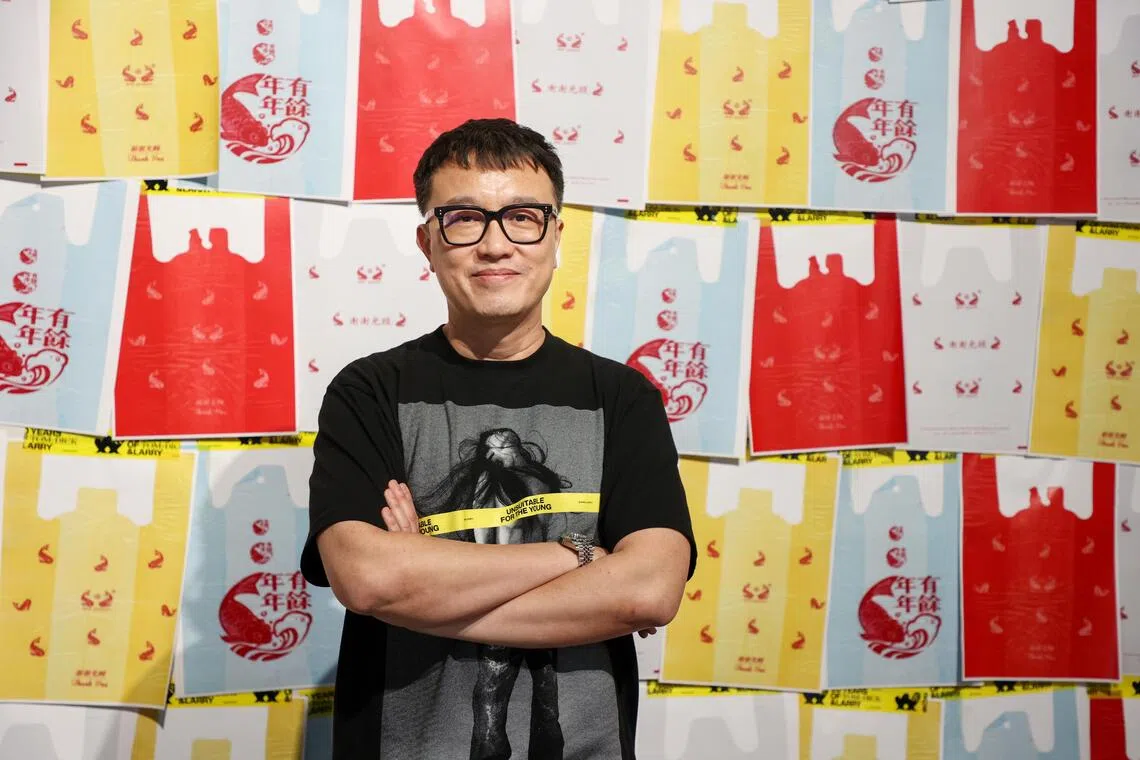
Larry Peh with the plastic bags featuring the red carp he designed.
PHOTO: LIANHE ZAOBAO FILE
Art was the one area in which he never doubted himself. He won school competitions so often that teachers held up his work as an example, much to the annoyance of his classmates.
When he was seven, he entered a competition at the Science Centre Singapore with a watercolour of a rocket, painstakingly capturing its light and shadows. The judges thought it was too accomplished for a child and assumed an adult had helped him. They gave him nothing. It was a bitter lesson: Sometimes being too good is its own kind of punishment.
Peh’s real design education, he says, took place not in a classroom but at the Popular bookstore in Hougang. He found himself drawn – he still doesn’t quite know why – to fashion magazine Harper’s Bazaar, and specifically to its then creative director, the legendary Fabien Baron.
“I didn’t know it’s called typography,” he says of his adolescent fascination with “the letters with the big O and then the girl with the big hat next to it”.
He was also captivated by the magazine’s late editor Liz Tilberis. When Tilberis died from ovarian cancer in 1999 and Baron left the magazine not long after, Peh felt he had lost “my two idols”.
He studied visual communication at what is now Temasek Polytechnic, then housed at the old Stirling Road campus. There, he frequently clashed with his final-year mentor, respected design educator Lim Chong Jin.
Lim rejected idea after idea for Peh’s final-year project until, running out of options, the student stripped everything back. His campaign for Osram light bulbs was so spare it was almost design-less.
It became one of the standout projects of his cohort and drew praise from external examiners from the UK.
“Chong Jin loved it. The guy who rejected my idea also fought very hard to say I should be top student.”
Peh did not get the honour, but says he did not mind. What stayed with him was a more valuable lesson: When an idea gets too clever or complicated, strip it back to its essence.
That belief in simplicity would come to define Peh’s work, which balances restraint with creative expression, and shape the course of his career.
One of his first jobs was at Asylum, an agency where he was so unconcerned about money that he did not know his salary – a princely $2,000 – until his first payday. He rose quickly, handling entire accounts on his own. But he grew frustrated at being saddled with the corporate and banking jobs that paid the bills while others worked on more creative, award-chasing projects.
So when a friend offered him a salary well above market rate to start an agency together, he did not baulk. But the partnership failed. After selling his stake, he left for his honeymoon and a sabbatical and returned a couple of months later to a lot of rumours and questions about his integrity.
“Former clients avoided me. Some wouldn’t even wave when I saw them on the street,” he says.
Still, Peh started his own studio &Larry in 2005 with little money and zero clients. His first job ended disastrously. The UK client fired him and, on the same unhappy afternoon, Peh returned the favour.
By then, he says, he had sunk into depression, although he never sought a formal diagnosis.
“I felt like a lion with its mane shaved off; I was still pretending to be a lion while privately falling apart. I couldn’t sleep at night,” he says.
What pulled him through were small acts of kindness.
When he told a South Bridge Road landlord that he could afford only three months’ rent, she was so moved by his honesty that she lowered the rent and gave Peh his first proper office.
Then came a timely vote of confidence. His old schoolmate, film-maker Royston Tan, asked him to design the poster for 4:30, a quirky drama about an 11-year-old Chinese boy and the depressed Korean tenant in his mother’s HDB flat.
When the film was screened at the Berlin International Film Festival in 2006, the posters – of the boy emerging from a cheap plastic wardrobe – proved a big hit.
“Royston called me and said, ‘If you’re still doubting yourself, people are stealing your posters.”’
Another lifeline came when a PR agency vouched for him and recommended him to footwear company Crocs.
By the time he crossed paths with “The Devil Wears Prada of Singapore” – his nickname for a notoriously demanding executive at Takashimaya – he had built enough resilience to scream back at her and still get invited to lunch the next day.
They worked on a high-profile, multi-year campaign, which paired luxury brands with Singapore cultural figures. The shoots took Peh around the world, from Balenciaga’s historic home in France to the site of Dior’s first boutique. It remains one of his proudest achievements.
The accolades followed. He won the President’s Design Award’s Designer of the Year title in 2014, and Design of the Year in 2016 for his work with gifting brand Bynd Artisan, making him one of a handful of Singaporean designers to be recognised twice by the country’s highest design honour.
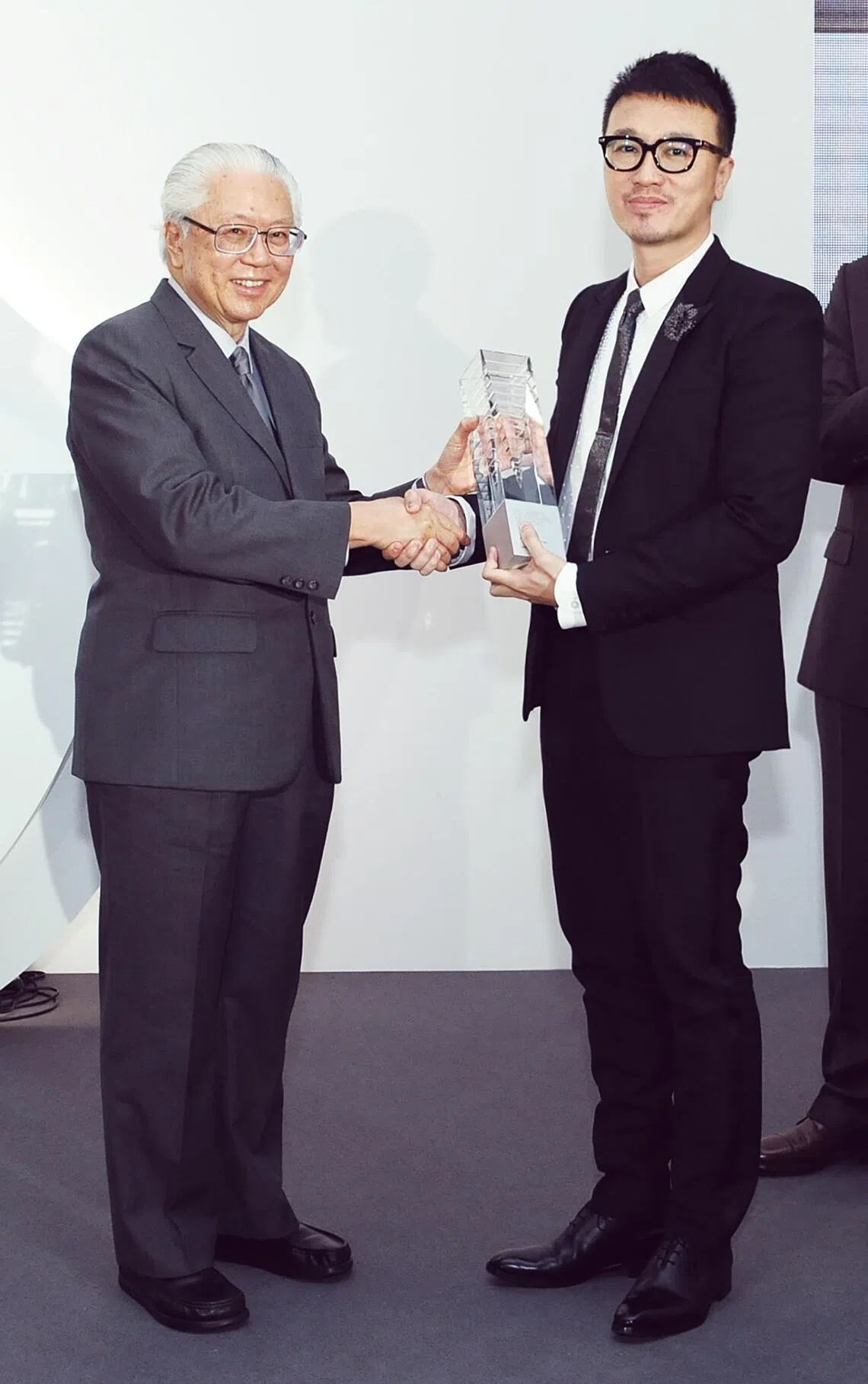
Larry Peh receiving the President's Design Award for Designer of the Year from former president Tony Tan in 2014.
PHOTO: COURTESY OF LARRY PEH
But there were other trials, including a recent failed investment which forced him to sell possessions and borrow money to pay his staff. One by one, employees left, including some who had been with him for as long as 16 years.
“It almost killed me,” he says.
Ask Peh about resilience and he does not reach for business metaphors. He points instead to his own body.
As a young man, he fell from a carpark while climbing up to take photographs and spent the next three days vomiting. Not long after, he was hit by a bus while crossing the road on a green light.
The consequences surfaced during national service, when Peh began suffering blinding headaches. One day, during basic military training, he started foaming at the mouth and thrashing in his bunk. A scan revealed a blood clot in his brain the size of a tennis ball. The neurosurgeon was astonished that Peh was still conscious; a clot that large, he told him, would normally leave a patient in a coma.
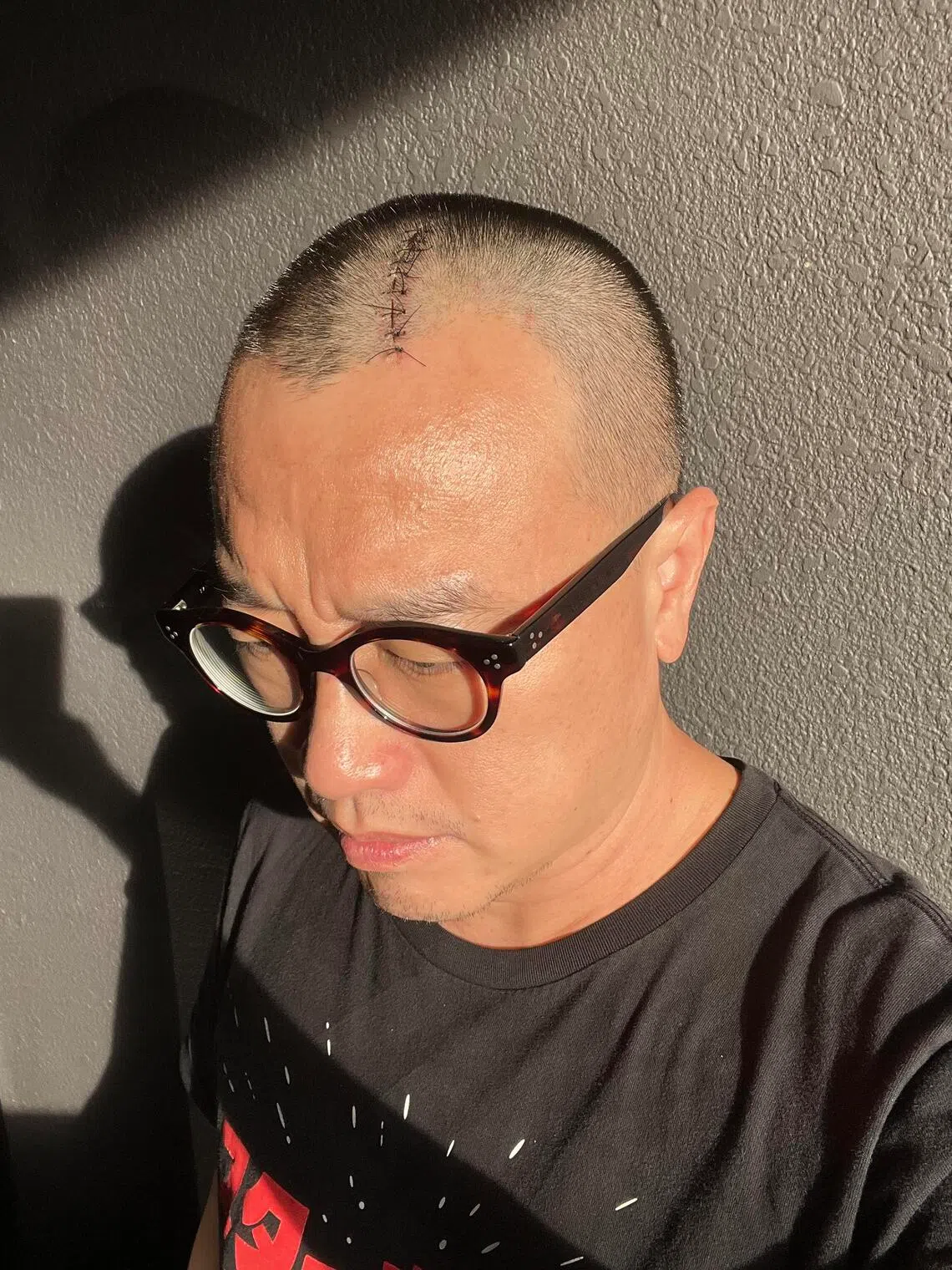
Doctors found a blood clot in Larry Peh's brain when he was doing national service.
PHOTO: COURTESY OF LARRY PEH
He was given two options: surgery, or wait and hope the clot disappeared on its own. He chose to wait.
For six months, he endured the pain at home, returning for monthly scans as the clot slowly shrank and eventually vanished. During this period, he nicknamed himself “Batman” as the clot left him acutely sensitive to light and sound. He spent much of his time alone in the dark.
Decades later came another close call. In Japan in 2025, Peh was driving with his wife and two children when their car skidded on ice, spun 180 degrees and stopped inches from another vehicle.
Yet Peh says he resents none of it. “My life is like the Mario Brothers,” he says, referring to the computer game. “I have to clear one obstacle after another without knowing where the finishing line is.”
He also holds close a line from the late Colombian sculptor Fernando Botero, relayed by Botero’s son Fernando Botero Zea over dinner in Singapore: “A good artist looks for solutions; a great artist looks for problems.”
That he is turning 50 in November 2026 made Peh take stock. A co-founder of local menswear label Faculty and a collector “obsessed with nice things”, he began thinking about what he would leave behind.
Then he discovered the Swedish practice of dostadning, or death cleaning: clearing out your possessions so the next generation “does not have to deal with your s**t”.
He began selling his beloved watches, partly to fund what he thought might be his swansong: a retrospective marking 20 years of &Larry.
XX&L: 20 Years of Tom, Dick & Larry, which opened at Objectifs Chapel Gallery in January 2026, traced two decades of his work and experimentation. It was an expensive gamble. Costs ballooned and Peh spent months pouring money into the show, unsure whether anyone beyond the design community would care.
The reception reassured him.
“It’s proof that I know what I’m doing,” he says, although he remains wistful that such achievements often go unnoticed at home.
If &Larry was his great professional love, Peh’s newest obsession comes in a bottle.
In 2023, he co-founded Normat, a sake label produced with a brewery in Niigata, Japan. Breaking into Japan’s deeply traditional sake industry was difficult and Peh says many newcomers disappear almost as quickly as they arrive.
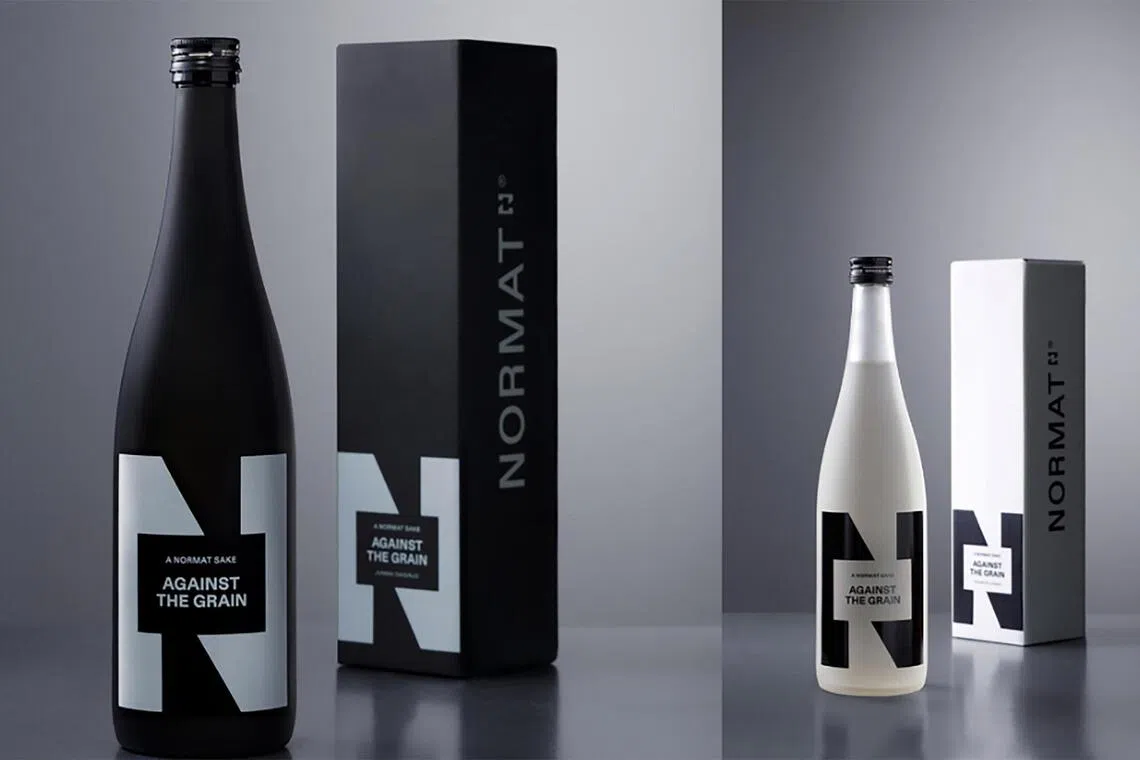
Normat's Against the Grain sake won major honours at the Kura Master France Sake Competition 2025 and the International Wine Challenge 2025 Sake Awards.
PHOTO: NORMAT
“But I went all out and spent five years doing it. Everybody was telling me, ‘You just drink, you’ll never be able to make a sake, you will never survive.’”
Normat survived. Its Against the Grain sake went on to win major honours at the Kura Master France Sake Competition 2025 and the International Wine Challenge 2025 Sake Awards.
“The awards are the equivalents of Michelin stars for sake,” he says. “For now, Normat is the baby I most want to nurture.”
These days, Peh likens himself to Forrest Gump: always running, never quite knowing when he will stop.
“I’m very tired. I’ve gone through many wars,” he says.
But like the red carp he put on a plastic bag all those years ago, Peh is still moving and swimming against the current.
KioskNews shows a cleaned-up reading view extracted from the publisher’s page — the original always lives on their site, not ours.