BUSINESS REFLECTION: Populist era politics cracks under the weight of economic reality
A month ago I wrote here that, 10 years into the age of populism, something was poised to crack. It has.
Four elections in four weeks have delivered four momentous results, and together they point to why: the economic consequences of populism have become obvious. As voters tire of spiralling living costs, the long era of kleptocratic populism is finding its limits at the ballot box.
Serbia came first. A student-led movement – a motley coalition of the exhausted and the furious, sick of the rapacious rule of Aleksandar Vučić – won what amounted to a plebiscite on a regime whose survival has rested on its ability to extract cash and favours from the Trump administration at will.

Brazil followed, with an upset of historic proportions. Luiz Inácio Lula da Silva, having trailed in the first round, came back to defeat far-right populist Flávio Bolsonaro, son of a jailed former president.
No surprise that the loser, facing grave corruption allegations, then fled on his Italian passport, travelling via Javier Milei’s quasi-fascist Argentina to Ecuador and thence to Miami, where he now resides. A fitting destination, being the playground of the tech and finance bros who have traded morals for pre-IPO stakes in Anthropic.
But the biggest shock was still to come.

The extent of the Democratic surge across the United States – a blue tsunami, or “blunami” – is hard to fathom even now. The latest result, a Democrat winning a Senate seat in Mississippi, with Scott Colom about to become the first Black senator from the state since the Reconstruction era, is the most extraordinary measure yet of how far the Republican Party has fallen under Donald Trump.
Ron DeSantis called it an “extinction-level event” for the GOP, and it is hard to see when or how the party recovers.
To borrow from Churchill, if Trump’s loss of the House in the 2018 midterms was the end of the beginning, this for him is the beginning of the end.
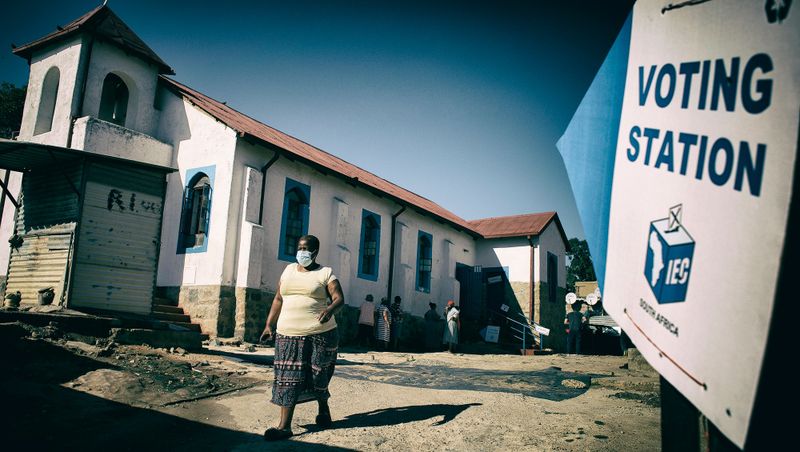
Then, to South Africa. The local government elections do not mark as clean a break as Serbia or the United States, nor the repudiation of kleptocratic populism that Brazil delivered.

But with the ANC on roughly 31%, down from nearly 46% in 2021, they are as decisive a rupture with the past as one could imagine. We have entered, at last, a post-ANC politics.
Democracy may not be built for this
The fundamental question is whether the democratic system can channel competing forces towards cooperation and consensus, or whether it degenerates into a race to the bottom of extraction and corruption.
The year ahead, running up to the ANC’s national conference in December 2027, will be critical as to where the party goes. But as for the majority of voters – if one adds together the ANC, MK, the EFF and ActionSA – that is up for grabs.

The other potentially game-changing event is unfolding behind closed doors in Israel, where the arithmetic of coalition-building is possibly more intricate than anywhere in the democratic world.
Tasked by the president with forming a government, Gadi Eisenkot is deep in negotiations after last month’s inconclusive election.
For three decades, the ultra-Orthodox parties have been the foundation of Benjamin Netanyahu’s limpet-like grip on power. Now they may help pry it loose. United Torah Judaism has broken ranks over the exemption of ultra-Orthodox young men from military service and opened talks with the former general.
Its seven seats would carry Eisenkot’s four Jewish opposition parties, which won 48, much closer to the 61 needed for a Knesset majority. Failing that, he could turn to the Arab parties, which secured a record number of seats.
Either way, an Eisenkot government, however long it lasts, would mark the end of the Netanyahu chapter. That chapter has seen Israel rise as a technological, economic and military power in the Middle East. It has also resulted in a genocide in Gaza and botched an attempt at regime change in Iran.
Tehran, which still has a vice-like grip over the Strait of Hormuz, is now the regional pre-eminent force. It is run by an even harder-line regime, more determined than ever to acquire a nuclear weapon as its only guarantee of survival.
Golden thread
The thread that runs through all of this is the cost of living. Serbian consumer prices have risen by more than 40% since 2021, and food there costs more than in several EU member states. South African electricity tariffs have risen roughly 900% since 2007, about five times faster than inflation. Petrol prices have risen by almost half this year. In Israel, an average household’s basket costs a fifth more than in Europe’s wealthiest countries. Americans who elected Trump to bring prices down went to the polls with inflation running at close to 4%.
It is no coincidence that Colom won in Mississippi with a brilliant TV ad that was an ingenious riposte to the sitting Republican senator’s advice that Mississippians should pick another protein when she was asked about rising beef prices. “Pick another protein?” says a disabled military veteran as he flips a burger on the grill. “Sheeeit. I’d rather pick another senator instead.”
The populists promised to protect ordinary households. The households have noticed otherwise.
These are monumental shifts, and as the world enters this period of unknowns, three men are trying to shape a new order in their own interests. On Thursday, the southern Chinese city of Shenzhen is due to host the first meeting between Donald Trump, Xi Jinping and Vladimir Putin. Some are already calling it “Yalta 2.0”, after the 1945 conference at which Roosevelt, Churchill and Stalin carved up the post-war settlement.
Few concrete outcomes are expected, but the imagery will reverberate through the world’s flashpoints, from Ukraine to Taiwan to the Middle East.
What the past few weeks have shown is a seminal shift from the venal, kleptocratic populism that has underpinned the technofeudal era of impunity.
Xi, Trump and Putin may dream of extinguishing aspirations of liberal democracy, yet the events of recent weeks suggest that voters, from Jackson, Mississippi via Jerusalem and to Johannesburg, have other ideas. DM
Natale Labia is a global economics correspondent for Daily Maverick and chief economist at an investment fund. He writes on the global economy, financial markets, politics and the intersection between economic policy and international affairs.
KioskNews shows a cleaned-up reading view extracted from the publisher’s page — the original always lives on their site, not ours.