Fund gives market shot in arm
ACTIVE COUNTERMEASURES: The NSF has stepped in for the 10th time since its establishment, giving local markets a massive single-day gain following an AI plunge
Taiwanese shares posted their second-largest single-day point gain yesterday after the management committee of the National Stabilization Fund (NSF) authorized market intervention on Friday following the longest selling streak since 2022 amid a global artificial intelligence (AI) stock rout.
The rebound also came after Taiwan’s financial regulator pledged to take steps from yesterday to calm investor nerves, including capping the volume of intraday short-sale orders for borrowed securities at 3 percent of a stock’s average daily trading volume over the preceding 30 days, down from 30 percent previously, and raising the minimum margin requirement for short-selling activities to 130 percent from 90 percent.
The TAIEX ended up 1,960.06 points, or 4.94 percent at 41,661.70. The point gain was surpassed only by the 3,186.45-point rise recorded on July 31, Taiwan Stock Exchange (TWSE) data showed.
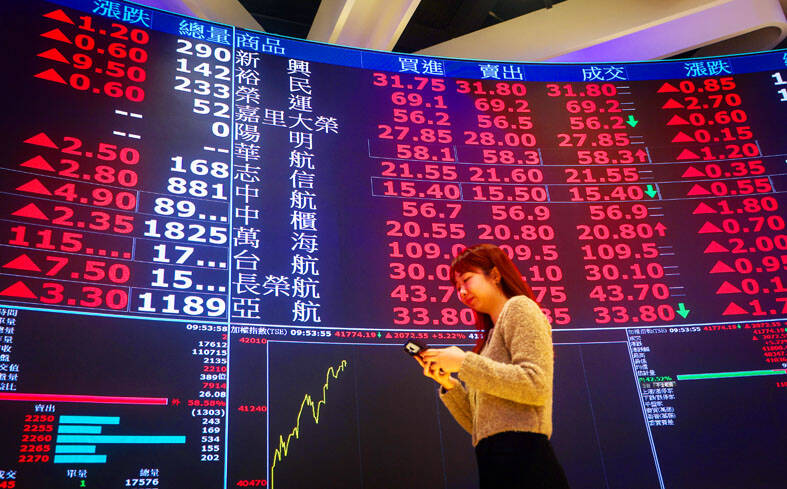
A woman looks at her mobile phone in front of an electronic stock board at the Taiwan Stock Exchange in Taipei yesterday.
Photo: CNA
Taiwan Semiconductor Manufacturing Co (TSMC, 台積電), which accounts for more than 40 percent of the TAIEX’s market capitalization, gained 4.68 percent.
Smartphone chip designer MediaTek Inc (聯發科) surged 10 percent, and chip packaging and testing company ASE Technology Holding Co (日月光投控) also jumped 10 percent, while iPhone assembler and AI server maker Hon Hai Precision Industry Co (鴻海精密) rose 6.46 percent.
Turnover on the local main board was NT$837.93 billion (US$25.48 billion), down from the previous session’s NT$1.246 trillion, TWSE data showed.
“With the government’s pledge to intervene in the market, investor sentiment improved, prompting many investors to buy on dips today,” Hua Nan Securities Co (華南永昌證券) analyst Kevin Su (蘇俊宏) said.
The decision marked the 10th time the NT$500 billion stabilization fund has been activated to intervene and curb market volatility since its establishment in 2000.
Before yesterday’s rally, the TAIEX had fallen about 10,267 points, or 20.55 percent, from its intraday high of 49,968.92 points recorded on Oct. 6, TWSE data showed.
“Buying was also fueled by a rebound in US tech stocks on Friday, with major electronics stocks in focus. Many of them rose to their 10 percent daily price limits,” Su said. “Trading volume was constrained as many stocks reached their daily price limits, leaving some buy orders unfilled.”
Lifting investor mood elsewhere was wider strength in Asian equities yesterday, despite concerns over an investigation into Nvidia Corp chief executive officer Jensen Huang (黃仁勳).
The market’s strong open clearly suggests the stabilization measures “are overpowering any impact from the Jensen Huang development that many investors may see as a sideshow on the semiconductor sector’s long-term trajectory,” Lombard Odier Asia Ltd senior macro strategist Homin Lee (李霍民) said in Singapore.
The National Stabilization Fund’s previous nine episodes of intervention, including those during the dotcom bubble, the 2008 financial crisis and the COVID-19 pandemic, prompted the market to rally 6 percent on average in the following week and 22 percent over one year, according to a Goldman Sachs Group Inc sales and trading desk note to institutional clients. However, six out of the nine times experienced additional 5 percent to 28 percent drawdowns within six months after the fund’s activation.
KioskNews shows a cleaned-up reading view extracted from the publisher’s page — the original always lives on their site, not ours.