Book review: A Tibetan Buddhist in the world of finance
A new novella from Tsering Namgyal Khortsa takes us back to Taipei in the 1990s
By David Frazier / Contributing Reporter


The Taipei that Tsering Namgyal Khortsa gives us in his new novella, A Season of Retreat, takes us back to the 1990s and 2000s. In that not so distant past, Taipei was a city on the cusp of affluence, though its blossoms were only starting to sprout through its grubby exterior. At the same time, the city was also a moody milieu for postmodern alienation, where even the rain was “quieter, gentler, somehow lonelier.”
It is in this Taipei that a young Tibetan exile, Tashi, finds himself living between two worlds. One of those worlds is his professional life as a business reporter and financial editor, with weekends spent in cruisy expat bars and funky student cafes. The other is that of Tibetan Buddhist centers, where he does duty assisting newly arrived lamas and translating religious teachings for Taiwanese devotees.
The novella, at only 192 pages, offers a taut yet endearing parable of a young Tibetan adrift in a sea of globalization. Its central irony is that Tashi, a financial reporter, sits in the beating heart of neoliberal capitalism — a system which he cannot help but look upon as the apogee of Buddhist “impermanence.”
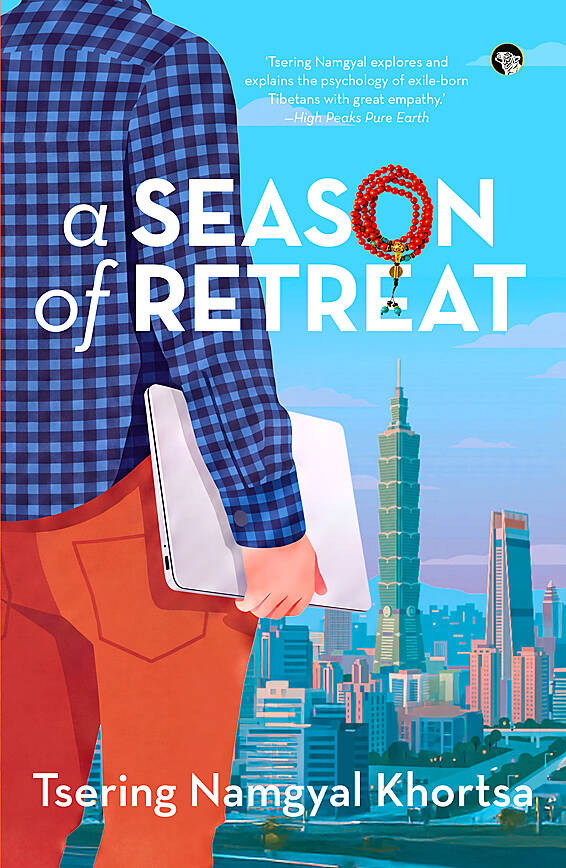
A Season of Retreat,by Tsering Namgyal Khortsa
For Khortsa, the novella is also a reckoning with his own younger self. Though he now lives in India, its story mirrors, though does not exactly describe, his formative years in Taipei. I worked with him in the early 2000s at the Taipei Times. Dapper and fastidious, he was a reporter on the business desk, while I sat in an adjoining island of cubicles in the Features Section. In those days, he used only his first two names for his byline, Tsering Namgyal.
Though the novella’s setting is the 1990s, the Taipei it describes is that of the 2000s. Most of its references are to real places I remember well. Tashi’s apartment is near Grandma Nitti’s, which served American-style brunch and was Taipei’s answer to a backpacker cafe. His favorite bar is Watersheds, a trendy dive off Anhe Road where I drank with Khortsa on occasion. There is also a brief mention of Eslite’s legendary 24-hour bookstore on Dunhua South Road, where lonely nerds once roamed through the wee hours. These places are all gone now.
The novel begins with Tashi, who has come from India to attend university in Taipei, landing his first job as a business reporter at the Taiwan News. (This, too, was and is a real media platform.) The job marks not only the start of his adulthood, but also his own personal crisis of being.
Skilled at his work, Tashi rapidly climbs the career ladder. It does not take him long to make a lateral move to an investment house, where he edits financial reports. Then after passing a test to obtain a brokerage license, he is offered a high-paying position as a full analyst.
On weekends, Tashi retreats to an artsy student cafe, Norwegian Wood — another real place. It was a literary-minded haunt near National Taiwan University that took its name from a novel by Haruki Murakami, not the Beatles’ song. There he dreams of Sikkim and taps out stories of the Himalayas on his laptop computer.
In the cafe, he manages to spark a romance with an American art critic, a fellow freefloating “exile.” But as the relationship goes forward, he is cavalier, flirting with other girls in other bars. After a time, the love affair goes as easily as it had come.
Though Tashi is doing everything right career-wise, he stills feels unmoored and spiritually restless. He experiences Taipei’s version of globalism as an absurdity — a Tibetan dating an American in Japanese-themed cafes and Thai restaurants, and where everybody speaks Chinese! Such dislocations fortify his sense of alienation and exile. At one point he compares his existence to that of the bardo, which for Tibetans is where souls are left to wander between the stages of death and rebirth.
It is only in Taipei’s community of Tibetan Buddhists that Tashi finds a sense of grounding. In previous writings, Khortsa has noted somewhat ironically that Buddhism is Tibet’s greatest export and the cornerstone of its identity. In the Taiwan of this novella, he finds further irony when he describes how the Taiwanese, amusingly, often treat the visiting lamas like fortune tellers.
But assisting newly arrived monks also gives Tashi a tangible sense of purpose, and this is reinforced by letters from his father, who has just been elected as a parliamentarian in Tibet’s exiled government. Though Buddhism for Tashi is a kind of life in the background, he nevertheless finds realness there. His most meaningful friendship is with a Buddhist nun who is dying of cancer.
As Tashi advances up the corporate ladder, he is increasingly torn between these two worlds. As a financial editor, he has a nagging sense that he is unfulfilled, that he is letting his authentic self down. At this point, he comes to see his weekend writing sessions as “a way of paying a sacred debt — to his motherland, Tibet — now fading from the world’s memory like a prayer half-whispered and lost to wind.”
The novella’s moment of truth comes with the arrival of the Asian financial crisis of 1997. Debts threaten to collapse Tashi’s firm. But while those around him scramble, he sees only impermanence. It is at this fork in the road that he knows he must choose his direction.
A Season of Retreat is Khortsa’s third book, all written since leaving Taipei in the mid-2000s. His second effort, The Tibetan Suitcase (2013) was a critically successful novel whose title still stands as a grand metaphor for the identity crisis of more than 100,000 exiled Tibetans worldwide. Reprising this theme in this latest work, he writes, “What you lose becomes part of the suitcase you must carry.”
In this newest work, Khortsa writes with lucid and disarmingly simple prose — almost like Murakami’s “invisible prose.” It is however hard for me, having known him, to disentangle his own life from this fiction. And in places I feel he, as a writer, did not solve the problem fully. But all told, it is an engaging and subtly complex read. I was quickly swept up in this tale of a young man facing down his own personal paradox, that of being a Tibetan Buddhist, and also a business reporter in Taipei.
For your information
Publication Notes
A Season of Retreat By Tsering Namgyal Khortsa 192 pages Speaking Tiger Books
KioskNews shows a cleaned-up reading view extracted from the publisher’s page — the original always lives on their site, not ours.