Judge unseals records on Ilhan Omar’s home search amid constitutional debate

A magistrate judge who authorized a recent search of Ilhan Omar’s home by federal agents ruled that the Minnesota Democratic congresswoman was entitled to assert her right to privacy protections afforded to sitting members of Congress at the outset of the search, according to court documents unsealed on Monday.
The unsealed filings reveal how federal justice department attorneys and US magistrate judge Matthew Sharbaugh resolved their initial disagreement over the thorny constitutional implications of searching a member of Congress’s private residence for a criminal investigation.
The heavily redacted documents – released in response to a lawsuit filed by media organizations – do not appear to shed new light on the reason or outcome of the search itself. They also do not disclose new details of an immigration-fraud investigation launched by the Trump administration – that Omar claims is politically motivated.
Federal authorities are investigating potential fraud in her family’s immigration paperwork and have issued grand jury subpoenas to some of her relatives, the Associated Press reported in October, citing a person briefed on the investigation who spoke on condition of anonymity because they were not authorized to discuss an active investigation.
The unsealed filings show that Sharbaugh – before authorizing the search of Omar’s home – raised concerns about the “speech or debate clause” implications of searching a private residence belonging to a member of Congress. The clause, which is designed to protect legislators from executive branch interference or intimidation, includes a privilege against compelled disclosures.
Sharbaugh said he disagreed with the government’s argument that the privilege is limited only to official congressional offices and certain electronic devices.
“That logic does not hold,” the magistrate wrote.
Sharbaugh concluded that the government’s law-enforcement interests needed to be balanced against Omar’s constitutional rights as a member of Congress. He said the government ultimately agreed to a search protocol allowing Omar to invoke a privilege over any speech or debate clause material before agents carried out the search.
Omar, a naturalized US citizen born in Somalia, has been a target of anti-immigrant rhetoric by Donald Trump and many of the president’s Republican allies. She hasn’t been charged with any crimes and has denied any wrongdoing.
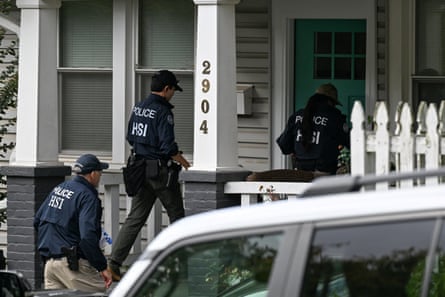
Washington DC federal court chief judge James Boasberg ordered the partial unsealing of court filings related to the 12 October search of Omar’s home in the nation’s capital, which was carried out by US Department of Homeland Security (DHS) agents.
He ruled after more than a dozen news organizations, including the AP, argued that the public has a right to access the records under the US constitution’s first amendment free press rights.
Boasberg agreed with the government that it would be premature to unseal a 67-page search warrant affidavit containing sensitive details of the government’s investigation. In a court filing in October, the government argued that it would jeopardize the investigation to unseal the court records before a charging decision is made.
An attorney for Omar didn’t immediately respond to an email seeking comment Monday on the unsealed documents.
Agents conducted the court-authorized search less than a month before the 3 November midterm elections, when Omar won her re-election bid and Trump’s Republican party lost control of Congress for the second half of his second presidency.
The US justice department historically has avoided public investigative actions involving a candidate within 60 days of an election.
Omar has said DHS agents seized 17 items, including phones, notebooks, a Somali-language children’s book and a vintage camera that her husband had received as a gift.
Year-end fundraiser
$0 of $2,000,000 goal
A moment full of possibility – and risk
We hope you appreciated this article. Before you close this tab, can we ask you to support the Guardian at this crucial time for democracy in the US? With Black Friday approaching, our most impactful monthly support option is just $7.50 a month for six months.
In the last two years alone, Donald Trump has eroded many of the pillars of US democracy – slashing funds for universities, undermining science, shutting down arts institutions, and attacking the free press as an “enemy of the American people” and “a threat to our national security”. While he and his allies have enriched themselves and spread lies, federal forces have harassed and imprisoned innocent people and violated the constitutional rights of many Americans.
Now, in a sweeping change election, the American people have spoken: Donald Trump, Pete Hegseth, RFK Jr, Elon Musk and the tech oligarchs may finally be held to account. A majority of American voters have demanded an end to the costly and immoral wars, the flagrant profiteering, and the corrosive attacks on communities and democratic institutions.
It’s a moment full of possibility, with more stories than we can possibly cover. New leaders are emerging from Texas and Michigan to Iowa and South Carolina – and heading to Washington to fight for affordability, against wealth inequality, and for human survival in the face of AI and the climate crisis.
These new leaders will be facing a cornered Trump and his hardline chief of staff, Stephen Miller, who have nothing left to lose. The next few years are critical for the future of the country. Journalism that covers the epic clash between these forces has a vital role to play right now.
Investigative journalism provides a fact-based paper trail for an emboldened Congress to follow. Members of Congress – and the American public – often rely on our in-depth reporting to inform the tough questions, to connect the dots and to pursue accountability for wrongdoing.
At the Guardian, our newsroom is devoted to uncovering the truth and conveying it to as many people as possible. We’re not alone in this mission, but this kind of journalism faces unprecedented hurdles: big tech threatening our financial stability and stealing our work for AI, billionaire owners telling journalists what to publish, and a hostile executive branch intent on suppressing our reporting.
The Guardian is free to dig deep without fear because we’re funded by our readers. Our readers hold us to account, and we hold the powerful to account.
However, this only works when enough of our readers contribute. Against the advice of most industry analysts, we’ve refused to put up a paywall – we believe good journalism should be freely available to all people, regardless of ability to pay. If you’re counting on our reporting, and you can’t afford to pay, please stop reading this message and go back to our articles.
If you can afford to contribute, please know that your support is not only helping yourself – from voters in Kansas to immigrants in Minnesota and families in Gaza, your generosity is bringing factual news to people around the globe.
Today is among our most important fundraising days of the year. To sustain our unique financial model, our goal is to raise $2,000,000 before the new Congress is seated on 3 January. More than 19,000 people have contributed already. All gifts are gratefully received, but for the next several days only, our most impactful monthly support option is $7.50 a month for the first six months. If you can afford 37 seconds, please join our ranks – and show your support for the rekindling of democracy in the US and around the world.
KioskNews shows a cleaned-up reading view extracted from the publisher’s page — the original always lives on their site, not ours.