What is mogging? The slang term named word of the year by Collins English Dictionary

The fast-growing slang word “mogging” has been crowned the Collins’ word of the year.
It’s defined as outperforming or outshining someone or something else, which might involve making them look inferior in terms of appearance, confidence or status.
Mostly used by Generations Z and Alpha both online and in everyday conversation, the word went mainstream in 2026.
Believed to be a shortening of AMOG (alpha male of the group), it started life around 2016 as a noun in bodybuilding culture, referring to the most physically dominant man in the gym, before morphing into a verb and doing the rounds in the manosphere.
But now a decade on it is a playful put-down or a compliment, depending on the context.
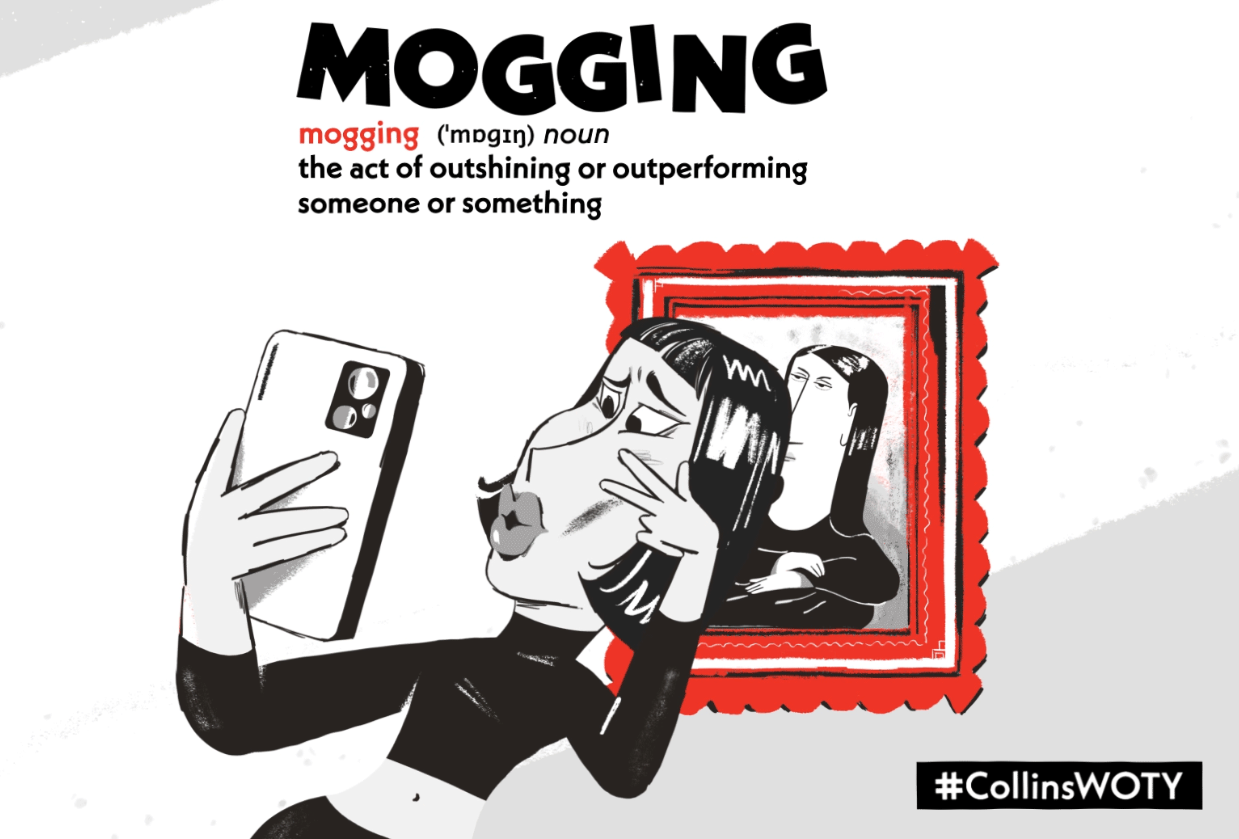
Lexicographers at Collins Dictionary chose the word after monitoring their database, Collins Corpus, which draws upon language used on social media.
Alex Beecroft, the managing director of Collins, said: “Collins lexicographers not only track how often words are used, but they also analyse patterns of usage.
“The selection of ‘mogging’ as Collins’ word of the year shows how each generation leaves its mark on language.
“It’s a great example of how Gen Z and Gen Alpha have adopted a word and turned it into humorous slang, making the language their own and ‘mogging’ the rest of us.”
Other words that made the dictionary’s shortlist included ghost job — when an employer posts a job position with no intention of hiring a new employee.
The latest messy and choppy hair trend is called a bixie, a style which is shorter than a bob but longer than a pixie cut. Halle Berry and Meg Ryan sported it first in the 1990s, and in 2026 Zendaya, Jessie Buckley and Helen Mirren have brought the trend back.
Hydration break was a term made famous by this year’s World Cup with the three-minute water breaks introduced due to the hot weather. Another word p(doom) is the estimation of probability of an AI-aided collapse of civilisation.
Manchesterism also made it to the top ten. The word is associated with prime minister Andy Burnham and is about the devolution of power to the regions.
Fricy was another top word for 2026. The term is used to describe a flavour that is both fruity and spicy, such as mango and chili. Other mash-up flavour words include swicy, swavoury and spour.
Last year the word of the year was “vibe coding”, which is the art of making an app or website by describing it to artificial intelligence (AI) instead of coding it manually.
KioskNews shows a cleaned-up reading view extracted from the publisher’s page — the original always lives on their site, not ours.