Rocky is Philadelphia’s founding myth – and 50 years later, we’re still telling it
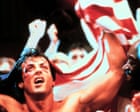
The story behind the making of Rocky has always sounded uncannily like Rocky itself. An unknown with an improbable dream, a skeptical establishment and a refusal to accept the odds: Sylvester Stallone’s real-life struggle to crack the industry and bring his breakthrough film to the screen contained all the elements of the underdog story he sought to tell. Now, half a century later, Peter Farrelly’s I Play Rocky has crafted those parallels into a crowd-pleasing yarn of its own.
It’s an extraordinary afterlife for a modest boxing flick that became the highest-grossing film of 1976 on a $1m budget and won the Oscar for best picture over one of the most stacked fields in history. Yet its greatest achievement may be the durability of the story – dismissed then by the New York Times as a “sentimental little slum movie” and Gene Siskel as a “flatout schmaltzy saga” – that we’re still finding new ways to repurpose all these years later through six Rocky films, three Creed sequels, a Broadway musical, and too many documentaries, novelizations and video games to count. At some point long ago, a screenplay written in three and a half days and never envisioned as IP became something closer to contemporary folklore.
Being from Philadelphia, I’ve been pressed repeatedly on what I made of I Play Rocky, where relative unknown Anthony Ippolito takes on the role of Stallone. Answer: it’s an unabashedly sentimental tribute to the original film, the New Hollywood era of American movie-making and betting on yourself in general. I can’t speak to the entire packed theater at my New York press screening last month, but the man to my left and the woman to my right were dabbing at their eyes not long after I had started. Anyone not instinctively put off by Farrelly’s sincerity and old-fashioned emotional appeal will find something to like about it. Of course, audiences gave in to the same bag of tricks 50 years ago.
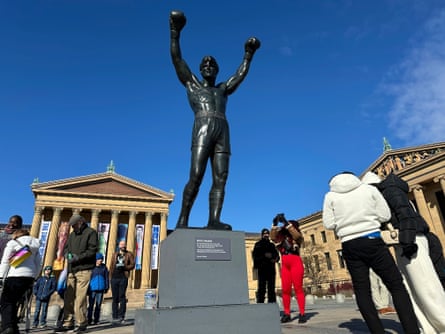
It will certainly play well in Philly, where the character and film are less a work of fiction than the ur-text of a city’s collective self-image. Growing up there, Rocky’s psychic imprint was everywhere. The Art Museum steps, where tourists still flock to raise their arms in triumph while swerving the Cezannes, Picassos and Duchamps inside. The 10-ft-tall bronze statue in Stallone’s likeness, a prop for the third film, that has become a city landmark. The Italian Market, where Rocky jogged past bewildered produce vendors during John G Avildsen’s guerrilla shoots. The battered rowhouses and industrial landscapes stretching out from Center City. I have lost count of how many times my mother told me about seeing Rocky on its release at the long-shuttered Sam Eric movie palace on Chestnut Street, where the audience stood on its feet during the climactic fight with Apollo Creed, hooting and hollering as though they were watching an actual sporting event.
Rocky wasn’t simply a movie set in Philadelphia. He was Philadelphia, or at least the version of itself the city most wanted to believe in: scrappy, stubborn, unpretentious, perpetually underestimated and possessed of an almost pathological determination to prove everyone wrong. Stallone understood the character’s wider appeal from the beginning: “He was to the seventies what Chaplin’s Little Tramp was to the twenties,” he wrote in The Official Rocky Scrapbook, the 1977 tie-in memoir.
That populist allure has been passed down the generations in wholly unexpected ways. In 2013, the late, great Philadelphia writer Dan McQuade calculated that Rocky’s training run in Rocky II covered more than 30 miles, inspiring an annual ultramarathon in which locals retrace the absurd route. Chicago has Ferris Bueller, Boston has Will Hunting and Brooklyn has Tony Manero. But Philadelphia has something closer to a secular patron saint. Joe Frazier was a real-life heavyweight champion who ran Philadelphia’s streets and defeated Muhammad Ali in the biggest fight ever, while Rocky was a fictional journeyman who lost to a thinly veiled Ali stand-in. Yet it is the Italian Stallion whose statue commands the attention of tourists, as Frazier’s stands largely unnoticed at the bottom of the Art Museum stairs.
The comparison is uncomfortable, and it should be. Frazier was Black, a real working-class Philadelphian by way of Beaufort, South Carolina, whose achievements came with none of the sentimental neatness of Hollywood. Rocky was white, ethnically Italian and conveniently fictional, his hardships uncomplicated by the racial contradictions of the city that embraced him. When Rocky premiered in 1976, Philadelphia was entering the second term of Frank Rizzo, the former police commissioner whose officers had notoriously stripped Black Panther members naked during a raid, allowing photographers to document their humiliation. The city’s elevation of one boxer over the other says something about whose stories become universal, and whose remain stubbornly particular.
The Philadelphia of Rocky was a metropolis in decline. Factories were closing, white flight was hollowing out entire swaths of the city and the postwar industrial economy was giving way to something far less certain. Avildsen’s camera lingered on vacant lots, elevated trains and streets that seemed permanently damp and cold, a landscape not so far removed from the urban hellscape of David Lynch’s Eraserhead – what the Pennsylvania Academy of the Fine Arts alum called “my Philadelphia story”. (“When I was there it was a very sick, twisted, violent, fear-ridden, decadent, decaying place,” he said.)
Fifty years on, many of those former industrial neighborhoods have become expensive residential enclaves, while Kensington, whose battered streets supplied so much of the original film’s inimitable atmosphere, is now associated with one of America’s most notorious open-air drug markets and the street rap of local artist Skrilla. Restaurants and universities occupy an increasingly prominent place in the economy. The skyline has changed almost beyond recognition, even as poverty remains entrenched. The old working-class Philadelphia survives as much in the city’s self-image as in its streets.
The understated world-building of Rocky gave that self-image a face. But the underdog mythology he has embodied has proved far more universal than the city that claimed him. The original Rocky didn’t invent that narrative, but it distilled an ancient dramatic structure into a formula so familiar and pan-cultural that its influence has become almost invisible. The Karate Kid is Rocky with martial arts. Cool Runnings is Rocky with bobsledding. Searching for Bobby Fischer is Rocky with chess. Akeelah and the Bee is Rocky with competitive spelling. The outsider, the mentor, the training montage, the formidable favorite, the climactic contest in which personal vindication matters more than the result: the template has become a genre unto itself.
And at some point, repetition becomes something more consequential than commercial exploitation. Shakespeare’s Macbeth has been reimagined through opera, cinema and countless theatrical reinventions. Verdi’s 1847 adaptation – currently the toast of the Met Opera season – remains part of the operatic repertoire nearly two centuries later. Austen’s novels continue to inspire new interpretations, including this year’s Sense and Sensibility, because their central tensions remain recognizable even as societies change. Rocky belongs, in its own decidedly less exalted register, to this storytelling tradition. A narrative becomes a myth when successive generations find new reasons to tell it. Even the much-maligned sequels have their peculiar merits. Tarantino calls the second film his favorite of the series, the third was nominated for best foreign film at the Japanese Academy Awards, while the fourth was the highest-grossing sports film for a quarter-century.
Consider how Rocky’s opponents reflected the evolving anxieties of white America. Apollo Creed, the charismatic Black champion, embodied the racial unease of the 1970s, when Black athletic excellence and cultural confidence challenged old hierarchies. Clubber Lang gave those fears a more menacing form, his aggression and swagger threatening Rocky’s hard-won place at the top. Ivan Drago transformed the squared circle into a cold war battlefield, with a flag-draped Rocky defending American virtue against the seemingly inhuman machinery of Soviet communism in a breathtaking piece of Reagan-era agitprop. Later installments turned inward, confronting fears of aging, irrelevance and obsolescence. The thornier subtexts were hardly lost on Eddie Murphy, who skewered Italian-Americans emerging from Rocky movies as though they had personally won the fight.
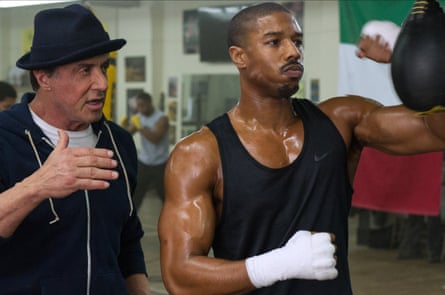
By the time the Creed spin-off series launched in 2015, Rocky had become the mentor rather than the hero. Michael B Jordan’s Adonis Creed inherited the franchise, along with its preoccupation with legacy and self-definition. The aging white working-class hero ceded the spotlight to a younger Black fighter without the story losing touch of its essential character.
And yet the original film’s most radical idea has been softened by endless repetition. Rocky loses a split decision to Creed but by then the outcome has become almost immaterial. He has endured, discovered his own worth and found love amid the wreckage of a life that seemed destined to be “just another bum from the neighborhood”. His victory is not over an outside opponent but over the prospect of his own insignificance. The American dream has always been more persuasive as an emotional proposition than an economic one. Rocky distills it to its simplest, most enduring promise: you do not have to win to matter.
Which brings us back to I Play Rocky, where the mythology finally turns back upon its creator. Stallone’s insistence on playing the lead despite the studio’s preference for an established star – turning down an escalating series of life-changing paydays – has become almost as familiar as Balboa’s compulsion to go the distance. The unknown actor who refused to surrender his dream is now another character in the mythology he concocted with “a nineteen-cent Bic pen and a forty-nine-cent pad”.
There is something both touching and faintly absurd about this endless succession of underdogs. But perhaps that is the secret sauce of Rocky’s longevity: the circumstances change, but every generation gets its own version of the same impossible fight. Philadelphia, meanwhile, keeps telling itself the same story. Its sports teams win and lose, its neighborhoods change and rising populations remake its streets. Yet the city continues to recognize itself in a fictional boxer trudging through the cold toward an improbable reckoning with self-meaning. Fifty years after Rocky, the question is no longer whether the character belongs to Philly, but whether Philly can imagine itself without him.
KioskNews shows a cleaned-up reading view extracted from the publisher’s page — the original always lives on their site, not ours.