China and Canada agree on fresh tariff relief as Xi and Carney continue thaw
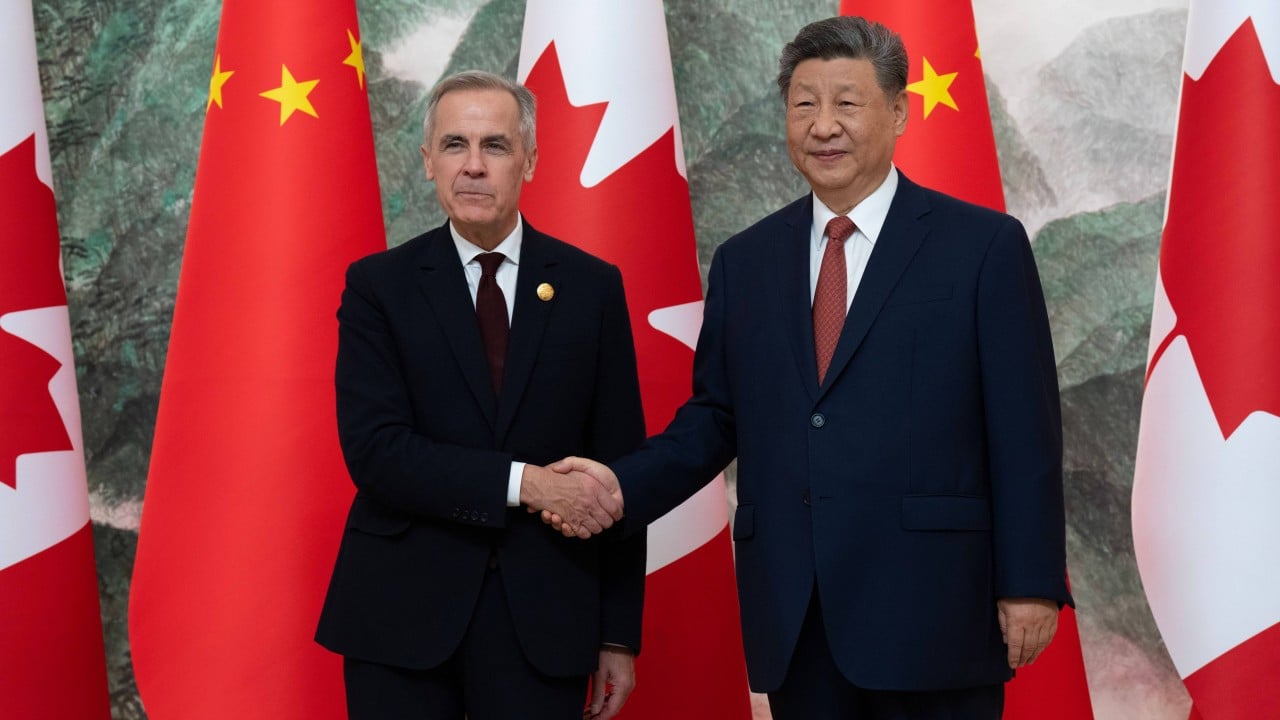
Chinese President Xi Jinping and Canadian Prime Minister Mark Carney have agreed on broader trade concessions as Ottawa seeks to reset relations with Beijing amid growing trade tensions with the United States.
The two leaders met ahead of the Asia-Pacific Economic Cooperation leaders’ meeting in Shenzhen on Tuesday, where they discussed ways of managing their differences.
He urged both sides to improve their understanding of each other’s development paths and policy intentions, and to respect each other’s core interests and major concerns.
Improving ties was in the interests of both countries’ peoples and would contribute to the world, Xi said, describing it as the “right choice”.
The two countries also agreed to expand existing tariff reliefs, improving access to the Chinese market for Canadian agricultural and seafood exports, according to a statement from Carney’s office.
The move will provide additional tariff reliefs for roughly C$400 million (US$280 million) in Canadian exports, including frozen pork, fish and seafood.
Meanwhile, Canada agreed to extend tariff exemptions on certain Chinese steel and aluminium products by another two years.
It also said it would expand the exemptions to cover an additional 32 tariff items where domestic supply was insufficient.
The agreement builds on Beijing’s decision earlier this month to extend for another two years tariff relief on Canadian food products, including canola meal, peas, lobster and crab.
Xi and Carney also discussed electric vehicles and outlined “opportunities to deepen cooperation in clean and conventional energy”, according to the Canadian prime minister’s office.
In January, following Carney’s visit to Beijing, Canada agreed to allow up to 49,000 Chinese electric vehicles into its market under a preferential tariff arrangement.
Other agreements announced on Tuesday included expanding direct flights between the two countries and strengthening cooperation in education and the arts.
Ahead of the latest meeting with Xi, Carney said Canada could turn to Chinese carmakers if trade negotiations with US President Donald Trump failed to preserve the integrated North American automotive industry.
“That market has become less integrated because of US trade actions,” he said on Monday.
Can Canada mend its relationship with China?
The meeting marked another step in efforts by Beijing and Ottawa to rebuild ties after years of diplomatic and trade tensions.
Ottawa’s pivot back to Beijing came after relations with Washington soured in the face of Trump’s tariff threats and repeated references to turning Canada into the 51st US state.
A meeting between Xi and Carney on the sidelines of the Apec summit in South Korea last October was seen as a turning point by both sides and Xi expressed his willingness to get relations back on a “healthy, stable and sustainable track”.
Carney then built on this with his visit to Beijing in January, when he became the first Canadian prime minister to visit China since 2017.
At the time, he said nearly a decade of “distant and uncertain” ties had hurt Canadian investment and left the country “even more dependent” on the United States.
Relations deteriorated sharply in 2018 after Canada detained Huawei Technologies executive Meng Wanzhou at Washington’s request. China subsequently detained two Canadian citizens, deepening the diplomatic crisis.
Tensions were further fuelled by Canada’s decision in 2024 to impose a 100 per cent tariff on Chinese electric vehicles, alongside duties on steel and aluminium.
Carney said in January that Canada was looking to “recalibrate our relationship with China strategically, pragmatically and decisively”.
A meeting between Xi and Carney on the sidelines of the Apec summit in South Korea last October was seen as a turning point by both sides and Xi expressed his willingness to get relations back on a “healthy, stable and sustainable track”.
Carney then built on this with a visit to Beijing in January, when he became the first Canadian prime minister to visit China since 2017.
At the time, he said nearly a decade of “distant and uncertain” ties had hurt Canadian investment and left the country “even more dependent” on the United States.
Relations had deteriorated sharply in 2018 after Canada detained Huawei Technologies executive Meng Wanzhou at Washington’s request. China subsequently detained two Canadian citizens, deepening the diplomatic crisis. Tensions were further fuelled by Canada’s decision in 2024 to impose a 100 per cent tariff on Chinese electric vehicles, alongside duties on steel and aluminium.
Carney also said in January Canada was looking to “recalibrate our relationship with China strategically, pragmatically and decisively”.
KioskNews shows a cleaned-up reading view extracted from the publisher’s page — the original always lives on their site, not ours.