Unlock the vaults! A glimpse of gothic Britain – in pictures
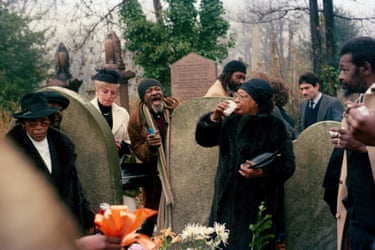
Charlie Phillips, Kensal Rise, 1988
A new specially-curated selection of gothic images from the Martin Parr Foundation collection combines renowned works with lesser-known images. Curator Isaac Blease has chosen a playful narrative which shows Britain as a resilient yet haunted place. It illustrates photography’s role in visualising emotions such as fear and fascination while amplifying the Gothic principle that horror thrives in proximity to the familiar. Dark Tales – British Documentary Photography and the Gothic runs at the Martin Parr Foundation, Bristol, until 20 December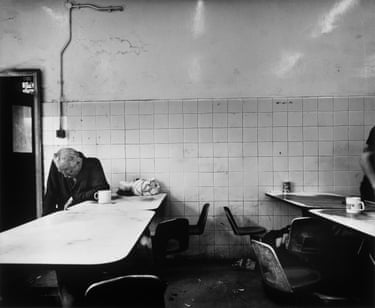
Graham Smith, Thirty Eight Bastard Years on the Furnace Front, Furnace Keeper, Mess room for Number 4 and Number 5 Furnaces, Clay Lane Ironworks, South Bank, Middlesbrough, 1983
Exploring the complex relationship between the gothic and British documentary photography, the collection depicts Britain from the postwar to the present day. The images reveal waning industrial powers, claustrophobic domestic scenes and menacing nocturnal activitiesPhotograph: Augusta Edwards Fine Art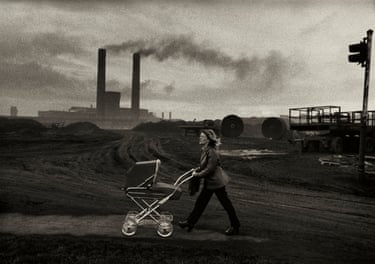
Don McCullin, Woman With Pram, Consett, 1974
Photojournalist Don McCullin’s UK images highlight British eccentricities, calendar events and ordinary leisure activities, while still addressing the political realities of the times. During this period he visited communities living in the north of England, which had been neglected by policies of de-industrialisation. This image was made in Consett and shows the resilience of those living in areas of industrial decline, as well as the looming presence of heavy industry in the landscapePhotograph: Don McCullin/Hauser & Wirth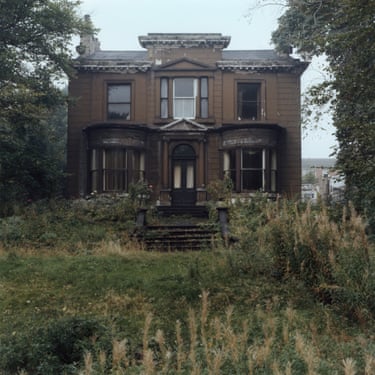
Peter Mitchell, Spencer Place, Leeds, 1979
Curator Isaac Blease writes: ‘The gothic has a rich tradition in Britain in literature, music, cinema and art, where imagination and metaphor have conveyed the anxieties of their respective times’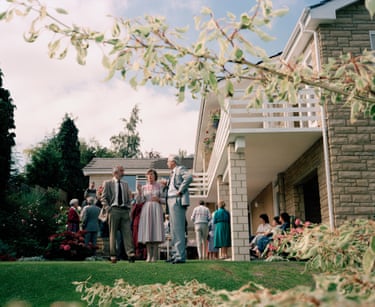
Martin Parr, Conservative Party fundraiser, England, 1988
‘Interest in the gothic resurfaces during times of uncertainty, and documentary photography itself is in a dark moment, with its purpose and role in question, public distrust of photographers, and the existential threat posed by artificial intelligence. This moment of turmoil presents intriguing conditions to explore the gothic imagination as a relevant lens through which to re-examine the medium, while also revelling in the ambiguity of images and the multitude of meanings they evoke’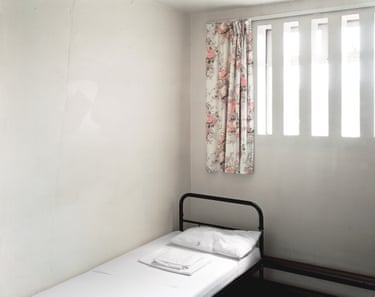
Donovan Wylie, The Maze/Long Kesh Prison, Prison Cell H — Block 5, B — Wing, 18/24, 2002-2003
Donovan Wylie spent almost 100 days photographing inside the Maze prison. Built in 1976 at the height of the Troubles to house both Loyalist and Republican prisoners, the prison was a model of repetitive, systematic architecture. Through his typological photographs, Donovan makes the psychological effects more visible, showing an architecture designed to disorient and diminish. The Maze became synonymous with the Northern Ireland Troubles before finally closing in 2000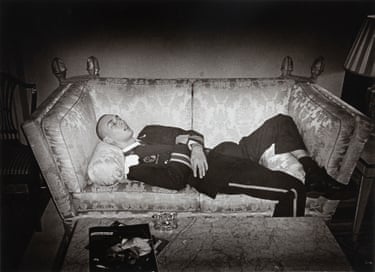
Chris Shaw, Jordi the Lounge Lizzard, The Howard Hotel, London 1999-2000
Working in hotels as a night porter, Chris Shaw began photographing the graveyard shift. Made mainly in London, we see chaos take place under his watch as the rickety hallways of hotels become alive with a raft of characters and clientele. The work also depicts the precarity of living in the metropolis as an artist without money, forced to take poorly paid work with unsociable hours, which often comes through in the artist’s stream of consciousness writing scrawled on each print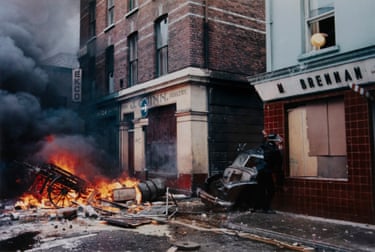
Akihiko Okamura, Derry Londonderry, Northern Ireland, at around 4 PM on August 12, 1969
In 1968, Japanese photographer Akihiko Okamura moved to Dublin with his family, with a view to exploring the Irish background of President JF Kennedy. During this early phase of the 30-year conflict, his often quietly understated images depict a reality that was shifting and unstablePhotograph: Akihiko Okamura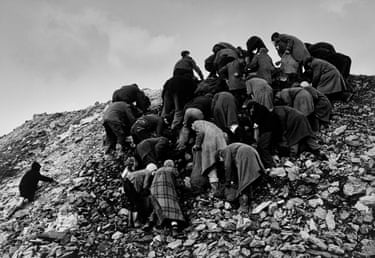
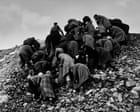
Colin Jones, Coal Scavengers Working On A Mound, Sunderland, North East of England, 1962
Isaac Blease: ‘Together, the exhibited works present Britain through varied perspectives, from the photographer as outsider, to artists’ intimate depictions of their own homes and communities. A short tale of Britain from the post-war to the present era unfolds, covering themes from conflict, domesticity, class relations, shifting industries and mental health, through to the emergence of the goth subculture’ Photograph: TopFoto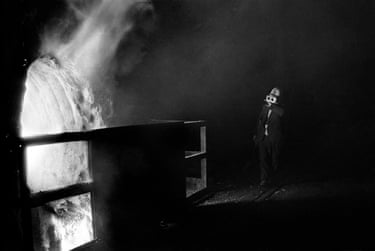
Janine Wiedel, Shelton Bar Iron and Steel Works in Stoke on Trent in 1978 just before it was closed down with loss of 2,500 jobs
Originally from the US, Wiedel moved to the UK in 1970 while working on her project about Irish Travellers. In 1977, she was awarded the West Midlands Arts bursary. As part of this commission she began photographing the heavy industries in the Midlands, including chain-makers, potteries, coal mines and steel furnaces. Her images often highlight human vulnerability against the sublime scale of the heavy metal structures and burning infernos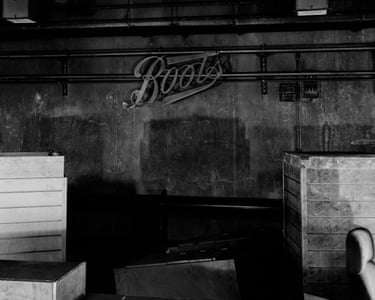
Sarah Pickering, Boots, 2008, from the series Incident
Pickering’s images document sites used to simulate emergency incidents in fire fighting training exercises. These controlled environments are built to feature just enough signs of domestic, industrial and commercial sites while remaining entirely fabricated spaces. Shot with a 5x4 large-format camera, the photographs are then printed by the artist on matte-fibre paper, drawing on the textures of the soot-heavy surfaces while emphasising traces of human presence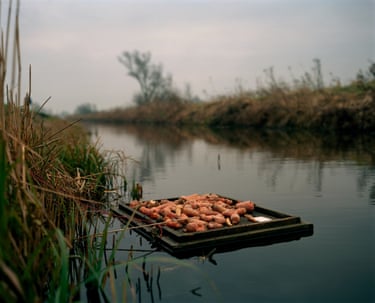
Jem Southam, The Raft of Carrots, 1987-1992
The Raft of Carrots is a photographic study by Jem Southam taken near his home in Exeter, Devon. It emerged from the pondering of a dream, a recurring nightmare from Southams’ early childhood. In the dream, a huge wave swept up his back garden, higher than the tallest tree. It continued to endlessly break and roar as he turned and struggled to run away. Dark Tales is part of the 2026 Bristol Photo festival. The full programme can be found hereKioskNews shows a cleaned-up reading view extracted from the publisher’s page — the original always lives on their site, not ours.