Donovan’s Deep Dives: The Changhua race gets stranger: Wang, Cheng and the mystery of Wei
As two independents join the county commissioner race and key Wei Ping-cheng allies face a vote-buying investigation, Wang Huei-mei says party leaders raised his name months before his nomination
By Courtney Donovan Smith / Staff Columnist


The Changhua County commissioner race is the most exciting and dramatic in this election cycle, with surprises within the Chinese Nationalist Party (KMT) popping up every week or two. Most recently, County Commissioner Wang Huei-mei (王惠美), who is about to term limit out, alleges that KMT Chair Cheng Li-wun (鄭麗文) pushed for unknown entity Wei Ping-cheng (魏平政) to be the party’s candidate for the position far earlier than was previously known.
If true, Wang’s accusations raise a lot of questions about Cheng and the party leadership’s motives.
Many local factions and power brokers in Changhua are in open revolt against Cheng, and now two of the few powerful local allies she had have been arrested and are being held incommunicado.
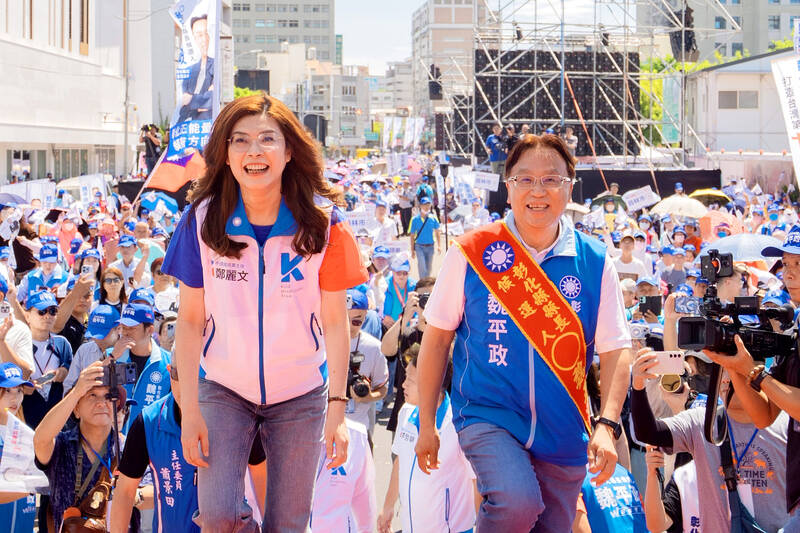
Wei Ping-cheng, the Chinese Nationalist Party candidate for Changhua County commissioner, right, on Sept. 11 attends a rally with KMT Chair Cheng Li-wun in Changhua County. It remains a mystery why Cheng wants Wei to be the candidate.
Photo courtesy of Wei Ping-cheng’s campaign office
Adding to the KMT’s woes, Changhua County Councilor Chen Chung-chia (陳重嘉), an independent candidate with pan-blue leanings (ideologically closer to the KMT), has joined the race. Chen surprised everyone, including his father, who was a legislator and formerly of the People’s First Party and KMT. Chen had been a TPP member briefly, but quit.
Though not as dramatic and messy, the Democratic Progressive Party (DPP) had a revolt of their own, splitting the pan-green (DPP-leaning) vote. A former DPP Changhua City mayor, Chiu Chien-fu (邱建富), a party member since 1987, came in third in the party primary. He accused the party of bias, claimed it had lost its original spirit and quit to run as an independent.
The DPP has a solid candidate in legislator Chen Su-yueh (陳素月). Although she keeps a low profile in the press, reportedly she makes an average of around 30 campaign stops a day, starting at 5:30am and finishing late. Party bigwigs both locally and nationally have rallied around her, not Chiu.
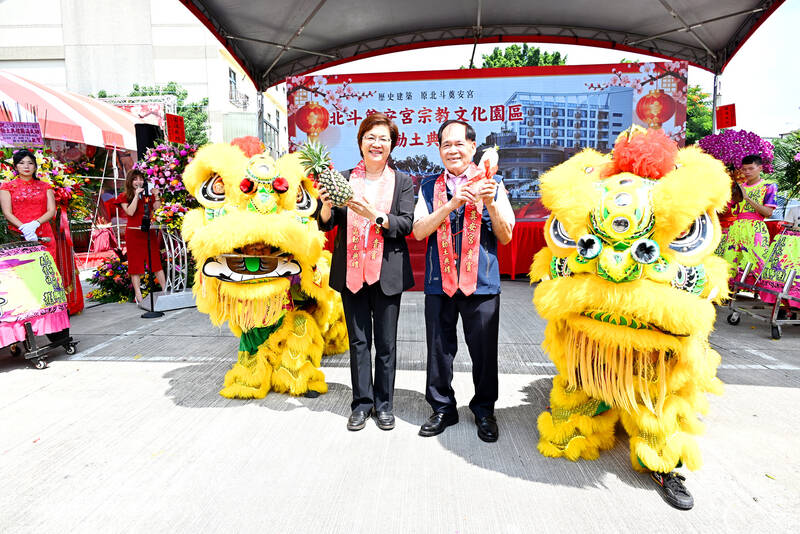
Changhua County Commissioner Wang Huei-mei, left, on Sept. 12 attends a ceremony for the opening of the Religious and Cultural Park in Changhua County.
Photo: Yen Hung-chun, Taipei Times
An ETtoday poll from last month put Chen ahead at 36.4 percent to Wei’s 19.4 percent and Chiu’s 12.7 percent. The poll, however, is not very useful; nearly a third were undecided, and Chen Chung-chia had not yet entered the race. Wei has announced that his camp will stop conducting internal polling, which was likely both depressing and costly to an underfunded campaign.
WEI’S SURPRISING NOMINATION
The previous story on how Wei became the nominee now has questions hanging over it.
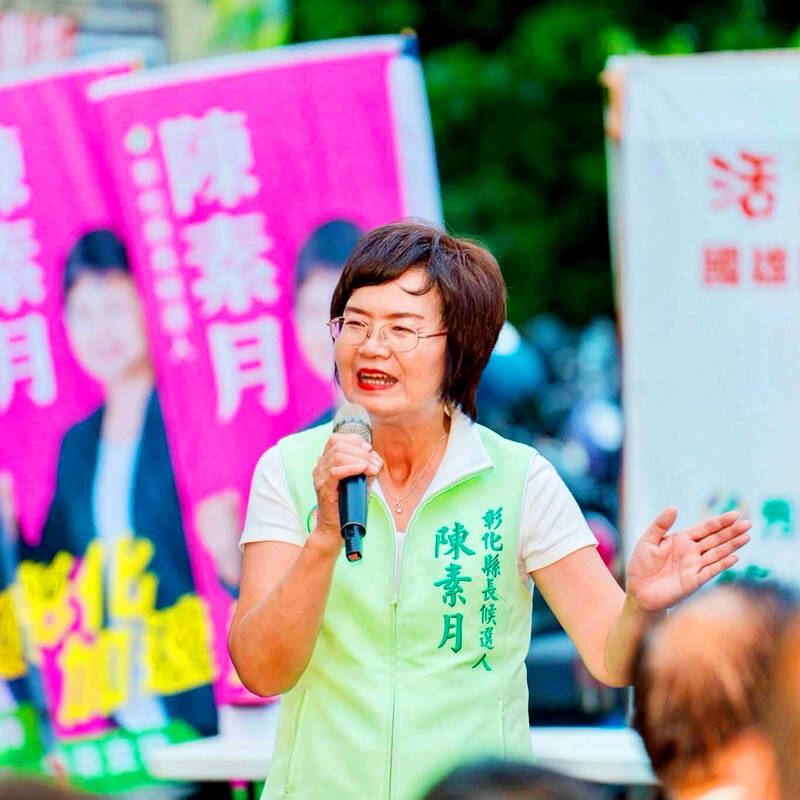
Democratic Progressive Party Legislator and candidate for Changhua County commissioner on Monday campaigns in Changhua County.
Photo courtesy of Chen Su-yue
Cheng faced a conundrum where no matter what she did, she would be offending powerful local party factions. Cheng had campaigned for Wei in part by excoriating her predecessor as KMT chair, Eric Chu (朱立倫), for his heavy-handed approach of directly choosing party candidates and bypassing the more common primaries — exactly what Cheng did with Wei.
This caused outrage. Wei’s (and Cheng’s) only significant supporters in the county were KMT Changhua County Council Speaker Hsieh Dien-lin (謝典霖) and his family. But now Hsieh Dien-lin and his father are in jail, and his mother is out on bail on suspicion of vote-buying, which may have been paid for by using county council funds. This is a disaster for Wei.
Not only were some candidates still fuming, others, including powerful political figures such as former commissioner Cho Po-yuan (卓伯源), came out demanding that Wei be dumped and a primary be held to replace him. Cho has another axe to grind: he has run twice for KMT chair and lost, the last time to Cheng.
Cheng stood firm, and registration day has now passed.
WANG’S FURY
Most notably, Commissioner Wang Huei-mei absolutely refused to support Wei. Her fury extended to boycotting Cheng’s and the KMT’s events.
Wang’s support is important. She is a second-generation politician and well connected. She won in 2018 with a solid 53 percent, and won re-election in 2022 with a strong 57 percent support.
She has recently heaped praise on the president, premier and local DPP lawmakers for securing government budgets for projects, including tagging DPP candidate Chen Su-yueh on social media. They also show up at official events together.
For a local politician, this is not entirely unusual; thanking the powers that secure local interests is good form. The unusually high praise, especially for Chen, and her resolute rejection of Wei has caused some to speculate Wang may actually want Chen to win.
This is not outlandish; Wang has declared her loyalty to her party and to serving Changhua, and she may calculate that Chen would be more in Changhua’s interests. They’ve worked together before.
Cheng and Wei have been speaking to Wang via the media. Wei has been especially obsequious and fawning in trying to win Wang’s support. He even spent 15 minutes forlornly waiting outside of Wang’s office to offer him an invitation personally, but she did not meet him. He is also leaving the position of campaign manager open for her.
WANG’S BOMBSHELLS
Why is Wang so hostile to Cheng and Wei? She made clear she had wanted New Taipei City Vice Mayor Liu Ho-jan (劉和然) as a compromise candidate, not Wei. However, she made clear she wanted Liu due to his reputation, not through any personal connection — so she was not wedded to him as a candidate. Liu was not interested, though.
Then, early this month, Wang used Facebook to clarify her take on the matter. She stated that she met with Cheng and KMT Vice Chairman Lee Chien-lung (李乾龍) on Dec. 31 last year to discuss the election.
Wang said she initially spoke about the ground game involving borough chiefs and finding a clean candidate for commissioner.
Cheng, Wang said, immediately asked: “Is the attorney Wei Ping-cheng suitable?”
Caught off guard, Wang replied, “I’m not familiar with Attorney Wei.”
She also described other incidents, including Cheng ignoring her phone calls while she was on a trip to Europe to further discuss the nomination.
Wang found out it was a done deal through the news, which, if true, was a serious slight to a powerful local politician.
Then she dropped the bombshell: Looking back, she now believes that Wei had been the party’s sole candidate under consideration from the very beginning.
Why would Cheng be so adamant on picking a total unknown like Wei? There is no obvious connection between the two, and Cheng has referred to not being familiar with him before.
One possibility is that Lee Chien-lung threw his support behind Wei. Lee has held several key posts within the party and is typically tasked with internal party issues. He would likely have known Wei when he was chair of the KMT’s evaluation and discipline committee.
But that still begs the question: why Wei? He is not an obviously logical choice.
Could it be Wang making this up? And if so, why? Why would she take on the party chair and make up lies about her, when Cheng is in a position to significantly influence Wang’s future political career?
Donovan’s Deep Dives is a regular column by Courtney Donovan Smith (石東文) who writes in-depth analysis on everything about Taiwan’s political scene and geopolitics. Donovan is also the central Taiwan correspondent at ICRT FM100 Radio News, co-publisher of Compass Magazine, co-founder Taiwan Report (report.tw) and former chair of the Taichung American Chamber of Commerce. Follow him on X: @donovan_smith.
KioskNews shows a cleaned-up reading view extracted from the publisher’s page — the original always lives on their site, not ours.