Ex-Biden aide: US pressure on Israel harmed talks with Hamas to release hostages
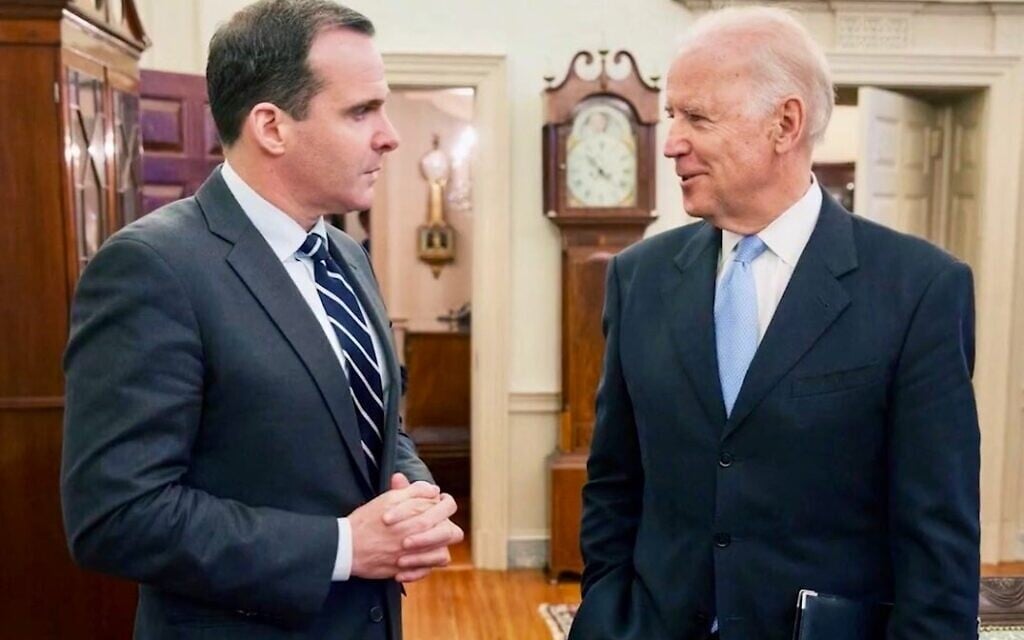
Former US president Joe Biden’s top Middle East adviser argues in his new book that public pressure on Israel from the previous administration proved counterproductive, as it led Hamas to harden its positions in negotiations on a Gaza ceasefire and hostage release deal.
“Looking back, it’s no wonder that Hamas never responded to our proposals during this period. We now know that in March 2024, as this political debate was taking place in the US, [then-Hamas leader Yahya] Sinwar was in a tunnel complex underneath Rafah. An avid consumer of news, he would have understood that relations between Biden and Netanyahu were approaching the boiling point,” McGurk writes in his book “Brink: Inside the Race to Free the October 7th Hostages.”
An edited excerpt of the book — out on October 6 — was published Monday in The Atlantic.
0:00 / 0:00
Promoted: Bridges for Peace

While Israeli officials have long made this argument to criticize the Biden administration’s pressure against Israel during the war, McGurk’s comments represent one of the first times such criticism has been voiced by a senior US official who appeared to acknowledge that the strategy was a mistake.
In his book excerpt, McGurk — who helped lead the administration’s efforts to broker a ceasefire and hostage release deal — places most of the blame for the dragged-out nature of the Gaza war on Hamas.
Get The Times of Israel's Daily Edition by email and never miss our top stories
By signing up, you agree to the terms
He says a November 2023 ceasefire deal collapsed after seven days because Hamas refused to adhere to its terms by holding onto young women still in its captivity.

Subsequent negotiations went nowhere, as Hamas was insisting that it be allowed to remain in power after the war— something McGurk said no Israeli government could have accepted after the terror group sparked the conflict by leading a mass invasion of southern Israel during which some 1,200 people were killed and another 250 were taken hostage into Gaza.
McGurk doesn’t exonerate Netanyahu completely, though. He recalls traveling to Jerusalem in early 2024 to push the premier to accept a six-week ceasefire and hostage release deal. Netanyahu didn’t want to discuss the hostages and was more focused on advancing Israel’s military campaign against Hamas, believing military pressure was the only tool that would work.
While Netanyahu eventually told McGurk he accepted the proposal in principle, the former Biden aide writes that he wasn’t sure if the premier was actually on board. It didn’t end up mattering, though, as Hamas would go on to reject the offer.
Biden’s accidental ‘red line’
By March of 2024, the civilian toll of Israel’s offensive in Gaza was piling up, and the administration was beginning to come under pressure at home and abroad over its continued military support for the Jewish state.
Biden was asked during a CNN interview whether a threatened Israeli invasion of the southern Gaza city of Rafah would be a “red line” for him, and he responded in the affirmative before somewhat contradictorily adding that he would “never leave Israel.”
“Biden later told us that he was referring to how Israel should conduct the operation, not whether it was conducted at all,” McGurk writes.
But he notes that later that month, then-US vice president Kamala Harris piled on the pressure by issuing her own warning to Israel over the planned Rafah operation, refusing to rule out “consequences” if it went ahead.
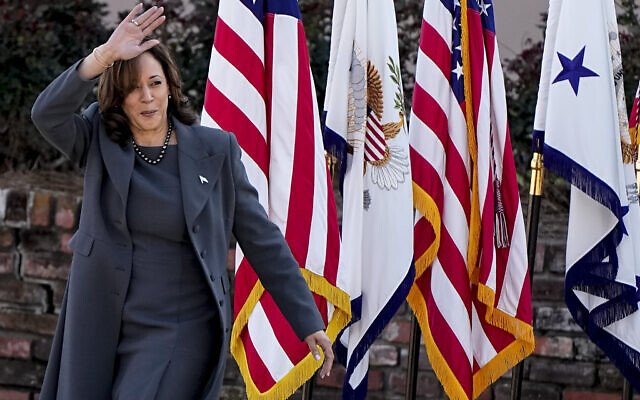
Israel would eventually agree to significantly amend its plans for invading the Hamas-stronghold of Rafah amid US pressure, allowing Palestinian civilians to evacuate before launching the operation.
“You think I’m Santa Claus?”
Around this time, the US decided to abstain on a UN Security Council resolution calling for a ceasefire during the Muslim holy month of Ramadan, allowing it to pass. The resolution also called for the release of the hostages, but did not explicitly link the two, and Israel fumed over its passing. McGurk says Netanyahu’s top aide Ron Dermer phoned him to ask why the US was treating Israel like a “dishrag.”
“While Dermer’s rhetoric was overheated, he was not wrong that Hamas saw the UN resolution as a strategic opening to strengthen its position,” McGurk writes.
Before the Rafah offensive began, Israel carried out an airstrike that killed seven aid workers from the World Central Kitchen. While Jerusalem insisted that the attack hadn’t been intentional, it sparked widespread international condemnation and fury in Washington.
McGurk recalls the phone call that Biden held with Netanyahu shortly after the strike.
“’Bibi, man, what the fuck are you doing?… You think I’m Santa Claus? No Santa in Israel, pal,'” McGurk quotes Biden as having said.
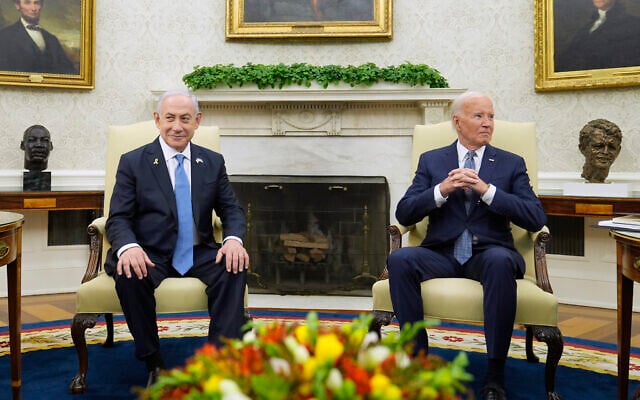
“When Netanyahu asked what he meant, Biden said he could cut off military aid to Israel with the snap of a finger, leaving the country on its own,” McGurk writes.
“Netanyahu retorted that Israel would defend itself even without the United States. We later learned that he concluded from this call that we were cutting military supplies,” he adds.
While the US did end up withholding one shipment of 2,000-lb (900-kg) bombs, all other aid continued through the end of Biden’s term.
A year later, after Biden had left office, Israel’s then-Shin Bet chief Ronen Bar met with a group of former Biden aides in Washington and was asked what the Democratic administration could have done differently in the hostage talks.
McGurk writes that “Bar pointed to this period in spring 2024, when Biden was said to be blocking Israel’s operation in Rafah. From Bar’s vantage point, that perception had hardened Hamas’s position, making it more difficult to free the hostages and end the war. ‘That was your biggest mistake.'”

Harris aide hits back at McGurk’s framing
Responding to the piece, Harris’s former national security adviser Phil Gordon took issue with McGurk’s assessment, including the latter’s apparent effort to place some blame on the former vice president.
“Harris was hardly the only US official to warn, publicly and privately, that an Israeli assault on Rafah would be a ‘huge mistake’ with potential ‘consequences.’ Biden had by then already called it a ‘red line’ and later went on CNN to threaten to withhold offensive weapons over it,” Gordon wrote on X. “And he was right to do so to prevent Israel from launching a ground offensive without a plan for the more than one million civilians sheltering there.
“It is implausible that a US green light would have unlocked a favorable hostage offer from Hamas, which made no such offer even after Israel went into Rafah (or for eight months after that) or that Netanyahu would have agreed to end the war with Sinwar still alive. Whatever the administration’s ‘biggest mistakes,’ pressing Israel to change its Rafah plans was not among them,” Gordon added.
Iran’s retaliation shielded Israel from US measures
On the same day as Israel’s accidental strike on the World Central Kitchen aid workers, on April 1, 2024, the IDF carried out another attack targeting top officials from Iran’s Islamic Revolutionary Guard Corps.
The IRGC officials were located in an Iranian consulate building in Damascus, and Tehran pledged to retaliate.
“If not for the pending Iranian attack, the US might have taken irreversible measures against Israel at this juncture,” McGurk writes.

“We all wanted the war to end. It was a sickening horror in every dimension. Was the means to that end the hostage and ceasefire deal—the course we had been on—or simply telling Israel to stop, even as it was under attack on multiple fronts?” he wonders. “If there was a better way to end the crisis, Biden would have taken it. He had tried a UN resolution calling for an unconditional ceasefire. He had tried increasing public pressure. Those steps only seemed to make the situation worse.”
He goes on to detail a dramatic meeting in the White House Situation Room where Biden and his aides gathered to monitor Iran’s retaliatory launch of hundreds of missiles and drones at Israel, which were almost entirely thwarted, thanks to US military support.
Biden then deliberated over what he would say to Netanyahu in a subsequent phone call.
“’Does he know we just saved his ass?’ Biden asked,” McGurk writes. “This was the first time the US military—let alone the US military together with a coalition of European and Arab countries—had fought to defend Israel.”
Biden would go on to tell Netanyahu to “take the win,” and respond in a manner that would deter Iran, rather than invite further escalation.
Netanyahu ultimately agreed, and a major expansion of the conflict was averted.
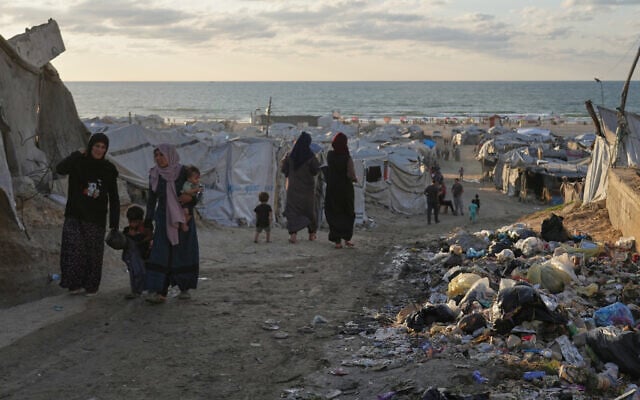
At the end of May 2024, the US quietly secured Netanyahu’s support for a phased ceasefire proposal, and Biden decided to go public with its terms to try and corner Jerusalem from backing out of them.
But talks with Hamas dragged on for months, with Biden officials blaming both Hamas and Netanyahu for staking positions at various points that suggested a prioritization of staying in power over ending the war.
A deal was ultimately reached in January 2025, with McGurk teaming up with aides from the incoming administration headed by Donald Trump, along with mediators from Egypt, Turkey and Qatar, to coax Israel and Hamas to get on board. That truce saw the return of 25 living Israeli hostages and eight deceased ones.
The agreement fell apart after six weeks, but another ceasefire was reached in October 2025 that secured the release of all remaining hostages and sought to pave the way to ending the conflict. But that process has subsequently stalled, amid Israeli opposition to its proposed gradual framework for disarming Hamas.
KioskNews shows a cleaned-up reading view extracted from the publisher’s page — the original always lives on their site, not ours.