Indian scientists first to prove ‘quantum measure’ can exceed 1
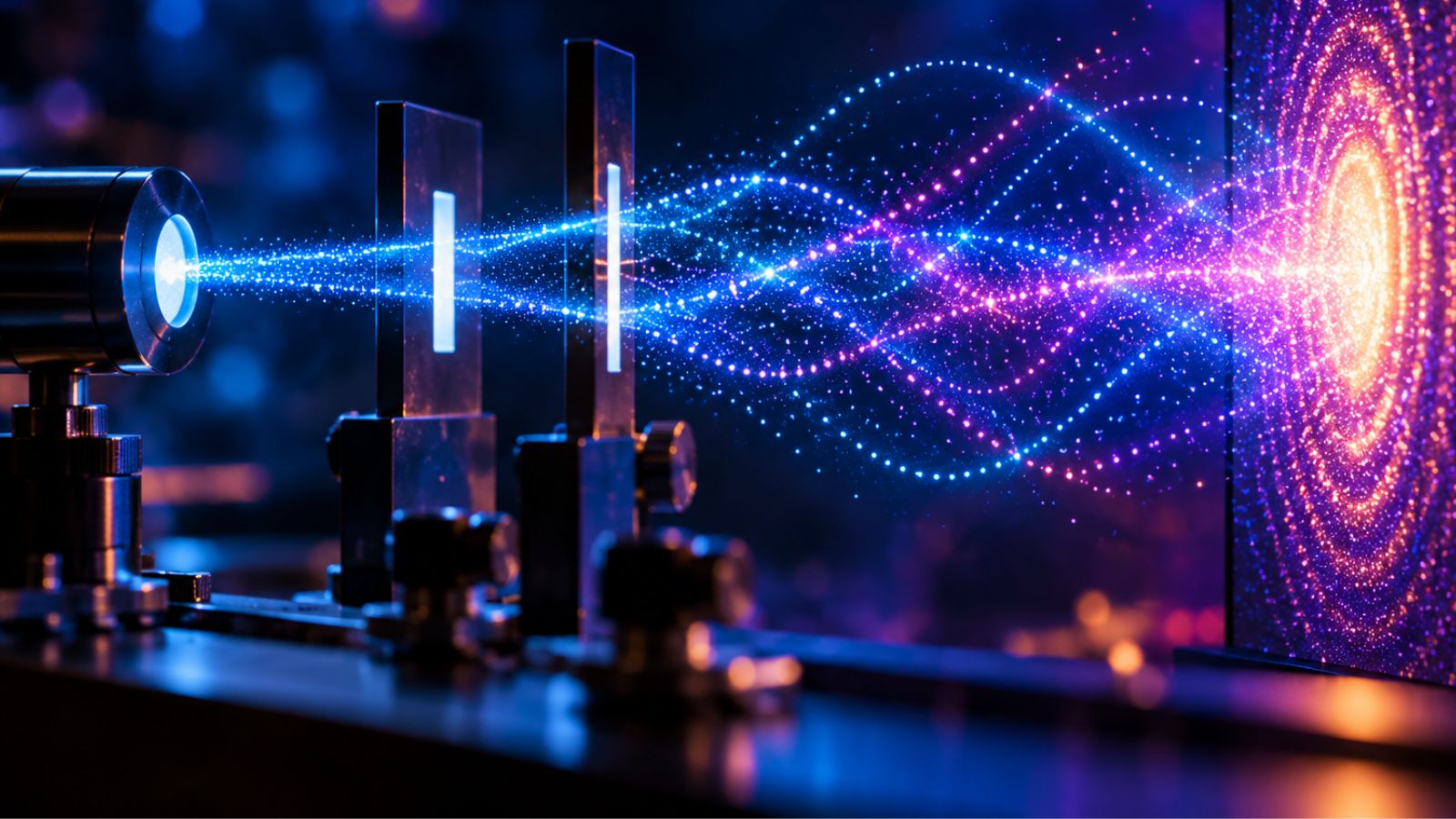
Raman Research Institute scientists experimentally recorded a quantum measure of 1.17, validating a theoretical prediction (Image generated using AI).
A group of Indian scientists has experimentally demonstrated, for the first time, that a quantity called ‘quantum measure’, which describes a set of possible paths a quantum entity like a light particle can take to reach a detector, can indeed exceed one.
This breakthrough by scientists at the Bengaluru-based Raman Research Institute (RRI) is the first experimental verification of a long-understood theoretical concept. This work, by Sanchari Chakraborti, then a PhD student at RRI, and conducted under the supervision of Urbasi Sinha, was published in the journal Quantum last month.
In our everyday world, the probability of any particle taking a particular route to reach its destination cannot exceed one, or 100 per cent. However, in the quantum world of very tiny particles, where their behaviour routinely defies everyday intuition, this is possible. ‘Quantum measure’ is the quantum world analogue of probability. Like many other quantum phenomena, ‘quantum measure’ is also affected by the strange properties of very small particles and leads to unexpected results.
Quantum mechanics is usually described in terms of a system’s state at a particular time and the outcomes obtained when we measure it. A complementary viewpoint is to describe a quantum system through its possible histories, meaning the different ways it can evolve between preparation and detection or the path that the photon could take in an experiment from a laser to a detector, a statement by RRI said.
Quantum Measure Theory assigns a generalised measure to sets of such histories, incorporating the interference between them. Unlike an ordinary probability, this quantum measure can exceed one, it said. But this is difficult to assess experimentally since these sets of histories, or the different possible pathways, do not necessarily correspond to a sequence of ordinary measurements.
The scientists at RRI built an ingenious experimental set-up to study this and successfully recorded the first-ever greater-than-one quantum measure. They measured a quantum measure of 1.17, which agreed with the theoretical calculation of 1.18 for the specific conditions they chose.
The greater-than-one quantum measure is possible because the multiple pathways a quantum particle can take can interfere with each other like waves. Just as overlapping wave crests can create a bigger wave, interference among these multiple pathways can lead to a situation where the quantum measure exceeds one.
Story continues below this ad
Sorkin’s theory validated
The experiment was carried out in collaboration with theoretical physicist Rafael Sorkin, who is credited with developing Quantum Measure Theory during his search for a theory of quantum gravity. Sorkin, a researcher emeritus at Canada’s Perimeter Institute of Theoretical Physics, where he worked for more than two decades, died on September 12, shortly after this work, on which he is a co-author, was accepted for publication. Sorkin was also a distinguished visiting faculty member at RRI.
“This paper means a great deal to me personally as well as scientifically,” said Sinha, group leader of the Quantum Information and Computing (QuIC) laboratory at RRI.
KioskNews shows a cleaned-up reading view extracted from the publisher’s page — the original always lives on their site, not ours.