Manchester City’s guilty verdict brings football’s great sell-off crashing to earth
It was somehow fitting that Tuesday’s damning ruling against Manchester City landed in the heart of the Labour party conference, in the afterglow of Andy Burnham’s rapturously received prime minister’s speech.
I was there, and read the astonishing 40 pages of findings – that City created “sham” contracts to boost income artificially by £900m – on my phone during a long meeting of the Socialist Campaign Group, where people were celebrating Keir Starmer’s ousting and Burnham’s more leftwing direction.
At the core of Burnham’s speech was the wrong turn he says Britain took under Margaret Thatcher in the 1980s, selling off and privatising council housing, water, energy, transport and care. “We built the common good,” he said, but “the common wealth … created for the many was seen as an opportunity for the few.”
He could have been talking about football, too. Where Manchester City have ended up, having been bought by Sheikh Mansour of the Abu Dhabi ruling family in 2008, is a culmination of decades in which “the people’s game” has been carved up for profits. Clubs like City, formed in the Victorian smog of industry by churches, schools and workplaces, then built by generations of supporters into powerful homes of belonging, were sold off just when football finally had enough wealth to go round.
I investigated and reported on that financial carve up in my early years of journalism, and Burnham worked on it too, at the start of his political career, as the administrator of New Labour’s football taskforce.
My 1997 book, The Football Business, in which I likened football’s commercialisation to Thatcher’s privatisations, chimed with many supporters’ groups campaigning against rocketing ticket prices, exclusive pay-TV deals, and the drawbridge the newly mega-rich Premier League had pulled up behind it.
My moment of clarity had come at Manchester City, reporting on an earlier takeover, in 1994 by a beloved former player, Francis “Franny” Lee. I grew up in Manchester and from as early as I could answer the challenge – “which club do you support?” – it was always City for me. My dad took me, fast-walking, hand-in-hand, to big matches in the 1970s, floodlit glory nights of my boyhood. I have always loved the colour blue, especially sky blue, and have never really worn anything red in my life.
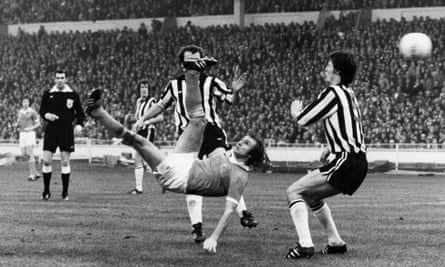
For supporters of my generation, the only trophy City won was the 1976 League Cup, claimed with a wondrous overhead “bicycle” kick goal by our winger, Dennis Tueart. I like art as much as the next ignoramus, but the photograph of Tueart’s goal must be the picture I have gazed at more than any other: the perfection of it, Tueart’s straight back in mid-air, arcing the ball behind him into the Wembley net, Newcastle’s opposition defenders frozen in time for ever.
But unlike Manchester United, Liverpool and Arsenal, City never had a period of sustained success. They compressed a golden age into two years, 1968-70, and soon after that League Cup triumph, they were relegated, in 1983. For years, while City fans became celebrated for their loyalty and sod-it humour – taking bananas and other inflatables to matches – there always remained a mournful yearning for success to return.
When Lee finally took City over, acclaimed by all supporters, it seemed like deliverance. As a fan in the old Maine Road stadium, I cheered him on Saturday, then as a journalist on Monday I pestered for an interview. They agreed, and I was escorted behind the scenes, along some threadbare corridors into the chairman’s office, where Franny sat glowing behind the desk.
Everybody involved was so delighted to have pulled it off that they shared details quite gleefully. And that was when I first understood that Manchester City wasn’t a club at all. It was a company, with “owners”, and this had been a corporate acquisition. Franny was one of many other business people, a consortium, who had bought the shares.
Later, one of the lawyers proudly showed me some corporate engineering they had done. They had formed a holding company, Manchester City plc, that would own the old football club company.
The new millions from Rupert Murdoch’s Sky TV had poured into the Premier League, a breakaway in 1992 by the top clubs from sharing TV money with the clubs in the other three divisions of the Football League. This boosted the value of the top club-companies, and the new consortium planned to float City on the stock exchange, like Manchester United and others, where ultimately their shares could then be sold at a profit.
I learned that holding companies were formed to bypass the longstanding rules of the Football Association – the game’s governing body – that restricted shareholders being paid dividends, and directors a salary. The FA imposed those at the dawn of professional football in 1892, allowing clubs to form limited liability companies, but limiting the personal money shareholders could make.
This was to retain the collective, service ethos of a club. A century on, the rules were still in the FA’s handbook, at No 34. To the relatively small but formidable core of people who really care about these principles, “rule 34” became totemic of football’s sell-off, surrendered to enable vast personal gains by investors. That was now deemed antiquated, blazers’ bureaucracy that must not restrain football’s new business dynamism. To me, it was all a gut punch.
This critique was put forcefully to Labour’s football taskforce, with calls by the Football Supporters’ Association for strong regulation to harness the benefits of the new era. Fans understood that German football’s response to the pay TV transformation was to permit corporate reorganisations, but require clubs to be controlled “50% plus one” by mutual supporters associations.
New Labour was never going to introduce a football regulator or major reforms, but Burnham worked hard for concrete improvements.
The Premier League agreed to distribute 5% of its TV deal to improving desolate grassroots playing facilities via a new grant-giving body, the Football Foundation, which has been transformative. Burnham also championed mutual fan ownership of clubs, helping to establish an organisation, Supporters Direct, to promote it.
But the impossible cost for fans of buying and sustaining their clubs has meant over the years that few are mutually owned. The Premier League roared on, and the sell-offs became more corporate. Some original shareholders made fortunes selling, mostly to US investors: about £90m by Martin Edwards at Manchester United; £90m by the Littlewoods pools heir David Moores for selling his Liverpool shares.
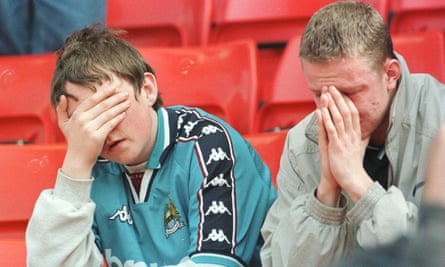
Lee and his consortium never managed it, though, and City were relegated to football’s third tier in 1998. Famously he said City would have won a room full of trophies “if cups were awarded for cock-ups”.
Mansour’s acquisition of Manchester City 10 years later can be seen as the pure essence of “Manchesterism” – spending public money on cultural assets and infrastructure to attract business investors – long before Burnham became mayor of Greater Manchester in 2017 and coined that word this year. The splendid new stadium was built for the 2002 Commonwealth Games with £127m from Manchester city council and the national lottery, the council spending £22m on removing the athletics track and conversion for City to move in. The plan was part of the regeneration of east Manchester, where industry had cranked and smoked, then died in the 1980s.
The council leaders could hardly have imagined that cups-for-cock-ups Manchester City would then attract one of the world’s richest buyers, and the oil wealth of the Gulf. But the Premier League’s global ubiquity, the new stadium and the loyal City crowd all added up for Abu Dhabi.
If you set aside the glaring concerns about the ruler of a country taking over a local heritage football club, the human rights and geopolitical complications that introduces, and the central dissonance of clubs being owned by investors at all, Mansour has been a dream for Manchester. He has poured billions into the club, to attract, buy and pay the world’s best players and the best manager, Pep Guardiola.
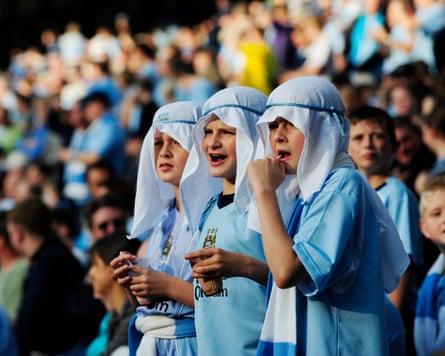
His new corporate regime expanded the stadium – named Etihad under a sponsorship deal with the Abu Dhabi state airline, which has now complained that the Premier League’s communication of the commission’s findings has created “damaging implications” for it.
As Burnham acknowledged this week when he described the Abu Dhabi ownership as “a huge partner in the building of modern Manchester”, and gave thanks for the money put in, they have also invested in property development, converting long-derelict mills into apartments for young professionals Manchester was seeking to attract.
The dizzying findings of financial cheating were finally delivered this week from a Premier League investigation process that took eight years, which City repeatedly tried to block. City will appeal, and claim, as they have throughout, that they have “irrefutable evidence” disproving the findings of the three-person commission, which took almost two years.
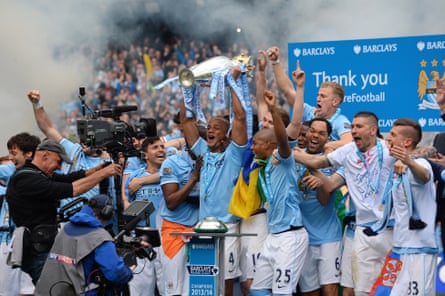
At the core of Mansour’s ownership has been a ruthless determination not just to make his Premier League acquisition competitive, but to attain total domination. Before 2008, in 116 years of professional football, City only won the old First Division championship twice.
Mansour’s regime has secured the Premier League eight times so far, four FA Cup victories, and the pinnacle, the Champions League, in 2023. The League Cup, so rare and special to my generation, has been brought back from Wembley seven times.
Burnham has boldly broken with accepting Thatcher’s great sell-offs, saying they produced today’s fractures.
As he left the stage to applause and acclaim, football’s great sell-off was crashing to earth.
KioskNews shows a cleaned-up reading view extracted from the publisher’s page — the original always lives on their site, not ours.