Spain goes to the polls as right-wing bloc eyes victory
This story in 20 other countries →- Spaniards head to the polls in snap election on Sunday
- Opinion polls point to change in government
- Prime Minister Pedro Sanchez could lose power after 8 years
- Alberto Nunez Feijoo's People's Party (PP) leads polls
- PP would likely need support from far-right Vox party to form government
Follow along for the latest news regarding Spain's snap election on November 29, 2026:
Skip next section Polls open in Spain's snap electionPolls open in Spain's snap election
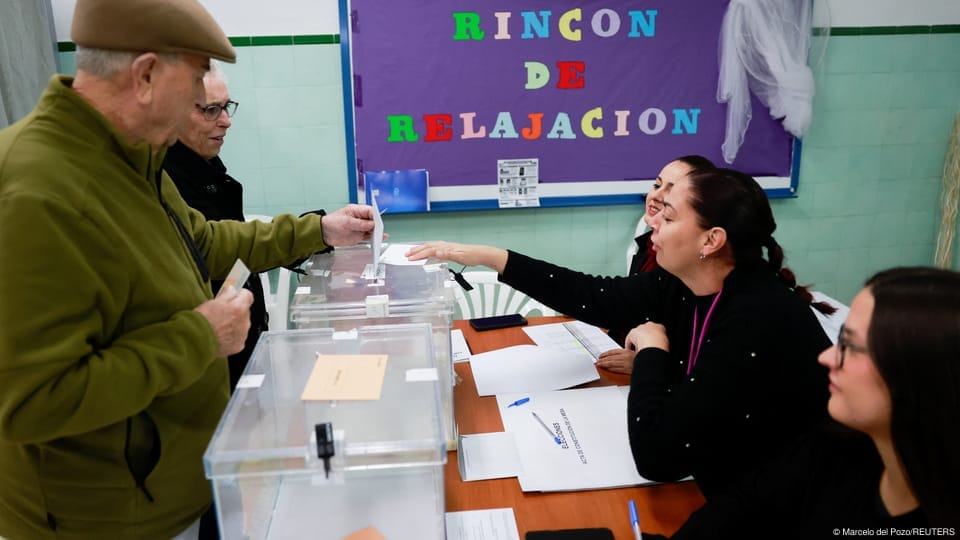
It is 9 a.m. (0800 GMT) in Spain, meaning polls have opened and voters can begin casting their votes to decide on whether Pedro Sanchez will extend his eight years in power, or whether a coalition of right and far-right parties takes control.
Polls will remain open until 8 p.m., with almost 36 million people eligible to vote across almost 22,500 polling stations.
The first results will start coming in shortly after and it is expected that we will have a good idea of the outcome before midnight.
Edited by:Kieran Burke
https://p.dw.com/p/5Q2tj
Skip next section Spain elections: What are the main issues?31 minutes ago
Spain elections: What are the main issues?
Spain's election matters because it could bring an end to Pedro Sanchez's leftist leadership at a time when right-wing populist parties have gained traction in Europe.
The elections are also the first in a round of elections across the continent through next year, including in Poland and France.
Here's what's on voters' minds ahead of the election.
Housing
There's perhaps no other issue that has concerned Spaniards more than unaffordable housing.
Economic growth and an expanding labor market have driven a boom in demand for additional housing in metropolitan areas and tourist regions.
But new construction remains stuck near levels seen in previous decades and wages haven't kept up.
Rental and home costs have soared, and voters said it's their top concern for over a year, according to the state pollster CIS.
Sanchez aimed to capitalize on the frustration when he called early elections last month, hoping to frame the race around affordability issues.
Both Sanchez and his main opponent, conservative Popular Party leader Alberto Nunez Feijoo, have promised to enact measures to help first-time homebuyers if elected, and improve conditions for renters.
Immigration
Sanchez's immigration-friendly policies have made the 54-year-old leader an outlier in Europe amid a rise in far-right populism and anti-immigration sentiment.
Spain has taken in millions of people from Latin America and Africa, and Sanchez has defended his government's stance by citing the country's economic boom having been spurred by those who have legally entered the workforce.
Feijoo and Santiago Abascal, the leader of the far-right Vox party that would likely join the PP in a coalition government, have advocated for tougher immigration policies.
Feijoo has promised stronger border management, while Abascal favors a much stricter approach, with Vox having advocated for mass deportations.
Spain offers legal status to migrants
05:02
Corruption
Sanchez's latest term has been overshadowed by numerous corruption investigations involving people in his inner circle and family.
Those legal cases have implicated a former minister and top officials as well as Sanchez's brother and wife — who denies wrongdoing.
Sanchez has linked the cases against his family to a smear campaign but has apologized for proven corruption cases involving his former cohorts.
Voters list corruption and bad behavior by politicians as a concern, but they factor lower than affordability issues, working conditions and immigration, according to the CIS survey.
Spain's Sanchez mounts charm offensive ahead of snap election
04:28
Train safety
Two fatal train accidents this year on Spain's extensive high-speed rail network have put safety issues at the center of the election.
Sanchez, whose transport minister resigned after the second crash, has stressed to voters that the right-wing government would cut social spending, which is necessary to maintain public services and the rail network.
Feijoo has excoriated Sanchez's record, vowing to "return quality to public services."
Spain's vast train network has been a source of pride for Spaniards, but accidents this year have raised greater questions about Spain's aging infrastructure.
Climate
Spain is highly exposed to natural disasters that are affected by climate change, including ferocious forest fires, long-term drought, and sometimes deadly flash floods.
The country is also a leader in renewable energy, generating more than half its electricity from non-carbon sources, mainly from solar and wind.
Under Sanchez, Spain's government has pledged to generate all its energy from renewable sources by 2050 and to shut down the country's remaining nuclear reactors by 2035.
Feijoo said he would "realistically reformulate" Spain's climate commitments, while keeping nuclear power in the mix with renewables, energy storage and sufficient backup capacity.
Vox, like other far-right parties, has pushed climate skepticism.
New heat wave could worsen France, Spain fires
02:02
Edited by:Sean Sinico
https://p.dw.com/p/5Q2n4
Skip next section Spain elections: Who are the top candidates and what are the top parties?32 minutes ago
Spain elections: Who are the top candidates and what are the top parties?
Pedro Sanchez (PSOE)
Prime Minister Pedro Sanchez first came to power in 2018, making him one of Europe's longest-serving leaders.
He called early elections after parliament rejected his minority Socialists (PSOE) government's decrees that sought to address growing anger about rising rents.
Sanchez hopes that the prospect of the far right entering parliament will mobilize left-leaning voters.
He has denied wrongdoing in corruption investigations involving members of his inner circle and family.
Alberto Nunez Feijoo (PP)
Alberto Nunez Feijoo of the People's Party is a lifelong civil servant-turned-politician who has avoided scandals and projects himself as a sensible center-right administrator.
Feijoo, the former president of Galicia, has led the People's Party since April 2022.
The PP won the most seats in the 2023 electionbut fell short of the majority needed to form a government.
Polls put it ahead of the Socialists, though it will possibly need to govern in a coalition with the far-right anti-immigration Vox party.
Its manifesto promises tax cuts, tighter borders and a slower climate transition plan.
Santiago Abascal (Vox)
Santiago Abascal co-founded Vox in 2014 after building his profile in the Basque Country opposing separatism as a legislator for the PP in the regional parliament.
The party has become Spain's third-largest, advocating tougher immigration control, recentralization of state powers and lower taxes.
Opinion polls suggest that a PP government would depend on Vox, potentially giving a far-right party a Cabinet role for the first time since right-wing dictator Francisco Franco's death in 1975.
Ada Colau (Frente Amplio)
The former Barcelona mayor leads the Broad Front, a new platform that replaces Sumar, the leftist coalition partner in Sanchez's last government.
Talks on a joint list with Podemos, led by former Equality Minister Irene Montero, collapsed in October, leaving the left to run on separate tickets.
Edited by:Sean Sinico
https://p.dw.com/p/5Q2m6
Skip next section Welcome to our blog32 minutes ago
Welcome to our blog
Spaniards are heading to the polls Sunday morning in a general election that could spell the end of Prime Minister Pedro Sanchez's Socialist government.
Sanchez beat the odds in 2023 and formed a minority government.
He called for early elections in October after parliament rejected a series of housing measures that came after his government was confronted with public anger over rising rents.
Sanchez hoped early elections would hand his Socialist Party a parliamentary majority, but opinion polls say that a right-wing bloc might take the reins this time.
There's also a possibility of a hung parliament where neither the right coalition nor the left bloc win an absolute majority.
We'll have the latest in the blog, thank you for joining us.
KioskNews shows a cleaned-up reading view extracted from the publisher’s page — the original always lives on their site, not ours.