[Vantage Point] DBP’s bad loans: The failures behind the billions

- The Commission on Audit (COA) has identified significant deficiencies in the Development Bank of the Philippines' (DBP) lending practices, leading to a rise in non-performing loans from P42.68 billion in 2024 to P46.50 billion in 2025, and a nearly 43% drop in net income.
- COA's audit revealed systemic failures in loan administration, including inadequate collateral verification and sluggish recovery measures, which have raised concerns about DBP's financial resilience and accountability.
- The ICONS program, intended to support government infrastructure projects, has become a financial liability with a significant portion of its loans overdue, highlighting mismanagement and the need for urgent reforms within DBP.
This is AI-generated. Read the article for full context. Report any errors.
Following Vantage Point’s exposé earlier this year on the Development Bank of the Philippines’ P36.21-billion non-performing loan portfolio, the Commission on Audit (COA) has uncovered serious deficiencies in the state-owned bank’s lending practices, credit safeguards and recovery procedures. With gross bad loans swelling to P46.50 billion and net income plunging by nearly 43%, COA’s 2025 audit reveals how weaknesses in credit administration, delayed collections and questionable loan-loss estimates have placed mounting pressure on DBP’s profitability, financial resilience and stewardship of public funds.
When Vantage Point exposed the Development Bank of the Philippines’ (DBP) P36.21-billion non-performing loan portfolio last January, the underlying concern extended far beyond the identities of delinquent borrowers.
The fundamental question was how a government-owned development institution could amass billions in troubled loans without triggering immediate alarms regarding its credit discipline, financial resilience, and internal accountability.
Now, the Commission on Audit’s (COA) newly obtained 2025 Annual Audit Report provides disturbing answers to those exact concerns. According to the government’s own auditors, the bank suffers from documented deficiencies in loan releases, inadequate collateral verification, sluggish recovery measures, and an outdated expected-credit-loss model.
The financial consequences of these operational shortcomings are unmistakable. DBP’s parent-bank gross non-performing loans escalated significantly, rising from P42.68 billion in 2024 to P46.50 billion in 2025.
To absorb this, its allowance against non-performing loans jumped from P23.03 billion to P33.49 billion. Consequently, the bank’s net income plunged by 42.9%, dropping from P7.30 billion to P4.17 billion. Put simply, while DBP technically remained profitable, its rapidly deteriorating credit quality took a heavy toll on its overall earnings.
The initial investigation scrutinized P36,208,917,505.63 in non-performing exposures across 442 businesses and individual borrowers. Among the largest exposures were Premium Megastructures Inc. with P3.4 billion, Manuel and Theresa Chua with P3.31 billion, Dennis Uy‘s Phoenix Petroleum Philippines Inc. with P2.93 billion, and Megaship Builders Inc. with P2.4 billion. Combined, these four accounts represented approximately one-third of the entire troubled portfolio examined.
While COA’s audit anonymized its sampled borrowers—meaning no direct documentary link has been formally established between these specific named accounts and the latest audit cases—the newly documented systemic failures substantially confirm our January exposé. The core issue was whether DBP’s internal systems for evaluating, monitoring, and recovering funds were robust enough to safeguard the public interest.
ICONS program
This systemic vulnerability is most vividly illustrated by COA’s examination of the Infrastructure Contractor Support (ICONS) program. Launched in 2017 to finance contractors for the government’s Build, Build, Build initiative, the program devolved into a financial liability.
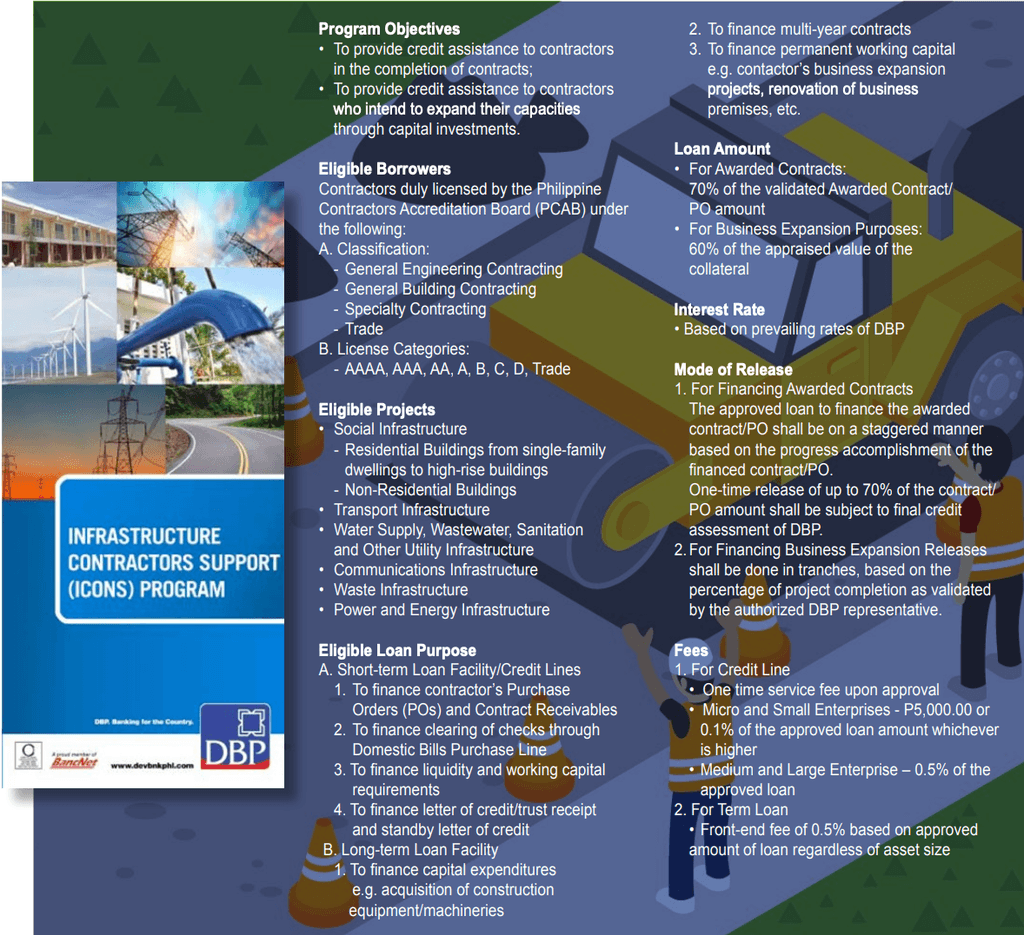
By December 31, 2025, ICONS carried P6.67 billion in outstanding loans. Alarmingly, P4.09 billion—or approximately 61.4% of that portfolio—was already past due. For every P10 outstanding, more than P6 was overdue, representing a troubling outcome for a program supposedly anchored by secure government infrastructure contracts.
COA’s deep dive into specific loans reveals exactly how these funds were mismanaged. Auditors examined a P300-million corporate loan approved in August 2019, where funds were released against assigned receivables from government projects.
However, releases bypassed progress-based disbursement rules, and actual project accomplishments were never properly verified before the capital was deployed. The borrower ceased payments in June 2020, and several of the underlying projects were eventually terminated for delays.
More than five years after default, the P300-million principal remains unpaid, forcing DBP to provide a 100% allowance against the exposure. Similarly, a P490.46-million loan account revealed that the underlying security projects were completed between 2017 and 2021, yet the debt remained unsettled. Auditors discovered the borrower had aggressively subcontracted the work, retaining an actual economic interest of only 3.5%, raising questions about how DBP assessed the borrower’s repayment cash flows.
Recovery efforts were equally flawed. One P97.24-million loan defaulted in June 2021, yet the first recorded demand notice was not issued until July 2025 after passing through six different account officers, undermining accountability. Another P82.21-million exposure languished waiting for foreclosure proceedings simply because the lending center lacked a full-time lawyer.
Most concerning is that DBP’s board was aware of these mounting issues. Under Resolution No. 0044, dated January 19, 2022, the board instructed units to investigate the 20 largest non-performing loans. Yet, it took more than four years for the board to officially terminate the ICONS program on June 3, 2026. COA has now recommended investigating potential negligence among officers, prompting DBP’s Management Committee to direct its Legal Services Group to conduct an inquiry.
Furthermore, COA discovered that DBP’s P49.88-billion allowance for credit losses relied on an expected-credit-loss model that was not properly recalibrated to current observable data, violating Philippine Financial Reporting Standard 9.
Expected-credit-loss models dictate how much a bank must recognize today against loans that may not be recovered tomorrow, relying heavily on probabilities of default and collateral values.
When uncalibrated, the reported allowances may fail to reflect prevailing risks. Consequently, auditors stated that the faithful representation of the bank’s P491.42-billion net loans balance and P12.52-billion impairment expense could not be established.
While DBP’s gross loan portfolio remained static at roughly P536.69 billion, its allowance surged by P11.78 billion. Concurrently, the appraised value of collateral held against impaired loans plummeted by P39.62 billion, dropping from P104.17 billion in 2024 to just P64.55 billion in 2025.
Although DBP maintains financial soundness with an 11.22% capital adequacy ratio and an unmodified audit opinion, regulatory capital compliance does not eliminate the necessity to fix costly internal control weaknesses.
The fact that 25 of COA’s 38 previous audit recommendations remained unimplemented by December 2025 underscores a sluggish approach to structural reform.
These findings firmly vindicate the demand for a transparent, independent asset-quality review and a serious reconsideration of merging DBP with LandBank to consolidate risk oversight. Public confidence in a development institution must be earned through disciplined lending, transparent accounting, and decisive accountability when financial safeguards inevitably fail. – Rappler.com
Documentary basis: DBP’s 2025 COA Annual Audit Report, particularly printed pages 6, 50–57, 76–79, 91–94, 102–103 and 158–164. The named borrower exposures derive from Vantage Point’s earlier investigation, not from COA’s anonymized ICONS findings. The audit’s unmodified opinion and unresolved recommendations are recorded in its executive summary.
KioskNews shows a cleaned-up reading view extracted from the publisher’s page — the original always lives on their site, not ours.