As King Charles visits the Caribbean, is the reparations movement approaching a tipping point?
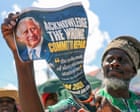
The sun is starting to set in the Bahamas and the loud wash of the tide, which is always audible on Nassau’s Western Esplanade, is beginning to be drowned out by the sound of excited screams. King Charles is visiting the Caribbean archipelago, for which he is still the head of state, for the first time in more than 50 years and a youth rally attended by schoolchildren makes for a particularly welcoming crowd.
Some have described the king’s nine-day tour of the Bahamas, Antigua and Guyana amid growing calls for reparations as a significant risk that may accelerate his removal as head of state from the six remaining Caribbean Commonwealth countries in which he still serves.
King Charles was in the Bahamas before travelling to Antigua for the Commonwealth Heads of Government meeting (Chogm), which is usually a collegial gathering of leaders, but has only just managed to keep enslavement and reparations off the formal agenda.
As the summit gets under way today, the prime minister, Andy Burnham, will begin talks about a formal apology with countries affected by Britain’s role in transatlantic enslavement.
Those talks will include plans for a “debt reset” for Commonwealth countries facing higher costs on their debts.
Writing last week in the Guardian, Burnham indicated he is open to the possibility of a formal apology, going further than any UK prime minister has before. However, he rejected demands for financial reparations, saying that British people cannot be held liable for what “happened in a different age under different laws and in which they played no personal part”.
Fresh from his trip to the Bahamas, the king is expected to speak with “unflinching honesty” and “sincere sorrow” on the lasting pain of the transatlantic trafficking of African people as he opens the summit.
‘The noise is getting louder and louder’
Given the mounting pressure before the summit, the fanatical atmosphere in Nassau may be a surprise, and a relief. “It’s a celebrity effect, isn’t it?” says the Guardian’s Caribbean correspondent, Natricia Duncan. “Shaking the king of England’s hand – that’s something that they will remember for ever.”
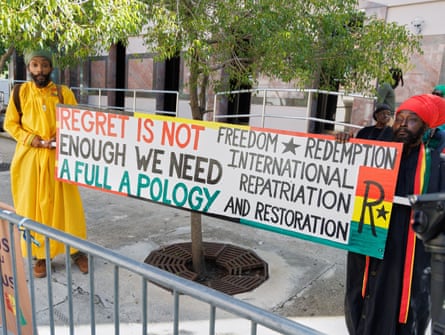
Still, beneath the sheen and structure of organised royal engagements, Natricia tells me that something has shifted. The venue, Clifford Park, marks the site where the country officially gained its independence from British colonial rule in 1973, and on a sandy stretch of the Esplanade opposite called Fish Fry, a small but visible group of protesters pick up the mantle. Their colourful signs read “pay us what you owe us”, and “reparation, repatriation, restoration is a must now”.
Sharon Purser-Cooper, who attended the protest organised by the Rastafari organisation Ethiopia Africa Black International Congress, tells me that she will not name an abstract figure for reparations; rather, she wants to see investment in healthcare, education, agriculture and infrastructure.
Like many, Purser-Cooper wants a formal apology.
“We are demanding an apology from England, and, by extension, all of the 52 countries that abstained from the vote to apologise to the people whose ancestors they slaughtered, raped and plundered,” she tells me.
The UK and EU members were among those that did not vote in March on the UN resolution to describe the transatlantic chattel slave trade as the “gravest crime against humanity” and call for reparations as “a concrete step towards remedying historical wrongs”. Purser-Cooper says: “We are not begging for anything, we are making a demand.”
Protests are not a new occurrence during Caribbean royal tours, Natricia tells me, with calls for reparations after the then Duke and Duchess of Cambridge to Belize, Jamaica and the Bahamas during Queen Elizabeth II’s platinum jubilee visit in 2022. “But now we have a call coming from the centre of politics, from government, from civil society, from academics. And it’s more organised. The noise is getting louder and louder, and much harder to ignore.”
The UN motion is not the only significant development in the reparations movement in the past 12 months. In September, the king referred a petition to a high-level UK appeals court for legal advice, after pressure from a delegation of Jamaican politicians. The petition, which will be heard by the privy council in March, seeks guidance on three questions: whether the forced transport of Africans to Jamaica was lawful; whether it constituted a crime against humanity; and whether Britain is under an obligation to provide restitution for slavery and its enduring consequences.
Still, many see the prospect of reparations as an impossibly abstract demand. The Bahamians that I speak to broadly express apathy towards the king, or mild disgruntlement at the cost of the visit. The campaigners see their task as to make things concrete. Natricia tells me: “In the Bahamas, there have been recent devastating hurricanes. Imagine you’re a mum in Trinidad or Barbados: you have bills to pay, you have your child going to school, the cost of living and other challenges. Top of your mind is going to be about providing for your family and your health.”
While the cost of this year’s trip is unconfirmed, the Duke and Duchess of Cambridge’s 2022 visit cost the Bahamas $636,000 (£505,620). The Caribbean might ask if there is something else that could be done with that money.
I ask Natricia if this Caribbean tour represents a tipping point for the reparations movement and if so, why at this moment in history? “If you asked me about this a year ago, I would have a very different answer,” Natricia tells me. “I am still really in awe of what has happened in the last year … The Rastafarian movement started this call, and they often make the point that initially, they were considered as being on the fringes.”
But things can change quickly. “You’re talking about really young countries,” Natricia says. “Where I come from, St Vincent and the Grenadines, we got our independence in 1979, around the same time as most Caribbean countries. You almost have to start from there in terms of defining who you are as a nation, bearing in mind that slavery and colonisation has taken so much away from people in terms of their identity.”
Either way, the conversation has begun. The very fact that the monarchy and British party leaders have been pushed to make statements on reparations and a formal apology looks like a possibility, signals a shift in the parameters of the debate. “The more they resist, I think, the more insistent people will become,” Natricia says. “This is not going away.”
Editor’s picks
-
‘Reparations now’: King and Burnham face protests at Antigua Commonwealth summit | Natricia Duncan
-
Barack Obama pays tribute to Manchester cotton workers and cites them as an inspiration | Chris Osuh
Regional spotlight
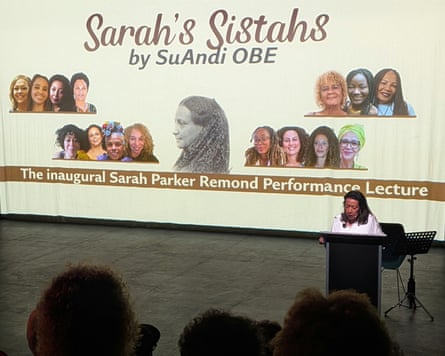
Manchester | The inaugural Sarah Parker Remond lecture, presented by Manchester arts charity SICK! Productions and Manchester City Galleries, has launched an annual commitment to celebrating global majority women whose leadership, creativity and activism has shaped Manchester.
after newsletter promotion
The acclaimed performance poet, writer, librettist and arts curator SuAndi opened a new chapter in the city’s Black history with the lecture, Sarah’s Sistahs, at Manchester Metropolitan University’s Grosvenor East Theatre.
Last month’s event marked the bicentenary of Parker Remond, the abolitionist, suffragist and international campaigner. Born in 1826, she spoke at the Manchester Athenaeum in 1859 during her anti-slavery lecture tour of Britain.
SuAndi drew inspiration from Remond’s belief in the power of testimony to fight injustice, asking whose voices have inspired social change, and whose contributions remain overlooked.
In a lecture that addressed memory, race, gender and the fight for equality over continents and centuries, SuAndi said: “Are not all our merits still determined, if not negated by race and gender, as the old strategy of divide and rule still influences society? What we all need to believe is that we are all treated equally, but are we?” Chris Osuh, community affairs correspondent
Sea Islands | We Were Fridays, a multidisciplinary project led by the cellist Jeffrey Zeigler, explores Gullah Geechee music from South Carolina and the connection to his ancestral roots. An amalgamation of music, theatre and dance, We Were Fridays premiered in Brooklyn in September and October.
The work that has been years in the making began when Zeigler learned as an adult that his father’s family, who he knew little about, were the descendants of formerly enslaved west Africans who retained their distinctive culture and customs. We Were Fridays merged music, oral history and genealogical documents to illustrate the preservation of ancestry.
Zeigler is joined in the musical project by the visual artist Sister Sylvester and the choreographer Reggie Gray. Last month’s event at Weeksville Heritage Center in Brooklyn, a site dedicated to preserving one of the first free Black communities in the US, included workshops on photography, textile-making, quilting and choreography. It ended with an evening performance. Melissa Hellmann, senior reporter on the Guardian US’s race and equity team.
Jamaica | Last month, campaigners scored a surprise victory in one of five court battles over free public access to Jamaica’s beaches. They are fighting to repeal the 1956 Beach Control Act, a colonial law enacted six years before Jamaican independence that gives the state ownership of the island’s foreshore and seabed. It means anyone wanting to use or develop a beach needs government permission. Campaigners argue it has led to beaches being sealed off to locals for luxurious hotel developments.
In October a court granted a temporary injunction preventing the government from continuing to restrict access to Little Dunn’s River in St Ann while the case is ongoing. Campaigners from the Jamaica Beach Birthright Environmental Movement (Jabbem), which was set up in 2020, have welcomed the ruling and said it had given them hope. “This victory means a lot for the Jamaican people. It means our case is strong,” said Dr Devon Taylor, the group’s founder.
The Jamaican government has said it plans to appeal against the decision.
If you want to know more about this issue, I recommend watching this excellent video, Why Jamaicans Can’t Access Their Own Beaches, from our It’s Complicated series, which breaks it all down. Angela Foster, assistant editor
What we’re enjoying

When I heard that, as a response to Lloyd’s of London unearthing new evidence on its historic links to slavery, the insurance company had commissioned an orchestral work, I wasn’t sure what to expect.
Though the task had been handed to a Black composer, David Önaç, Atlantic Requiem was to be performed by the London Symphony Orchestra. Hardly a typical example of reparative justice. Could a piece of music really help atone for slavery and its legacies?
Lloyd’s insured ships and their human cargo during the transatlantic trade in the 18th and 19th centuries. I’d expected some kind of sorrowful but soothing sound experience, lamenting on the injustices of slavery. It was very different. From the start it grabbed the attention: a cacophony of discordant, syncopated jabbing sounds.
Unnerving, jarring, unpleasant even, giving the listener a feeling of continuous discomfort. And above this “noise”, three singers read out words extracted from 18th-century court testimony and insurance documents: on African lives valued at £45; on an enslaved woman who contracted smallpox being thrown overboard tied to a chair; on the captain’s regret over losing “so good a chair”. The disconnect between the dull language of bureaucracy, and the brutalised lives of those under discussion. The banality of evil.
A jolting experience leaving the audience somewhat shellshocked. And a very creative and impactful way to mark this centuries-long horror. Joseph Harker, senior editor, diversity and development
We want to hear from you
What would you like to see covered in Cotton Capital?
Let us know by emailing cottoncapital@theguardian.com. We’ll be back next month.
KioskNews shows a cleaned-up reading view extracted from the publisher’s page — the original always lives on their site, not ours.