From Manila, a question: Does Quad membership translate into influence?
India’s Quad agenda is to emerge as a net security provider in the Indian Ocean, protect sea lanes and monitor China’s expanding maritime footprint.
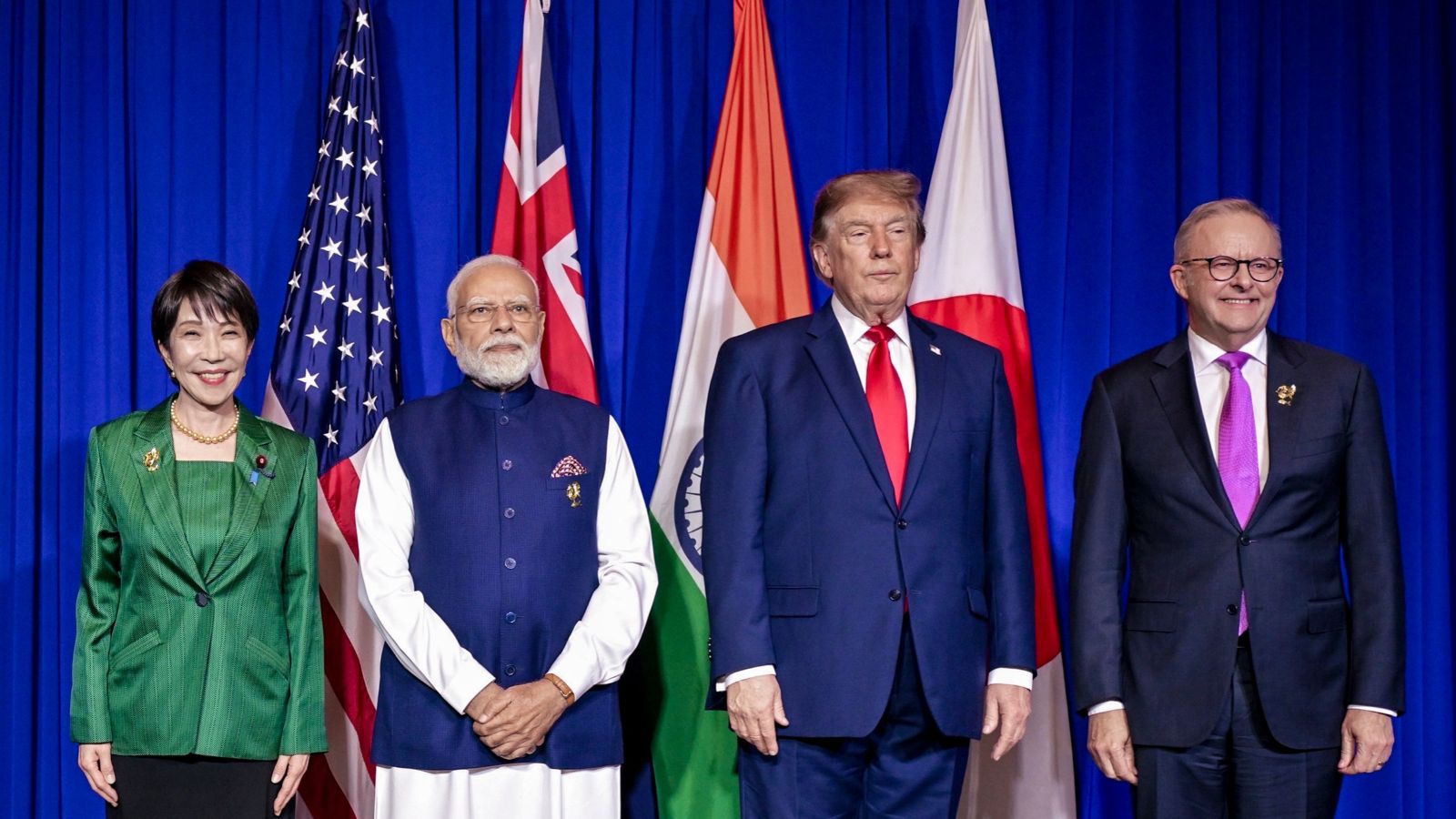
Prime Minister Narendra Modi (second from left), Japan's Prime Minister Sanae Takaichi (left), US President Donald Trump (third from left) and Australia's Prime Minister Anthony Albanese (right) during the Quad Leaders Meeting, in Philippines. (narendramodi.in via PTI Photo)
AI Narration
Listen
00:00
3 min readNov 23, 2026 06:17 AM IST First published on: Nov 23, 2026 at 06:17 AM IST
The Quad Summit in Manila, the first in two years, was significant not merely for the revival of leadership meetings but also for its wider signalling. To partners, it signalled a transition from strategic intent to operational cooperation. It provided assurances to a democratic ASEAN. And the juxtaposition of the Quad and the Shenzhen trilateral meetings captured a defining feature of contemporary geopolitics: Accommodation by a global power in its simultaneous pursuit of coalitions and great-power consultations. The Quad joint statement identified items of operational cooperation in maritime security, economic resilience, AI technologies, connectivity extending to the Indian Ocean, cybersecurity and a business leaders’ forum. The leaders reaffirmed opposition to unilateral attempts to alter the status quo through force or coercion, without explicitly naming China. Counterterrorism and support for ASEAN centrality were also reiterated.
The US provided reassurance to Indo-Pacific partners before Trump engaged Xi and Putin. The Manila and Shenzhen summits recognised the US as the pre-eminent power, sought by both friends and adversaries, but implementation capacity has yet to be tested. The US also conveyed its ability to pursue consultations with competitors without entirely relinquishing its regional security architecture. For Japan, the summit was important for its objective to be a principal security pillar in the Indo-Pacific with increased defence outlay. Australia strengthened recognition as the southern anchor of the Quad. India’s geography, naval capabilities, economic potential and independent diplomatic relationships made it an essential partner. These factors reflect that India has strategic relevance, but not yet strategic primacy.
India’s Quad agenda is to emerge as a net security provider in the Indian Ocean, protect sea lanes and monitor China’s expanding maritime footprint. Building economic and technological resilience in critical minerals, supply chains, AI and cybersecurity is the key to reducing strategic dependency, attracting investment and developing manufacturing capability. India also seeks to pursue strategic autonomy to engage with the US, Russia, China and the Global South. The Manila summit delivered on most issues.
There was, nevertheless, a diplomatic irony. India was expected to host the 2025 Quad summit, but it was postponed by the Trump administration, indicating that US priorities were elsewhere. Eventually, the US convened it on the margins of ASEAN to balance the trilateral. India must ensure that its membership of the Quad translates into influence in global affairs. China has discomfort with the Quad, but maintained restraint on the Manila outcomes that addressed vulnerabilities arising from its dominant position in certain areas. Beijing pushed for a Shenzhen trilateral of “major powers”, but it may be a one-off event in a world of geopolitical fragmentation. Emerging, middle and regional powers are unlikely to accept new structures of hegemony.
For India, the summits pose a more fundamental question: Will the emerging global order be shaped by a small group of great powers or a wider constellation of consequential powers? Only the accumulation of hard power can leverage India’s position as it navigates the two competing but interconnected dimensions of coalition-building and great-power bargaining. India’s diplomacy must not become captive to either.
The writer, a former diplomat, is professor at Jindal Global University
KioskNews shows a cleaned-up reading view extracted from the publisher’s page — the original always lives on their site, not ours.