The Hunger Games: Sunrise On The Reaping Ending Explained: How Haymitch Wins The Hunger Games & What Happens To His Family


Liz Declan is a Lead Writer for ScreenRant, primarily covering movies. She is a massive fan of Star Wars, the MCU, and Supernatural. In addition to writing, Liz loves attending and covering conventions and interviewing actors. Find her on TikTok and Instagram @va.va.vera
Sign in to your ScreenRant account
Warning! This post contains SPOILERS for The Hunger Games: Sunrise on the Reaping.The newest addition to Suzanne Collin's nearly 20-year-old, smash-hit Hunger Games franchise, The Hunger Games: Sunrise on the Reaping, has finally arrived in theaters, and while any Hunger Games movie is going to leave audiences devastated, this ending truly packs a punch. The new movie, like the novel, centers on Haymitch Abernathy, the mentor of Katniss Everdeen and Peeta Mellark from the original Hunger Games trilogy, and that automatically meant that audiences would know Haymitch made it out of the arena alive. However, his path to victory was far from straightforward.
After all, Haymitch didn't just fight in any Games; he fought during the 50th anniversary year, what is called the Second Quarter Quell, which saw double the number of tributes—two boys and two girls from each district, totaling 48 children. With that alone, the bloodshed for Sunrise on the Reaping was going to be significantly higher, as were the tragedies and the deaths. Sadly, for Haymitch, the horrors didn't stop there, as cruelty followed him all the way home, back to District 12.
Hunger Games fans who read the book may feel that they already know how this story ends, and while reviews of Sunrise on the Reaping have already made it clear that the story, in many ways, remains loyal to the book, not everything about this ending—from character deaths to how Haymitch responds to these many losses and more—remains exactly the same. Here's everything you need to know about how the brand-new movie, Sunrise on the Reaping, ends.
How Haymitch Abernathy Wins The Hunger Games

Initially, like Katniss, Haymitch is an unlikely hero and relatively resistant to the idea of truly becoming a rebel against the Capitol; he doesn't see himself that way, it seems, even as he clearly hates everything that the Capitol stands for and what they do to the people of Panem living in the districts and forced to fight in the Games. However, especially after connecting with Beetee and formulating a plan, Haymitch agrees to use his time in the arena as a way to, hopefully, ruin the Games—even if it means his death, which he assumes is certain.
In the end, though, Haymitch doesn't die. Rather, he becomes the last man standing, almost accidentally. Like in the books, in the movie, Haymitch is determined to bring an end to the Hunger Games, or at the very least show President Snow that the districts are no longer willing to play his games. However, the numbers of the remaining districts dwindle, ultimately leaving just a few tributes fighting to the death. That includes, towards the end, Haymitch, Maysilee Donner, Wellie (one of the Newcomers and therefore an ally to Haymitch), and the lingering career named Silka.
Similar to the book, Maysilee is devastatingly attacked by vicious birds, eventually dying as a result of their assault on her. Likewise, despite Haymitch hoping for Wellie's survival and even, potentially, victory, Wellie is ultimately killed by Silka. Notably, there is a change from the book, as in the novel, Silka gruesomely cuts off Wellie's head, whereas in the movie she kills her without thrat horrific decaptiation.
In the end, though, it's Haymitch against Silka, and while certain details are different, such as where Silka is struck by the hammer, her fate is the same. Ultimately, Haymitch uses the force field built into the arena to his advantage, watching as Silka sends her axe flying, only for the axe to rebound from the force field, striking and killing Silka. This leaves Haymitch as the winner, although he still tries, in the end, to destroy the arena rather than survive. Sadly, for Haymitch, his plans are foiled, and he becomes the victor.
President Snow's Punishment For Haymitch Explained
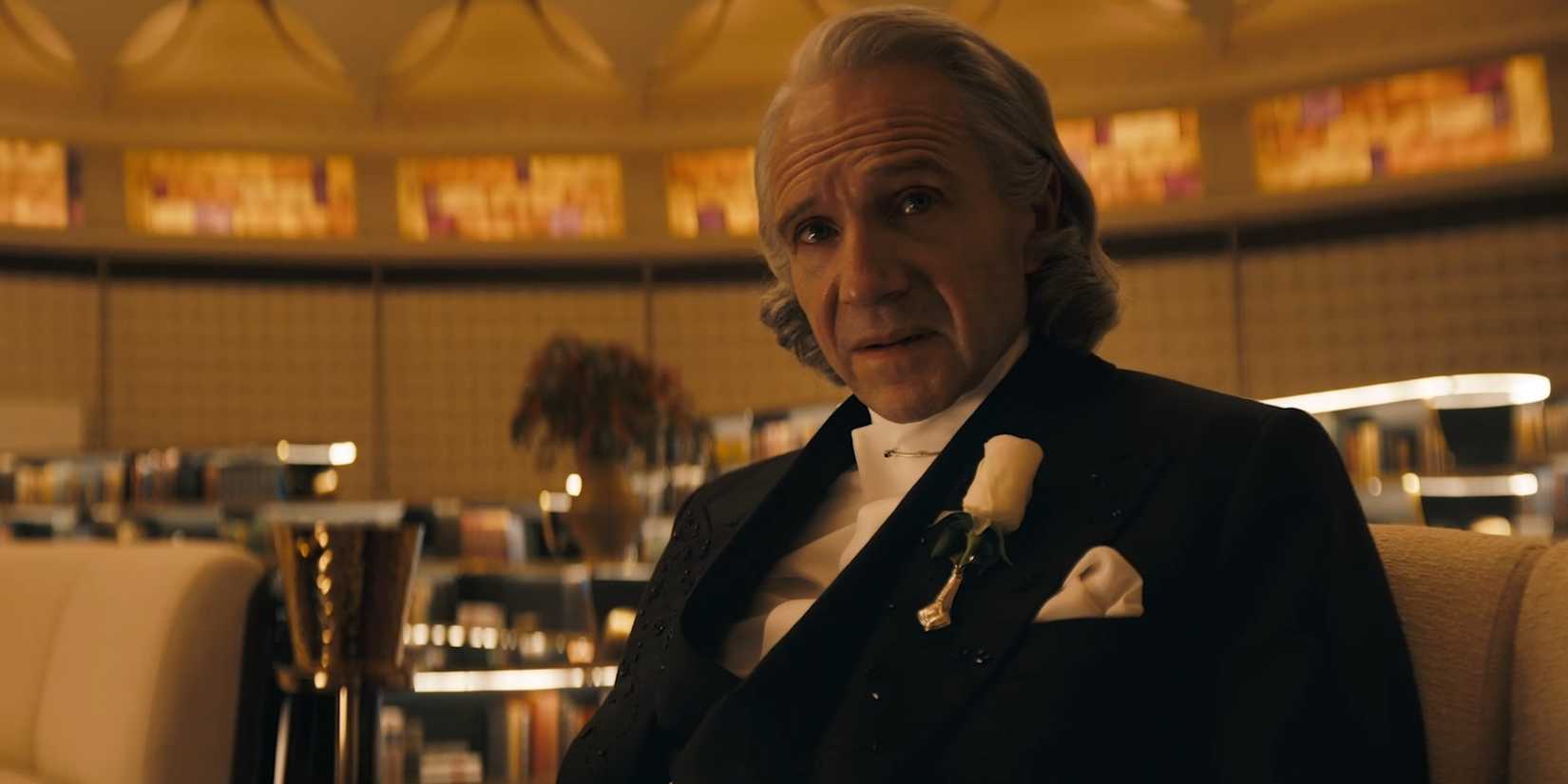
Although Haymitch is the victor of the 50th annual Hunger Games, his troubles are far from over once he leaves the arena. On the contrary, President Snow ultimately decides to punish Haymitch in the most horrific ways following his win in the arena. Once Haymitch returns home in the movie, he is immediately greeted by the caskets of his four former allies and other District 12 tributes, Maysilee, Louella, and Wyatt. That's very far from the worst thing that Haymitch witnesses after his return home, though.
First, Haymitch loses his only surviving relatives, both his Ma and his little brother, Sid, in a house fire. Very obviously, though, this house fire isn't an actual accident. Rather, Snow has orchestrated this house fire, determined to to kill both Sid and Haymitch's Ma as a form of cruel punishment for his rebellious behavior. Still, though, the cruelty is not over, as Snow is also dead set on killing the only person remaining who Haymitch cares about: his girlfriend, Lenore Dove.
A Covey, just like Snow's former love interest Lucy Gray, Lenore Dove is Haymitch's last remaining loved one. Brutally, Snow sets up a horrifying scenario, in which Haymitch unwittingly feeds Lenore Dove poisoned gumdrops. Try as he might, once he realizes they are poisoned, Haymitch is unable to save Lenore Dove, and she dies right in front of him, leaving him well and truly alone.
Why Do Katniss And Peeta Appear At The End Of The Movie?

Amidst all the devastation is the return of fan-favorite characters Katniss Everdeen and Peeta Mellark, who appear in the epilogue of the movie, set not only after the events of Sunrise on the Reaping but also after the events of the original Hunger Games books/movies. In this scene, Katniss and Peeta are clearly established as Haymitch's true family in his older age, and while there is very little in terms of the story at this point in the movie, seeing them is enough.
Based on what is shown, Peeta, Katniss, and Haymitch have finally found true peace, living out their days in District 12 without fear of the Hunger Games, the Capitol, or war. It's a heartwarming conclusion, and however brief, it really is nice to see Katniss and Peeta again and get confirmation that, long after the books and movies, this trio remains a happy, finally safe family.
Where The End Of Sunrise On The Reaping Fits Into The Original Hunger Games Movies

As mentioned, the epilogue of Sunrise on the Reaping is set many years after the original Hunger Games movies and books. It's not clear precisely how long afterwards this epilogue takes place, nor is it all that important. What's really being shown here is simply that Katniss, Peeta, and Haymitch do eventually find some well-deserved peace. In terms of the story prior to the epilogue, though, the story is set more than two decades before the original Hunger Games book/movie.
Specifically, Sunrise on the Reaping takes place during the Second Quarter Quell, 24 years before Katniss's first Hunger Games. However, the end of the movie does showcase several skips in time, depicting Haymitch witnessing reapings and then returning home with caskets again and again. It's a compelling, meaningful sequence, but in addition to it demonstrating the suffering that Haymitch continued to experience for years, it does show a small passage of time within the movie.
Does Sunrise On The Reaping Set Up Another Movie?

Understandably, the question on many fans' minds is whether Sunrise on the Reaping will truly be the end for Hunger Games movies and books. It was honestly shocking that Collins eventually continued beyond The Mockingjay, but with both Sunrise on the Reaping and The Ballad of Songbirds and Snakes coming out, it seems like Collins is open to additional stories. Even so, it seems safe to assume that Sunrise on the Reaping is the true end. Never say never, but for one, all previously written books (and therefore movies) focus on the District 12 victors.
With Haymitch, those stories have come to an end. What's more, the conclusion of Sunrise on the Reaping is geared towards establishing that the Hunger Games are now truly over. It would be more than a little surprising if Collins now decided to revisit other stories. Granted, there are those who want Finnick's story or a story set before the Hunger Games began, and that's not off the table, certainly, but for now, it seems most likely that Sunrise on the Reaping is the true end of this fan-favorite franchise.

- Release Date
- November 20, 2026
- Runtime
- 158 Minutes
- Director
- Francis Lawrence
- Writers
- Billy Ray, Michael Lesslie, Suzanne Collins
- Producers
- Brad Simpson, Nina Jacobson
KioskNews shows a cleaned-up reading view extracted from the publisher’s page — the original always lives on their site, not ours.