Iran warns new U.S. assault would see it expand "geography of the war"
- A spokesman for Iran's Islamic Revolutionary Guard Corps threatened Monday to respond to any new U.S. assault with unspecified new weapons and an expansion of "the geography of the" nearly 7-month war.
- President Trump told Fox News on Sunday that he's in "deciding mode" as he considers options including "wiping Iran out," "letting them rot economically," or trying again to strike a deal to end the war. He said he'd "probably" be open to meeting his Iranian counterpart on the sidelines of the U.N. General Assembly in New York this week.
- U.S. embassies across the Middle East issued security alerts Sunday as fighting between Yemen's Iran-backed Houthi rebels and a Saudi-backed coalition intensified. The embassies told U.S. nationals to exercise caution and be prepared for travel disruptions, citing the "potential for unforeseen escalation" in the region.
Iran warns it will expand the war if there is another U.S. assault
Iran's powerful Islamic Revolutionary Guard Corps warned Monday that any new U.S. assault would be met with an expansion of the already-complex regional conflict to new areas.
"If a new aggression occurs, we will certainly change the weaponry and the geography of the war," IRGC spokesman Hossein Mohebbi said Monday according to the country's semi-official Fars news agency.
Mohebbi added that Tehran was prepared for the nearly seven-month war to drag on.
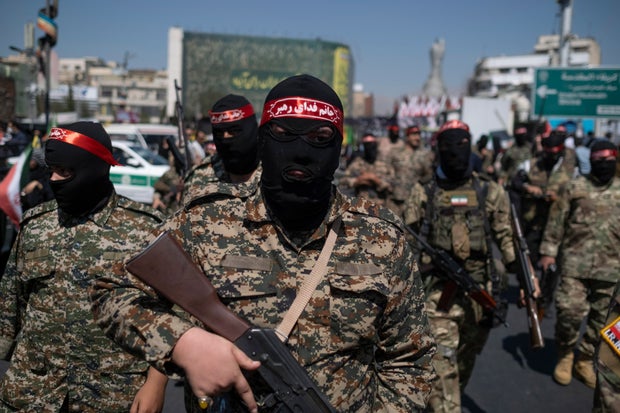
The statement came after President Trump reiterated on Sunday that he was poised to make a decision on whether to re-intensify U.S. attacks on Iran that he previously said could "annihilate" the country's Islamic Republic regime, or to seek a new diplomatic agreement to end the war.
Mr. Trump told Fox News he was "probably" open to the idea of meeting with Iranian President Masoud Pezeshkian this week on the sidelines of the United Nations General Assembly in New York.
Trump says he's in "deciding mode" on Iran
President Trump told Fox News that he's in a "deciding mode" on Iran, forecasting "very big things" to come in the near future as he considers his options in the war.
Fox News' Trey Yingst said he spoke with the president, who said he's considering a handful of choices, including "wiping Iran out," "letting them rot economically," or striking a deal.
"My question is, if and when do I blow the entire nation up? They better behave," the president told Yingst.
Yingst said the president also told him he'd probably be open to meeting with Iranian President Masoud Pezeshkian, who is expected to attend the United Nations General Assembly in New York this week.
The comments come after Mr. Trump told Axios on Thursday that he's facing a "big decision" on whether to "annihilate" the Iranian regime.
CIA director meets with Egypt's Sisi amid U.S. warning of "potential" Middle East escalation
CIA Director John Ratcliffe met with Egyptian President Abdel Fattah al-Sisi during a rare visit to Cairo on Sunday.
Sisi's office said the meeting, attended by Egypt's spy chief Hassan Rashad, included discussion of the wars in Iran, the Gaza Strip and Sudan, as well as attacks on Gulf countries and threats to maritime security.
Sisi stressed "the paramount importance of settling regional crises through political and diplomatic tracks," according to a presidency statement.
On Saturday, the U.S. State Department warned Americans against traveling to the region as hostilities rage between Saudi Arabia and Yemen's Houthis.
Ratcliffe's visit also came days after de facto Saudi leader Crown Prince Mohammed bin Salman met Sisi in Cairo. The pair urged safe and secure maritime navigation through the Bab el-Mandeb Strait, after the Iran-backed Houthis seized the Yemeni coast along the vital waterway in a lightning offensive.
Cairo is a key U.S. ally in the region and one of the top recipients of U.S. military aid. It has repeatedly positioned itself as a stabilizing force in a turbulent region, keeping open lines of communication with rival sides, including Israel, Hamas and Iran.
Sisi's office said Ratcliffe "lauded Egypt's pivotal role in supporting efforts aimed at reaching peaceful, comprehensive settlements to regional crises."
CBS/AFP
Tehran has conveyed conditions to U.S. for reopening of Strait of Hormuz, Iran's top negotiator says
Iran has conveyed to Washington through mediators its conditions for reopening the strategic Strait of Hormuz, which it has blockaded throughout the Middle East war, Tehran's top negotiator said Sunday.
The two foes are locked in a stalemate months into the conflict, particularly over the Strait of Hormuz, a vital shipping route for the world's oil and gas.
"Our messages and the explanation of our conditions have been clearly conveyed to the other party through mediators," said Iranian parliament speaker Mohammad Bagher Ghalibaf, who has acted as chief negotiator in talks to end the war.
"As long as the conditions are not met ... and the U.S. commitments are not honored, it will be impossible to return to the situation from before the negotiations and to an open strait," he added, according to state television.
Mohsen Rezaei, the head of Iran's supreme national security council, said on Saturday that the Islamic Republic had conveyed its conditions to the U.S. via mediator Qatar.
"Our conditions are an end to the war on all fronts, the release of our frozen funds and an end to the naval blockade," he said in an interview with Al Jazeera.
CBS/AFP
Egypt, Jordan and Kuwait condemn Houthi attack in Riyadh
Three Muslim and Arab countries condemned the Houthis' attack in Riyadh, saying it was a threat to regional security and stability and a violation of international law.
Egypt, Jordan and Kuwait, in separate statements, said their governments stand with Saudi Arabia in support of its sovereignty and protection of its civilians.
The Muslim World League also condemned the attack on civilians and civilian infrastructure as a violation of "all religious values as well as international and humanitarian laws and norms."
It was the first time the Saudi capital has been targeted since the escalation in fighting with the Iran-backed rebels opened a new front in the Iran war. Saudi Arabia said the attack was intercepted. Some residents in Riyadh heard an explosion, and later some saw a plume of smoke near the airport. There were no reports of casualties or damage.
In recent weeks, fighting has intensified between Saudi Arabia and the Houthis, who have taken control of vast swaths of Yemen's Red Sea coastline, along with several islands in the critical Bab al-Mandab Strait, a move which has put more pressure on an already stressed global oil supply.
CBS/AP
U.S. embassies across Mideast issue security alerts amid "potential for unforeseen escalation"
U.S. embassies across the Middle East early Sunday morning local time issued security alerts for American citizens in the region.
"Due to tensions in the Middle East, the security environment remains complex with the potential for unforeseen escalation," said the alerts issued by embassies in Israel, Saudi Arabia, Iraq, Kuwait, Lebanon, Jordan, Bahrain, the United Arab Emirates and Qatar.
The alerts did not state a specific threat, but called for Americans to "exercise heightened vigilance and be aware of potential flight cancellations, airspace closures, and travel disruptions."
They cited the recent fighting between Saudi Arabia and the Iranian-backed Houthi militants in Yemen, noting that the conflict between the two sides "has the potential to escalate rapidly."
Turki al-Malki, a spokesperson for the Saudi coalition fighting the Houthis, said in an earlier statement posted on X that Saudi forces had intercepted a ballistic missile fired at capital city Riyadh on Saturday.
In recent weeks, fighting has intensified between Saudi Arabia and the Houthis, who have taken control of vast swaths of Yemen's Red Sea coastline, along with several islands in the critical Bab el-Mandeb Strait, a move which has put more pressure on an already stressed global oil supply.
Saudi Arabia's crucial East-West oil pipeline was damaged by drone strikes earlier this month believed to have been conducted by Iran-backed militias operating in Iraq, although no group has taken credit for the attacks.
The Houthis have attempted a blockade on Saudi ports since July.
In:
KioskNews shows a cleaned-up reading view extracted from the publisher’s page — the original always lives on their site, not ours.