Kurdish Peshmerga completes its long process of unification - explainer
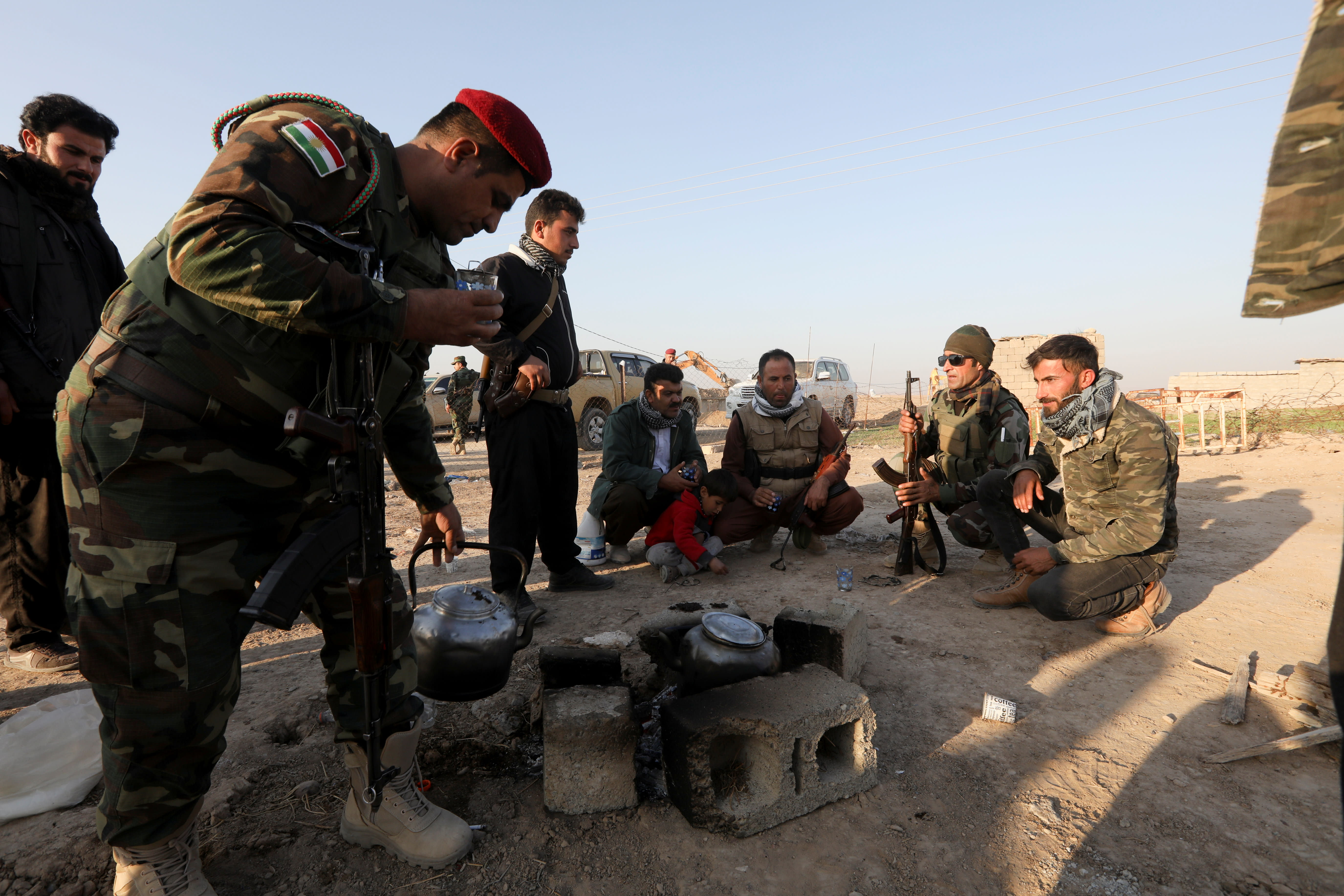
The Kurdistan Regional Government in northern Iraq announced Monday that its Peshmerga forces have finally completed unification.
This process dates back more than a decade. Western countries, helping fight the war on ISIS, have backed Peshmerga unification in the past. The announcement comes as US forces are leaving Iraq and as Iran continues its threats.
The KRG’s Prime Minister Masrour Barzani said “the Peshmerga is more than a military force. It is a symbol of the struggle, sacrifice and identity of the people of Kurdistan.”
He added, “Today is a historic day for Kurdistan and the Peshmerga; the process of unifying and reorganizing the Peshmerga forces has been successfully completed.
This unification is the first step of a long process, and the next phase is even more important. It must focus on strengthening military capabilities, providing advanced weapons and air defense systems, developing competencies, and comprehensively advancing the Peshmerga forces.”

Kurdistan's armed forces
The Peshmerga are the armed forces of the Kurdistan autonomous government. They have their origins many decades ago as a key force that defended Kurdish rights in their struggle against the oppressive Iraqi regime of Saddam Hussein.
After the 1991 Gulf War and the establishment of Kurdish self-rule in northern Iraq, the Kurdistan Democratic Party (KDP) and the Patriotic Union of Kurdistan (PUK) each had their own armed forces. Since then, the goal has been to unify these Peshmerga.
Instead, political and economic disputes contributed to a Kurdish civil war beginning in 1994. A 1998 agreement ended the fighting, but institutionalized a division between KDP and PUK areas and their respective security forces.
After the US invasion of Iraq in 2003, the Kurdistan Regional Government’s Ministry of Peshmerga Affairs launched new efforts to create a professional force. The two major parties signed a unification agreement in 2006 and eventually created joint Regional Guard Brigades.
Nevertheless, large formations remained under partisan control, particularly the PUK-associated 70 Forces and KDP-associated 80 Forces.
It’s important to understand how this manifested itself on the frontline. I spent several years covering the Peshmerga fight against ISIS. In many frontline positions, the political divisions were visible, often because nearby bases displayed the flags or images associated with the two political parties.
There was unity but also clear evidence of division. The war on ISIS postponed unification and reform.
The war against ISIS transformed the Peshmerga’s role. The Peshmerga were supported by the US-led Combined Joint Task Force-Operation Inherent Resolve (CJTF-OIR).
Coalition countries provided weapons, training, funding, and advisers, including through the Kurdistan Training Coordination Center (KTCC). The war also highlighted weaknesses caused by competing command structures and accelerated pressure for reform.
Beginning in 2017, the KRG, United States, United Kingdom, and Germany moved forward with an extensive program intended to professionalize the Peshmerga. The concept was that the Ministry of Peshmerga Affairs would take the lead, not the parties.
Under subsequent US-KRG agreements, CJTF-OIR continued supporting restructuring, logistics, training, and institutional reform. The objective evolved toward unified Peshmerga divisions incorporating personnel from the Regional Guard Brigades and former 70 and 80 Forces.
Reorganizing groups under a single professional Peshmerga
Although integration repeatedly missed deadlines, the creation of unified divisional structures represented an important step toward replacing parallel party armies with a single professional Peshmerga force
Kurdistan Regional Government Prime Minister Masrour Barzani announced the completion of the multi-year effort to unify the Kurdistan Region’s Peshmerga forces, calling it a “historic day for Kurdistan and the Peshmerga.” Barzani said the process was carried out under an understanding between the KRG and the US Department of War, with support from the United States and Coalition forces.
“All forces have been brought under the umbrella of the Ministry of Peshmerga Affairs,” Barzani said. He said the Peshmerga now operate within “a single modern military structure,” unified in operations, training, command and control, communications and accounting.
Barzani cautioned that unification represented only “the first stage and first step of a long process.” The next phase will focus on improving military capabilities, acquiring advanced weapons and air defense systems, strengthening training and developing personnel according to international military standards.
He also emphasized removing the Peshmerga from partisan rivalries.
“We want the Peshmerga to be a national Kurdistani force that stands above all party and individual interests,” Barzani said.
The prime minister thanked the United States and Coalition forces for supporting the reforms and helping the Peshmerga defeat ISIS, while calling for stronger coordination with the Iraqi Army and equal financial rights for Peshmerga personnel.
With US forces set to leave Iraq ahead of a September 30 deadline, the Peshmerga will need this new unity to confront challenges. Baghdad has often tried to weaken the Kurdistan region economically. Iran and its militias have carried out 1,000 attacks since February. The challenges ahead are immense.
Unification and reform are a step. However, the KDP and PUK still cannot form a unified government, creating numerous challenges for the Kurdistan Region.
KioskNews shows a cleaned-up reading view extracted from the publisher’s page — the original always lives on their site, not ours.