To understand the threat to our real democracy, watch Putin’s fake one
As Russians vote this weekend, remember that Britain is not immune to the cynical tactics and corrosion of trust that keep Putin in power
By Rafael Behr / The Guardian


Millions of people are participating in Russia’s three-day elections to choose a new parliament. The purpose of the exercise is to maintain Russian President Vladimir Putin’s authority over the political process, which means his party, United Russia, would retain control of the Duma.
That much is settled before the polls opened yesterday, although the scale of the government’s victory would not be declared until the votes are counted. A portion of seats is available for other “systemic parties” that function as Kremlin licensed-opposition, padding out the pretence of pluralism. They serve as pressure valves for public frustration and parliamentary proxies when rival factions within the ruling elite want to nudge Kremlin policy in one direction or another.
The Kremlin likes to minimize the difference between United Russia’s official tally and a number that would plausibly reflect public attitudes to the regime. If the gap is too wide, achieved by fraud too blatant, it conveys insecurity in the Kremlin. Putin’s power does not depend on endorsement by ordinary Russians, but his authority is sustained by the illusion that he listens and cares. An egregiously stolen election would prove that he does not.
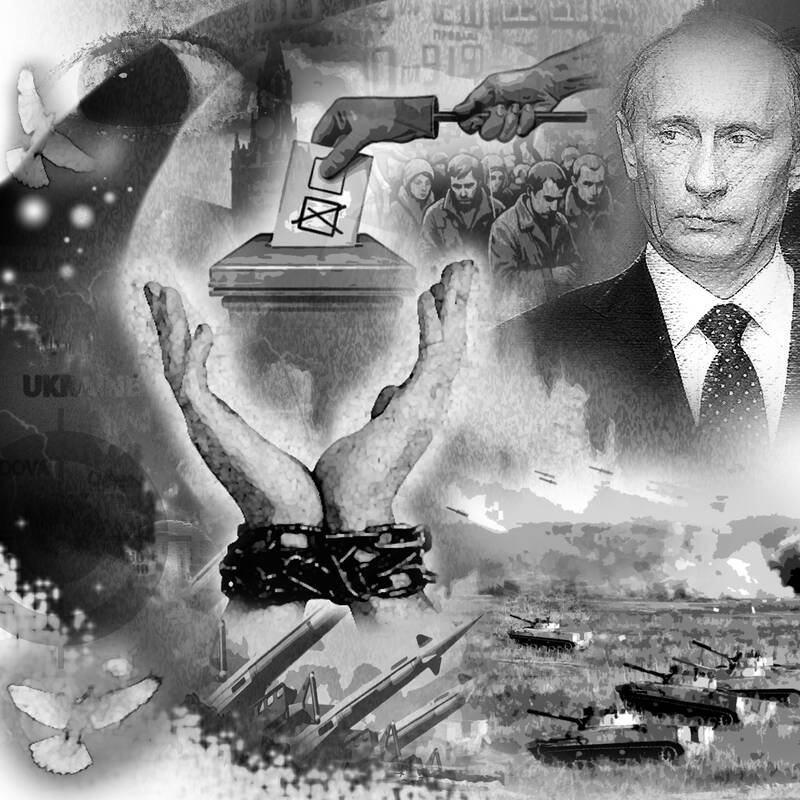
Illustration: Kevin Sheu
Everyone knows the result is fixed, but it would breach a social contract if the fiction became too absurd. Electoral verisimilitude is harder than usual to pull off this time because of war fatigue. No one can pretend any more that the “special military operation” in Ukraine has gone to plan. It was supposed to take weeks and is now in its fifth year. There have been about 1.5 million Russian casualties.
A shortage of volunteers stirs fear that another mobilization of unwilling army reserves is in the works. Putin has denied that any such draft is required. That he needs to offer public reassurance at all amounts to recognition that progress on the front has stalled and the mood at home has soured.
Ukrainian drone and missile strikes have made the war visible and economically palpable thousands of kilometers away from the frontline. The veil of state propaganda cannot be drawn across plumes of smoke rising from oil refineries and lines at gasoline pumps.
There are no accurate opinion polls in an authoritarian state. Russians are disinclined to share their private thoughts with strangers on the phone, especially when denigrating the armed forces is a criminal offense.
A more reliable indicator of growing dissent is the increased rate of its repression. Last month, Yabloko, an inconsequential liberal party, was barred from the elections on a preposterous trumped-up technicality. The real objection was the party’s campaign slogan — “For peace and freedom.”
Yabloko had previously been tolerated as an irrelevant vintage party from the pre-Putin era, not exactly tame, but unthreatening; not worth the risk of aggrandizement by political martyrdom. That calculus changed with signs that voters were drifting toward the only available anti-war banner. It was not a big movement, but enough to persuade the authorities that denying the party representation after the ballot could be messier than blocking it in advance.
If banning the opposition depresses turnout, all the better. The Kremlin appears to have accepted that a sincere show of enthusiasm for the status quo is unavailable. A boring, low-key election, telling a story of submission and stability, is the next best thing.
Such is the perverse craft of “managed democracy” — the mechanics of running gangster authoritarianism through a notionally liberal constitution. It requires a mix of performative coercion, tactical concession and confected consent. The economic spoils of corruption have to be dispensed widely enough to feed a quiescent elite. There has to be enough theater of public participation to legitimize the regime. However, genuine freedom must also be discredited as the path of chaos.
That has been an easy line to sell to Russians who recall post-Soviet democratization as a time of rampant gangsterism, surrendered superpower status and national immiseration. Putin is a product of that era and the embodied backlash against it. He transferred the engines of oligarchic capitalist self-enrichment to the reconstituted chassis of a Soviet-style state. He made himself an avatar for imperial nostalgia and an exhausted population’s craving for order. He promised to express the national interest more efficiently as its sole incarnation than any raucous, divided parliament ever could.
That offer has less appeal in established democracies, where political pluralism and the rule of law have deeper roots, but it has an audience. The core proposition — a strong leader to avenge a once great country’s humiliation by — has twice carried Donald Trump to the White House. His ratings have plummeted, but he can still count on credulous adulation from as many as one in three Americans.
What is the equivalent number in Britain? The leading product in this market is Reform UK, which now polls at about 23 percent, level with Labour. Nigel Farage’s position has slipped this year as his personal and party finances have come under scrutiny, but his core supporters are untroubled by the whiff of grubby lucre. For some, convinced that the whole system is a rotten sham, scandal around Reform UK’s receipt of multimillion-dollar donations positively burnishes the brand. It proves that Farage is a baller, capable of beating the “establishment” parties at their own game — a gamble that the savvy, loadsamoney crypto crowd are backing.
The deep cynicism feeding that judgement is a vital element in the chemical compound that corrodes democracy. I remember it as the most pungent feature of Russian politics when I lived in Moscow, watching the 1990s experiment in democracy fail.
It is the demoralized conviction that no politician would ever be motivated by a spirit of public service. The only categories are weak and strong; suckers and players. To succeed, a nation needs to be led by a strong player. Constitutions and laws are just parts of the toolkit for exercising power. The liberal view that holds them sacred as a system for holding governments to account is the mark of a sucker.
Farage does not put it quite like that. He did tell his party conference last week that an incoming Reform government would declare a “national emergency” to enact a radical agenda within the first 100 days and tolerate no objection from parliament, the courts or Whitehall. No one can say they were not warned.
It is not an explicitly anti-democratic agenda, but it never is with populists in opposition. No one wins elections by promising to cancel future ballots and, as the Russian experience shows, once power has been secured, the well-managed poll is a valuable mechanism for consolidating control.
There is a process of hollowing-out that comes first. It is a relentless corrosion of trust in independent institutions and the sluicing of public debate with caustic cynicism. It is the stirring of disillusionment and frustration into nihilistic rage against the system; sowing division and amplifying despair to make authoritarian rule sound like release from political paralysis.
Russia was lost down that road long ago. British democracy is thankfully more robust, more culturally embedded. Or so we hope. Resilience is not immunity. The Putin model of venal cynicism that dresses authoritarian kleptocracy in a call for national redemption will not declare its motives in an election campaign. The democratic fightback cannot wait until that election to see how far the poison has spread.
KioskNews shows a cleaned-up reading view extracted from the publisher’s page — the original always lives on their site, not ours.