Big EU defence projects under threat from proposed budget cuts: Commissioner Andrius Kubilius
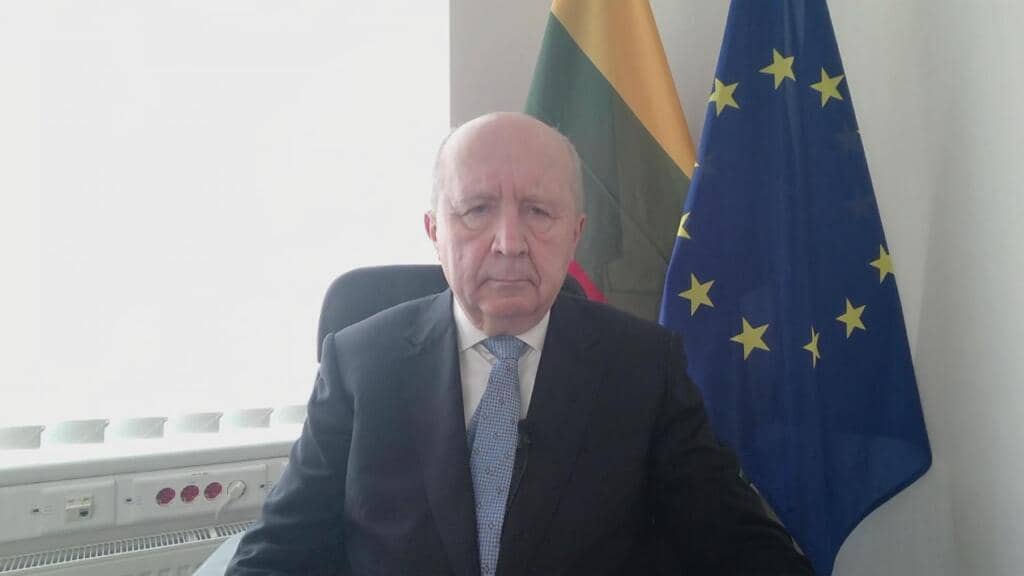
We speak to the EU's Commissioner for Defence and Space, Andrius Kubilius. The former prime minister of Lithuania – who grew up during the Soviet era – tells us how he sees the confrontation between Europe and Russia. He also sounds the alarm over proposed cuts in the EU's future budget, saying that they could jeopardise major European projects in defence and space. Kubilius praises the EU's SAFE defence loans programme, remarking that it has been "really very successful".
Kubilius warns that cuts in the EU's next long-term budget, proposed by member states, could have serious consequences.
"We are definitely worried because we calculated very clearly (the funding for) projects that we need to develop in Europe, both in defence and space," he explains. "And we see that member states and leaders of institutions are proposing to cut our initial proposal by 30 percent, cutting down by €40 billion. This is one of the biggest cuts among all the spending lines of the next MFF (Multiannual Financial Framework). We are really concerned because there is the danger that European defence projects of common interest, or space projects like Iris Square or the Earth Observation Governmental Service (EOGS) – we shall not be able to implement them because of a lack of money at the European level."
Noting that "the space sector is now becoming very crucial for defence", Kubilius reacts to reports from Germany that Russia is considering launching a nuclear-armed satellite – something that Moscow denies.
"Nuclear weapons in space are very dangerous because they can totally destroy our space systems, which are crucial both for civilian life and for our security and defence," Kubilius says. "So we need to look at how we can defend our systems in space, also against the possibility of our adversaries trying to destroy them."
Kubilius believes that proposed EU budget cuts send the wrong signal at a time when Russia is rapidly increasing its own capabilities.
"Russia is increasing its defence-military budget up to €180 billion. That's 30 percent more than they spent this year," he notes. "And we cannot look only into nominal numbers because when we are comparing ourselves with Russia, we need to use the so-called purchasing power parity method of comparison. And then it appears that Russia next year will spend around €500, €550 billion. And this is the same amount or even a little bit more than the EU member states together. In addition to that, we see that Russian industry is able to produce more, and to innovate. This year Russia is producing around 10 million drones. Ukrainians are matching that number. But Ukrainians are predicting that Russians next year will be able to produce 20 million drones, and they will also increase their production of ballistic missiles."
Even if the EU and Ukraine are only just achieving parity with Russia, Kubilius credits the Security Action for Europe (SAFE) programme with playing an important part in boosting European defence. "It was really very successful," Kubilius states. "And now we have made a second call; we are asking member states to look into the possibility of taking those loans and using them to scale up production; European production, which is very much needed for Ukraine. We have an industrial challenge because when our industries present the contracts to Ukraine, the delivery dates are usually not 2027, but 2028 or 2029. So that is why we are trying to incentivise member states to scale up and to produce more quickly, and to do more for Ukrainian needs."
Programme prepared by Oihana Almandoz, Isabelle Romero, Perrine Desplats and Florine Hausfater.
Our guests
-
Andrius Kubilius European Commissioner for Defence and Space
KioskNews shows a cleaned-up reading view extracted from the publisher’s page — the original always lives on their site, not ours.