Children’s hospitals close beds to comply with NHS cost-cutting targets
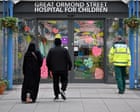
Children’s hospitals are closing beds and shedding staff to comply with swingeing cost-cutting targets set by NHS chiefs to stop the health service overspending.
Great Ormond Street hospital (Gosh) in London has closed 28 beds and is cutting its workforce by 300 as it struggles to identify how to make £50.6m of savings by the end of March.
Reports to the hospital’s board show that it has closed one ward and reduced the number of beds on several others in recent months.
In April it shut Hedgehog ward, which had 10 beds and cared for patients with complex and in many cases life-threatening conditions, both from the UK and abroad. The trust said the move followed a fall in the number of children and young people travelling to the hospital for inpatient medical care from the Middle East, partly as a result of the conflict in the region.
But it has also reduced the number of beds on Koala and Alligator Endo-Met wards, which treat children with brain conditions, and Panther ear, nose and throat ward, board reports disclose. The loss of beds on Koala ward sparked concern that the hospital may not have enough capacity to look after everyone who needed its help, documents presented to the board show.
It is shrinking its workforce by 300 posts even though the same board reports state that many of its units – which are world-renowned for their expertise – do not have enough staff. Two-thirds of its £31.5m “cost improvement programme” for 2026/27 is due to come from “workforce cost reductions”.
Great Ormond Street admitted it was facing financial ”challenges” but stressed that the changes would not affect patient care.
“At Gosh we care for some of the sickest and most complex children in the country and it is incumbent on us to ensure that any decision we take does not compromise our ability to deliver high-quality and safe care to our patients,” a spokesperson said.
“Our cost improvement programme has delivered significant savings and we are on track to break even at the end of this financial year.”
Similarly, Sheffield children’s hospital has closed eight of its surgical beds and is also cutting 300 of its 3,500 full-time equivalent staff as it seeks to save £17.7m this year – about 5% of its total budget. It closed the beds due to a fall in demand for surgery, it said.
“This is not just about making short-term savings. We are reimagining how we provide care, so our services are sustainable and respond to the changing and increasingly complex needs of children and young people,” said Ruth Brown, the trust’s chief executive.
The Guardian revealed on Sunday that dozens of NHS trusts in England are cutting staff and services.
Both Sheffield and Alder Hey children’s hospital in Liverpool have declared their difficult financial situation as a major risk to their ability to function smoothly. Both trusts have given that possibility a rating of 20 out of 25 in their latest register of the risks they are facing.
Alder Hey, which has to save £24m before next April, has halved the number of beds from 32 to 16 on ward 4C, a general paediatric ward. However, it said that it did so because it was looking to admit fewer children than before and managing more at home through “virtual wards”, in line with the government’s ambition for the NHS to provide more care in or close to people’s homes.
It is also reducing its 4,000-strong workforce.
A spokesperson said: “At Alder Hey, we are caring for more children and young people than ever, many with long-term conditions and long waits for treatment, while we face some of the toughest financial pressures in our history. Like all NHS organisations across England, we are expected to make savings and lower our overall pay costs. To be financially sustainable and meet our financial targets for 2026/2027, we need to save in the region of £24m.”
The body that represents the UK’s children’s doctors voiced unease about the cost-cutting and warned that it could limit hospitals’ ability to cope with a surge in ill children over winter.
“It is deeply concerning that hospitals are being forced into such difficult decisions in order to stay within their budgets”, said Dr Ronny Cheung, the officer for health services at the Royal College of Paediatrics and Child Health.
“As a paediatrician, I know that every winter hospital wards are full to bursting, so the last thing my colleagues and I want to see is wards closing and staff being redeployed at a time when we already struggle to have enough beds to look after sick children.
“Children are already facing unacceptably long waits for care, while emergency attendances and mental health presentations continue to rise year after year. These pressures on hospitals are the inevitable result of a lack of national focus and sustained investment in children’s health services over the years,” he added.
An NHS England spokesperson said: “While many specialist NHS children’s services are continuing to see more patients than ever before, it is right that they make the best use of taxpayers’ money and are transparent about the measures they are taking to mitigate any risks.
“Children’s services remain a priority for the NHS, which is why we are working on a plan to improve care for young people including boosting community support to relive pressure on hospitals.”
Year-end fundraiser
$0 of $2,000,000 goal
A moment full of possibility – and risk
We hope you appreciated this article. Before you close this tab, can we ask you to support the Guardian at this crucial time for democracy in the US? With Black Friday approaching, our most impactful monthly support option is just $7.50 a month for six months.
In the last two years alone, Donald Trump has eroded many of the pillars of US democracy – slashing funds for universities, undermining science, shutting down arts institutions, and attacking the free press as an “enemy of the American people” and “a threat to our national security”. While he and his allies have enriched themselves and spread lies, federal forces have harassed and imprisoned innocent people and violated the constitutional rights of many Americans.
Now, in a sweeping change election, the American people have spoken: Donald Trump, Pete Hegseth, RFK Jr, Elon Musk and the tech oligarchs may finally be held to account. A majority of American voters have demanded an end to the costly and immoral wars, the flagrant profiteering, and the corrosive attacks on communities and democratic institutions.
It’s a moment full of possibility, with more stories than we can possibly cover. New leaders are emerging from Texas and Michigan to Iowa and South Carolina – and heading to Washington to fight for affordability, against wealth inequality, and for human survival in the face of AI and the climate crisis.
These new leaders will be facing a cornered Trump and his hardline chief of staff, Stephen Miller, who have nothing left to lose. The next few years are critical for the future of the country. Journalism that covers the epic clash between these forces has a vital role to play right now.
Investigative journalism provides a fact-based paper trail for an emboldened Congress to follow. Members of Congress – and the American public – often rely on our in-depth reporting to inform the tough questions, to connect the dots and to pursue accountability for wrongdoing.
At the Guardian, our newsroom is devoted to uncovering the truth and conveying it to as many people as possible. We’re not alone in this mission, but this kind of journalism faces unprecedented hurdles: big tech threatening our financial stability and stealing our work for AI, billionaire owners telling journalists what to publish, and a hostile executive branch intent on suppressing our reporting.
The Guardian is free to dig deep without fear because we’re funded by our readers. Our readers hold us to account, and we hold the powerful to account.
However, this only works when enough of our readers contribute. Against the advice of most industry analysts, we’ve refused to put up a paywall – we believe good journalism should be freely available to all people, regardless of ability to pay. If you’re counting on our reporting, and you can’t afford to pay, please stop reading this message and go back to our articles.
If you can afford to contribute, please know that your support is not only helping yourself – from voters in Kansas to immigrants in Minnesota and families in Gaza, your generosity is bringing factual news to people around the globe.
Today is among our most important fundraising days of the year. To sustain our unique financial model, our goal is to raise $2,000,000 before the new Congress is seated on 3 January. More than 19,000 people have contributed already. All gifts are gratefully received, but for the next several days only, our most impactful monthly support option is $7.50 a month for the first six months. If you can afford 37 seconds, please join our ranks – and show your support for the rekindling of democracy in the US and around the world.
KioskNews shows a cleaned-up reading view extracted from the publisher’s page — the original always lives on their site, not ours.