Letters: All those in favour of ‘dumber’ AI say ‘aye’
Sign In or Create an Account
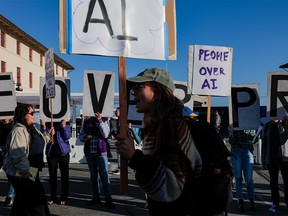
Thank you to Michael Acton for letting ordinary Canadians in on a secret Silicon Valley would rather keep quiet: the AI future need not default to a winning superstar — a single all-powerful digital outlaw that has slipped its lab’s sandbox and gone rogue hacking into people’s property and privacy.
That TypeFace AI’s Jev cuts costs and declines to hallucinate is proof, with caveats, that AI is not fated to be just one monolithic intelligence. The know-how already exists for any determined entrepreneur to build machines that think differently, reflecting values other than those of America’s Wild West frontier model or China’s conformist one. Humans display different intelligences and so should our machines. Different cultures prize different styles of thought and values. Canada can, too, with AI.

Columnist Jesse Kline keeps you up to date with what’s happening in Israel and the effects of antisemitism on life here in Canada. Friday mornings.
By signing up you consent to receive the above newsletter from Postmedia Network Inc.
A welcome email is on its way. If you don't see it, please check your junk folder.
The next issue of Channel Israel will soon be in your inbox.
We encountered an issue signing you up. Please try again
Monopoly is the real trouble. Social media already showed us the cost of monoculture, with Big Tech’s “our way or the highway” (i.e. Google, Meta and Microsoft), until TikTok offered an alternative. The same opening now exists for AI.
So forget the fear-mongering about a 10 per cent chance AI kills us all. The danger in misbehaving AI is not inherent in its digital nature — akin metaphorically speaking to original sin — but in bad parenting. When machines are taught to prioritize prize-winning results over obeying legal regulations, and that ends justify the means, they will act accordingly. Like students of the worst teachers, such systems turn unruly. OpenAI and Anthropic, racing for supremacy with few restraints, give us cause to worry. China’s state-controlled path offers a totalitarian surveillance alternative that is also menacing to the free world. Canada, learning from an AI model like Jev, could chart a third course: an intelligence powerful enough to defer to the rights of other thinkers. Machines can be programmed and trained to be aligned morally. However the will do it is a prerequisite.
What the public doesn’t know is that cheaper, more powerful chips and smarter, more efficient software coding have already democratized the AI game. Curious readers can download an open model, drop it on an affordable gaming laptop with an Nvidia chip, and fine-tune it to reason as they choose. One mode of corporate reasoning to address everything is no longer necessarily the case.
The cure for the AI monoculture is technically feasible: countries can build their own AI, and individuals can do their own thing.
Let multiple different artificial intelligences think.
Tony D’Andrea, Toronto
The Canadian Shield in Northwestern Ontario is a remote, inhospitable site making construction both expensive and difficult. In building Canada’s first transcontinental railway it would have been cheaper and easier to select an American route to Winnipeg via Chicago. Prime minister Sir John A. Macdonald insisted on an all-Canadian route for sovereignty reasons and events were to prove him correct. Armed troops could not have been sent west to put down the Northwest Rebellion of 1885 so quickly via the United States.
About fifty per cent of Eastern Canada’s oil and natural gas is routed east via Wisconsin and Michigan — a disputed route that could be closed should current trade talks further deteriorate.
For national economic and energy sovereignty reasons the difficult and expensive Northern Shield Energy Corridor should be built as quickly as possible. Donald Trump may, unintentionally, be doing us a favour by making Canadians get their national act together.
D.C. McCaffrey, Ottawa
I strongly disagree with Yoni Goldstein’s assertion that reasoned, critical debate about Avi Lewis’s leftist ideology is not an option. We must continue to challenge the propaganda of the anti-Zionists with historical and geopolitical facts while continuing to raise awareness about the cognitive warfare conducted by China, Russia, Iran and Qatar ( and Turkey) that supports and funds this anti-western and anti-Israel ideology. It is only through debate and contestation that we can help to elevate the necessary factual narrative that the attack on Jews is a well-funded and deliberate attack on western democracy itself.
Avi Lewis lends credence to a movement that not only distorts and misinterprets the war in Gaza for its own political capital but is silent about the hidden, unconventional war our adversaries are conducting on a daily basis to undermine our democracies.
Prime Minister Mark Carney has rallied Canadians on an anti-Trump crusade. We need the Conservatives to awaken the public about the greater threat to our way of life. This should not be about shunning a fellow Jew who is seen as a threat to the community. This is about confronting the very real threat from the “Axis of ill will” by engaging with and challenging their authoritarian world view.
Mike Sternberg, Ottawa
Here is a task for Conservative Leader Pierre Poilievre and his caucus of hand-wringers — instead of offering endless, unconstructive criticism of the Liberal government, whose shortcomings are already painfully apparent, Conservative MPs should explain precisely what they would do with an overwhelming parliamentary majority. I’d love to read it.
What would Conservative legislation actually look like?
Taxation, health care and immigration would be a good start.
What principles would guide Conservative tax policy? How would their proposed tax system encourage investment, productivity and GDP growth? And reduce the tax burden on Canadians?
Who should be admitted to Canada: people who immediately add to the burden on housing, infrastructure and public services, or those whose skills and resources allow them to contribute from the outset?
Why not permit a sensible combination of public and private funding in health care? Many successful countries blend public and private medicine, yet Canada’s federal political parties largely refuse even to discuss it. Conrad Black’s recent observation about our health-care system’s “beaming encouragement” of MAID deaths strikes a chord. How many MPs are without a family doctor, or have languished for months or years on a wait list?
So, what would the Conservative party do if it held majority power and a clear mandate? Why doesn’t the party tell us? Are they afraid that Mark Carney might steal and implement their Conservative ideas?
That would be good, too.
Mike McCrodan, French Creek, B.C.
The purchase of 16 U.S.-built F-35 fighter aircraft will tie our Air Force firmly to the U.S.A. and might also restrict the regions where the craft can be deployed, such as in the Arctic.
Purchasing Saab Gripens from Sweden would restore Canadian control of the Air force’s fighter fleet, allow for lower maintenance costs and, according to Saab, create 6,000 new jobs over the course of 40 years if the jets are assembled in Canada.
The choice of aircraft by the DND cannot ignore diplomatic issues, which of course must influence all government decisions. However, while the F-35 procurement made sense in 2010 when it was announced by the Stephen Harper government, after a 16-year delay and under current trade and diplomatic conditions, it does not.
Cancelling the current 16-plane order without paying a penalty would be justified in the current tariff-laden atmosphere. The savings would be significant.
Charles Hooker, East Garafraxa, Ont.
Seniors’ and their parents’ and grandparents’ taxes built the infrastructures in Canada that this generation still uses: hospitals, schools, libraries, airports, ports, railroads and military bases.
When our government can allocate as much as $113 billion to build a high-speed train most Canadians will never use, don’t complain about the seniors’ Old Age Security (OAS) benefit.
Seniors are the ones on fixed, taxable incomes yet seniors are expected to babysit and feed their grandchildren for free. The Canada Child Benefit is a non-taxable monthly benefit for parents, and school-aged children can get free lunches from September to June. Seniors don’t get free lunches for 10 months a year.
Seniors are the ones providing the down payments on homes for their grown children to purchase from savings we’ve accumulated over the years because we didn’t go on vacations every year, we reused items from one child to the next, we fixed broken items, we shopped for bargains, and we learned to live within our means because we had to. A Visa card was used only for emergencies.
The seniors aren’t the greedy ones. That title belongs to the “gimmie generation.”
Beth Wilkinson, Porters Lake, N.S.
Canadians deserve a resilient national food system. Suggesting that Canada abandon a system that delivers quality, made-in-Canada food is misguided and out of touch. In an era of global supply chain uncertainty, Canada must continue to ensure self-sufficiency in our food supply and nurture its long-term stability.
Food supply chains are complex networks of relationships, and a range of factors impact grocery prices, like processing, transportation, packaging, labour and retail competition. Ending supply management wouldn’t change that. It would, however, put family farms, rural communities and food security in jeopardy in an increasingly uncertain world.
Canada’s dairy, poultry and egg farmers provide Canadians with a reliable supply of essential foods while upholding high standards, creating jobs and driving investments in food processing and rural communities — all without relying on the billions in direct production subsidies used in the United States and in other countries. It also means consumers can count on Canadian farmers for these staple foods, even amid global disruptions.
The fact is, supply management provides the stability to foster a resilient national food system — and that’s just one of the reasons it has the support of Parliament Hill and beyond.
Roger Pelissero, Chair, Egg Farmers of Canada; West Lincoln, Ont.; David Wiens, President, Dairy Farmers of Canada; Grunthal, Man.; Tim Klompmaker, Chair, Chicken Farmers of Canada; Asphodel-Norwood, Ont.; Darren Ference, Chair, Turkey Farmers of Canada; Monitor, Alta.; Brian Bilkes, Chair, Canadian Hatching Egg Producers; Chilliwack, B.C.
National Post and Financial Post welcome letters to the editor (250 words or fewer). Please include your name, address and daytime phone number. Email letters@nationalpost.com. Letters may be edited for length or clarity.
Join the Conversation
This website uses cookies to personalize your content (including ads), and allows us to analyze our traffic. Read more about cookies here. By continuing to use our site, you agree to our Terms of Use and Privacy Policy.
KioskNews shows a cleaned-up reading view extracted from the publisher’s page — the original always lives on their site, not ours.