Bird and bat droppings reveal 87 rice pests in their diets: Study
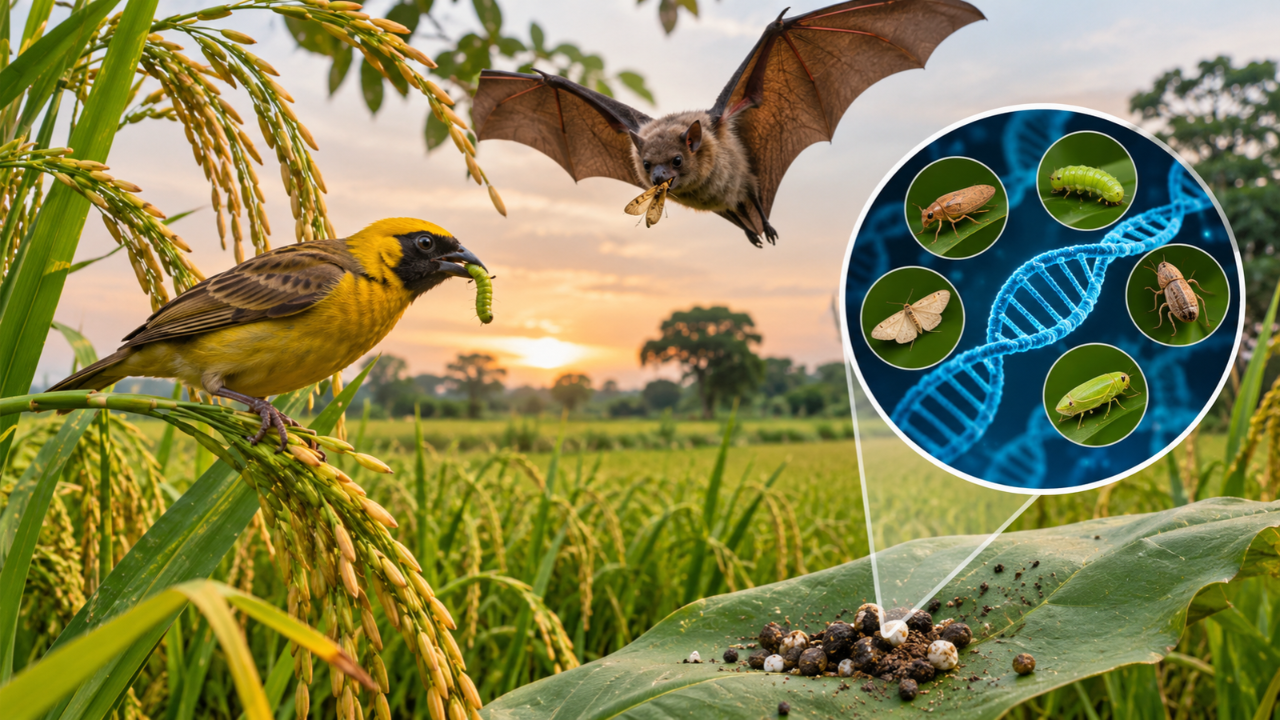
Image AI generated
Rice is a staple food for nearly half of the world’s population. A study tested the droppings of 502 birds and bats caught in lowland rice fields in northern Guinea-Bissau. According to the researchers, insect DNA in the samples revealed 2,276 feeding interactions between 34 predator species, 18 bats and 16 birds, and 1,347 types of prey.
According to the study published in Agriculture, Ecosystems and Environment, titled ‘Ecological networks reveal strong pest suppression complementarity between birds and bats within rice-dominated agroecosystems in West Africa’, of the prey identified to genus or species level, 87 were rice pests. The authors report that bats and birds ate a similar number of pest species when compared at the same sample size, but mostly different ones.
How did researchers identify rice pests in bird and bat droppings
According to the authors, the work took place in the Oio region of northern Guinea-Bissau, between the towns of Farim and Mansaba.
They describe a flat landscape dominated by small family farms. Rice grows across most of the seasonally flooded lowlands, while cashew orchards cover the higher ground around them. Birds and bats were caught in the rice fields in 2021 and 2022, from June, before the rice was sown, to December, when it ripened and was harvested.The study states that the animals were caught in mist nets set up in the fields and along their edges.
Each one was placed in a single-use bag for 20 to 30 minutes so that droppings could be collected. In total, droppings from 502 animals were analysed, 345 from bats and 157 from birds. The researchers read the insect DNA in each sample and matched it against reference databases. Prey identified to genus or species level were then labelled as rice pests or non-pests using published literature.
How many rice pest species did birds and bats consume in the study
According to the paper, 262 prey types were identified to genus or species level, and 87 of them were rice pests.
Thirteen bird species, which is 81% of the birds sampled, ate rice pests, averaging 5.9 pest species each. All of the bat species ate rice pests, averaging 6.2 pest species each. Among birds, the village weaver (Ploceus cucullatus) ate the most pest types, 16 from 64 samples. The Northern red bishop (Euplectes franciscanus) followed with 12 from 12 samples, and the red-billed firefinch (Lagonosticta senegala) with 9 from 9 samples.
Among bats, a yellow bat (Scotophilus otu1) recorded 24 pest types from 103 samples, a leaf-nosed bat (Hipposideros caffer/ruber) 15 from 34, and the banana serotine bat (Afronycteris nana) 10 from 33.The authors report that bats and birds ate a similar number of pest species when compared at the same sample size, but they mostly ate different ones. The study also found that diets changed with the seasons. In the dry season the animals ate 909 prey species, against 620 in the rainy season, and about 45% were shared between the two.
For rice pests, 61 species were recorded in the dry season and 48 in the rainy season, and only 14% of pest species appeared in both.
The most commonly eaten pests were two termites, Macrotermes bellicosus (eaten by 15 predator species) and Microtermes otu9 (11), and a spittlebug, Poophilus costalis (9).
How was the bird and bat feeding network divided into 16 distinct groups
The feeding network was split into 16 distinct groups, which the authors call modules. Within each group, predators and prey interacted mainly with one another.
The authors say this points to relatively independent communities of predators and prey, with little overlap between what different predators eat. They also report that the network could cope well with the loss of prey species, scoring 0.993 on a scale where 1 is the maximum, although this was not significantly different from random networks.The paper also compares the two predator groups. Bats fed on a significantly wider range of prey than birds did, with bats averaging 94.94 prey types against 35.38 for birds.
Birds were significantly more specialised in what they ate, scoring 0.74 against 0.52 for bats. When only pests were considered, the study found no significant difference between birds and bats in the number of pest species eaten. The authors also report that the red-cheeked cordon-bleu (Uraeginthus bengalus) had the highest frequency of pest interactions among birds, at 39%, and a slit-faced bat (Nycteris otu27) the highest among bats, at 35%.
Banana serotine bat and Northern red bishop contribute to pest control
The authors report that the species most important to the overall feeding network were not always the ones most important for pest control. The yellow-faced bat, the leaf-nosed bat, another bat (Scotoecus otu14), the village weaver and the wire-tailed swallow (Hirundo smithii) were identified as key in the wider community. When only pests were considered, the banana serotine bat stood out as the key bat, and the Northern red bishop became the second most important bird.The study sets out several limits. The DNA method cannot show how much prey an animal ate or how many individuals, so the authors say it is hard to judge the actual effect on pest numbers. They also note that West African insects are poorly covered in DNA databases, and that the true number of pests eaten is probably higher. The paper adds that farmers in the region often see birds, especially weavers, as major threats to rice fields.
The authors write that some birds can cause serious crop damage, but that these same birds may also help suppress pests. They recommend that future studies pair DNA analysis with field experiments that exclude birds and bats from plots.
KioskNews shows a cleaned-up reading view extracted from the publisher’s page — the original always lives on their site, not ours.