Malaysia must pursue legal action against Indonesia over transboundary haze — Shahrul Mizan Ismail
SEPTEMBER 19 — The duty to prevent dangerous pollution does not begin when a neighbouring government sends a letter. Malaysia should prepare an international claim over transboundary haze wherever the evidence establishes Indonesia’s failure to meet its obligations. Anger should become a legal strategy with identified breaches, defensible evidence and realistic remedies.
The Asean Specialised Meteorological Centre activated its highest regional haze alert on August 26, 2026. Its monitoring has also recorded smoke drifting from Kalimantan towards Sarawak. That supports investigation. It does not, by itself, establish Indonesia’s legal responsibility for every Malaysian loss.
The legal foundation already exists. Malaysia and Indonesia are parties to the Asean Agreement on Transboundary Haze Pollution. Its provisions address monitoring, prevention, preparedness and emergency response. Article 4(2) requires prompt responses to requests for relevant information or consultations where transboundary haze originates within a party’s territory. Article 12(4) requires a prompt decision and notification on an offer of assistance.
These obligations do not await a formal protest. But neither does the treaty make Indonesia automatically liable whenever smoke crosses a border.
The central question is whether Indonesian authorities exercised the diligence required by international law. In Pulp Mills, the International Court of Justice explained that due diligence involves appropriate regulation, vigilant enforcement and administrative supervision of public and private operators.
Malaysia should therefore investigate specific failures. Were known fire risks addressed before the dry season? Were recurring violations investigated? Were enforcement orders implemented? Were warnings followed by reasonable preventive measures?
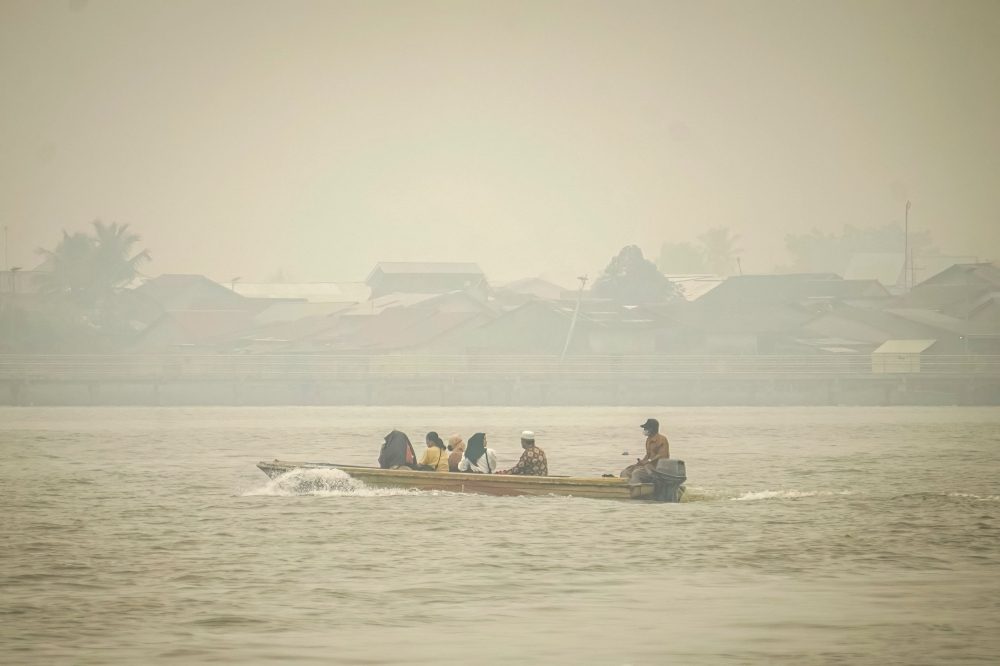
People travel on a river boat as thick haze from forest and land fires blankets Benua Melayu Darat village in Pontianak, West Kalimantan, on September 16, 2026. Toxic haze has shrouded parts of Indonesia, Malaysia and Singapore for weeks as Jakarta struggles to contain fires that have scorched large tracts of Borneo and Sumatra, with the smoke drifting across the region. — AFP pic
Indonesia must have an opportunity to supply evidence of its response. Extreme weather and difficult terrain matter to the assessment. So does evidence that reasonable precautions were available but neglected.
Private plantation fires need not be treated as government acts. A state can instead be responsible for its own failure to discharge regulatory duties. The Court’s 2025 climate advisory opinion reinforces that distinction, although it does not decide this haze dispute.
Malaysia should take four practical steps.
First, Wisma Putra and the Attorney General’s Chambers should issue a substantiated notice of claim. It should identify the obligations allegedly breached, request records and consultations, and reserve Malaysia’s right to reparation. Emergency cooperation should continue.
Second, independent experts should connect fires, pollutant transport and Malaysian exposure. Satellite observations must be tested against ground measurements and atmospheric modelling. Domestic pollution sources and scientific uncertainty must be included. A hotspot is an investigative lead, not proof of who started a fire.
Third, quantify losses caused by the alleged breach. Additional treatment, monitoring and emergency expenditure should be supported by records. The Court’s 2018 Costa Rica–Nicaragua compensation judgment recognised environmental damage as compensable, while requiring a sufficiently direct and certain causal connection. Malaysia must explain what injury adequate diligence would have prevented or reduced.
Fourth, secure a lawful route to a binding decision. The haze treaty provides consultation or negotiation, not compulsory adjudication. An ICJ case requires a valid basis of jurisdiction. Malaysia should propose a special agreement, arbitration or a bilateral claims commission with independent experts and binding awards.
Unclos deserves separate examination if evidence establishes relevant marine pollution. Smoke passing above the sea is insufficient. Jurisdiction, procedural requirements and exceptions must be addressed before litigation is threatened.
An initial ninety-day programme should produce an evidence dossier, a provisional loss account and a reasoned proposal for settlement or adjudication. These are proposed administrative targets, not treaty deadlines.
Any implicated Malaysian companies should face the same scrutiny. Nationality cannot become an excuse for selective accountability.
Malaysia already has legal tools. It needs the discipline to use them. The absence of a protest cannot erase an existing duty; the absence of a serious legal strategy would be harder to explain.
* Dr Shahrul Mizan Ismail is an associate professor at the Faculty of Law, Universiti Kebangsaan Malaysia.
** This is the personal opinion of the writer or publication and does not necessarily represent the views of Malay Mail.
KioskNews shows a cleaned-up reading view extracted from the publisher’s page — the original always lives on their site, not ours.