One man, 185-m Metro link: After years of holdout, Mumbai resident vacates home
LEFT FOREVER: the words are written, bold and underlined, by the calendar entry for November 16, 2026.
The date marks the day when Ben Muthanna, or Mutha, moved out of his home of 45 years in the Juhu Gulmohar Cooperative Housing Society (CHS). Mutha was the last resident of the society’s two buildings for several years, with the others deserting it as its condition grew worse. And he was the only one in the way of its long-pending demolition, holding up a 185-metre stretch of Metro Line 2B at Juhu Circle, one of the busiest junctions in Mumbai’s western suburbs.
Mutha was not the only one for whom the day marked a momentous occasion.
Many others were relieved when he completed the short walk, a few buildings away, to his new home. His fellow society members, waiting for the redevelopment. Officials of the Mumbai Metropolitan Region Development Authority (MMRDA), who had spent at least a year trying to persuade him to leave. And officials of MHADA, the state housing authority that owns the land, roped in as the metro’s March 2027 deadline drew closer. If Mutha’s elder sister had been alive, she, too, would have been relieved that her pleas had finally been heard.
“Have they started demolishing it yet?” Mutha asked when The Indian Express went to meet him at his new home. From a window in his bedroom, workers could be seen atop the under-construction stretch of metro his old building has made way for, as it came within its safety buffer. Hidden from view, workers from Bhoomi Realty, the developer appointed for the redevelopment, have begun hacking at the building, answering Mutha’s question.
A home since 1981
Flat no 9, second floor: the two-bedroom flat that Mutha finally vacated had been his family’s home since 1981, when the building was new. The family had shifted to Juhu Gulmohar CHS, a stone’s throw from Juhu beach, from Khar — his father in civil aviation, mother a teacher, Mutha and his elder sister.
Mutha did not respond to queries about his age. While his former neighbours put him at about 55, officials said he was closer to 66. Mutha did his B Com, went into sales and marketing, and eventually worked for a popular water purifier company. He remembers being quite the catch, with several proposals lining up at his door, although none of them worked out. Over the years, the Juhu Circle junction at which his building stood became ever more important and congested.
Story continues below this ad
This was also the home in which he lost everything he knew. His parents died in the 2000s, leaving the siblings with the house in Juhu and another in Coorg. His sister eventually moved to Coorg, the two siblings, both single, parting ways. Talks of the building’s redevelopment, which Mutha remembers beginning in 2005, sparked fears of losing his home. Age caught up with him, with knee pain troubling him and limiting his movement. And in September this year, he lost his sister to breast cancer, many miles away from him.
“I have moved from one prison to another,” said Mutha, speaking of the paranoia and fear he has lived with, of his home and belongings being taken away and destroyed. The years of isolation, the fear that if he were to step out, his house would be snatched from under his feet, and his ageing knees, have kept him mostly homebound. “I wish I could go to the park sometimes.”
“When the conversation about redevelopment started, I was largely kept out of it,” he said. “I caught a sentence here and there occasionally. So I never really knew what was going on.”
A promise of another home
In Mumbai, redevelopment is how ageing housing societies renew themselves. Residents hand their building to a builder, who tears it down and puts up a taller one, selling the extra flats to pay for it. The residents get new flats, and rent to live elsewhere until these are ready.
Story continues below this ad
Juhu Gulmohar’s redevelopment, which formally began in 2011, has been a long-drawn saga. The society had its approvals by 2014, but the final alignment of Metro Line 2B, a 23.64-km elevated line across the city’s suburbs, from Mandale in the east to DN Nagar in the west, put its buildings in the metro’s safety zone, and they had to be demolished. Height restrictions near the airport stopped the society from making up the lost space by building higher. The fix was a land swap, sealed in September this year: the society takes a plot at Tilak Udyan, a garden 650 metres away, and its old plot becomes the garden, with the metro passing overhead.
Mutha knows only the contours of the saga. He harboured suspicion that the other society members had unfairly benefited from the redevelopment deal, and that he would be swindled out of his rightful home. This insecurity of losing their home also led to his sister returning to Coorg in March, in the middle of her cancer treatment in Mumbai, to hold down her guard there.
“There were rumours of something happening to the home from our extended family, so she left after a few months of being here. I told her not to go,” he said.
In all this, Mutha held on to his home. “A built home is better than a promise of another one down the line,” he said.
Story continues below this ad
After the housing society, MMRDA and MHADA signed an MoU for the land swap in February 2025, the promise of redevelopment was much more solid than it had ever been. And officials of the MMRDA wanted the building’s demolition, to begin construction on the remaining 185 metres, so they tried to persuade him to move out. But Mutha had earned the reputation of being a non-cooperative recluse. (When The Indian Express knocked on his door one afternoon, Mutha opened the door, albeit wearing a mask.)
“It was around this time last year when officials from the MMRDA had come, many of them together. A senior MMRDA official had also come, but due to the pain in my knees, I could not go down to meet him,” said Mutha, referring to the MMRDA’s chief.
After the lease for the new plot was signed in September, the urgency to move the last resident grew. The MMRDA had already begun placing girders in the 185-metre gap, with vibration monitors tracking the effect on the building, and was to finish lifting them by November 18. Any further work needed the building gone, and the extra space its demolition would open up. And this was the only incomplete section on the next phase of Line 2B. Until it is built, trains cannot run between Andheri and Khar, and commuters in Vile Parle, Santacruz and Khar are still waiting for the metro to reach them.
‘Human being to human being’
The final triumph was owed to a MHADA officer.
“The rumours about him turned out to be unfounded,” said the MHADA official in charge of the area, who finally convinced Mutha. “Mutha has been living in isolation for the past few years, without any close family and had grown insecure that he would end up losing his home. But as we spoke to him, understood his concerns, and assured him, he came around,” said the official who did not want to be identified.
Story continues below this ad
Mutha said it was the official who convinced him to finally give in. “He spoke to me, human being to human being. He was kind and heard me out,” he said. “He even bought me a walking stick, although I am afraid if I use it, it will spell the beginning of my end.”
The shifting, when it happened, was fast. Mutha was shown six flats in the area on November 13, none much to his liking. Three days later, he was shown the flat in a MHADA staff quarters building, a one-bedroom, smaller and cheaper, but with a wide open terrace that clinched the deal. He moved in that same day.
Four fridges and a terrace
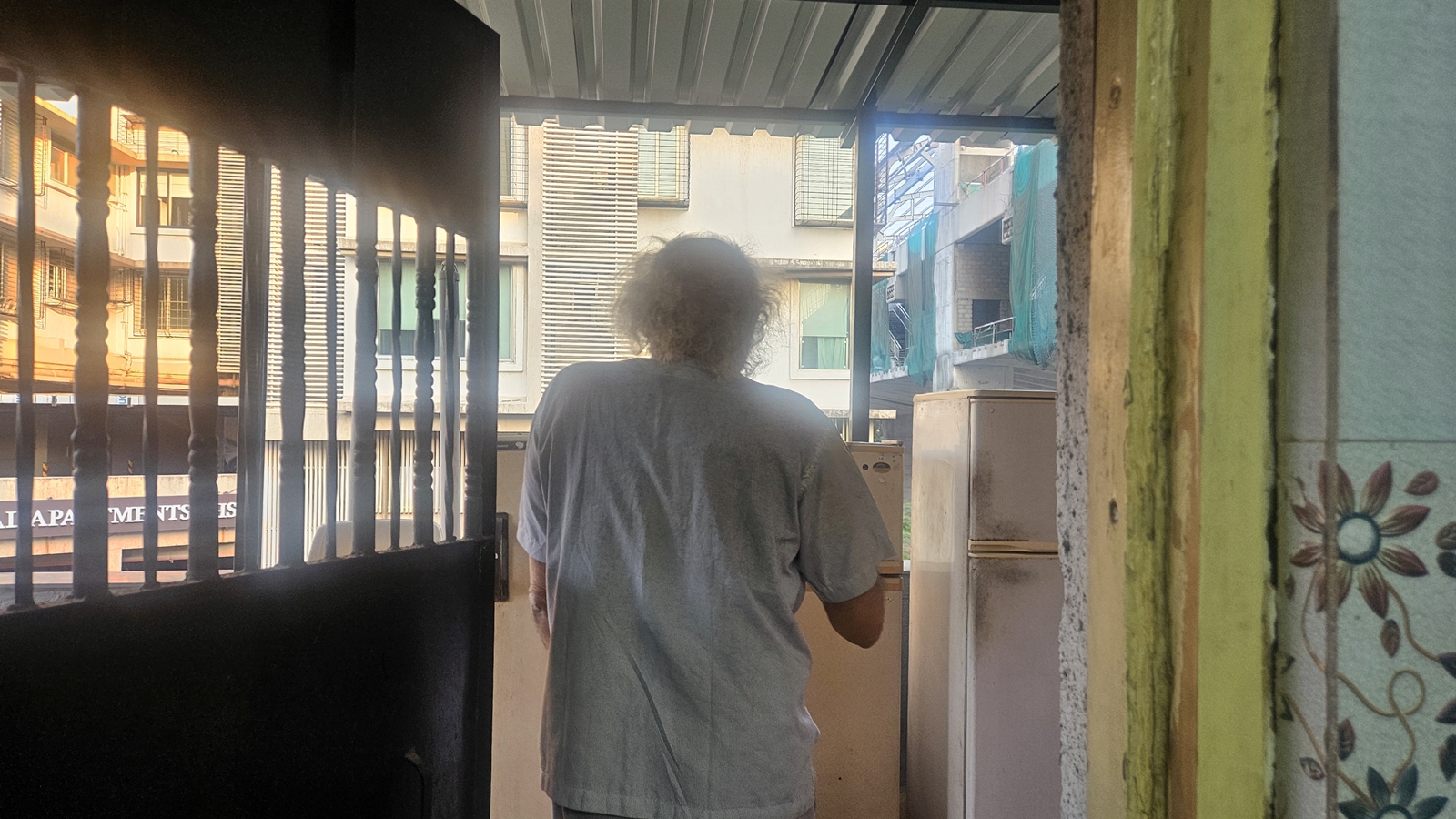
When The Indian Express visited him in his new home, the one-bedroom-hall-kitchen with an open terrace was in the midst of being set up. In the bedroom, a bed was covered with a mosquito net. All the other belongings from his old home were dumped on the open terrace. Four refrigerators, with only one plugged in, held much of Mutha’s food and belongings: cartons of juice, rows of chyawanprash tubs, folded plastic bags, medicines, and even old sunglasses. This habit, he said, was an after-effect of a rat infestation many years ago.
He orders his meals from restaurants he’s known for decades, and groceries from kirana stores. He keeps up with the news, tuning into the radio in the afternoons.
Story continues below this ad
Mutha was full of philosophical musings. He spoke about laughing when the going gets tough, and then remarked that he should take his own advice. He acknowledged he had been “an idiot far too many times” in his life.
“Mutha is alright,” said the MHADA official. “Initially, we were wary because of everything we’d heard about him… He has all his accounts in place. It is only his years in isolation that have made him a little wary of the world around him. A psychologist from an NGO we called to check up on him said he was fine, and was just exhibiting effects of solitude.”
No payment or agreement
But Mutha’s apprehensions are not all unfounded. In a typical redevelopment, residents move out and buildings come down only after the final building plans are approved and construction is cleared to begin. Juhu Gulmohar CHS is being rebuilt on a different plot. And while that plot is boarded up, final approvals are yet to come in. Only then will the builder and the residents sign the permanent alternative accommodation agreements, which commit the builder to new flats and start the rent residents are paid while they live elsewhere. The society has an agreement with the developer, but the flat is still listed under Mutha’s father’s name.
“If I had moved out years ago like the others, I would have been paying rent out of my own pocket for all this while,” noted Mutha, and he’s not wrong. “Right now, I have left my home without any money or an agreement.”
Story continues below this ad
The officials from MHADA said the rent for his flat in the MHADA building was yet to be calculated, and would be deducted from the rent the builder is due to pay him while the new Juhu Gulmohar CHS, 10 storeys tall, up from three to four, is built.
Outside his new home, the world is already moving towards forgetting the old Juhu Gulmohar CHS. On November 17, a day after Mutha moved out, demolition of the buildings began.
KioskNews shows a cleaned-up reading view extracted from the publisher’s page — the original always lives on their site, not ours.