Ukraine war briefing: Energy attacks made possible by continuing Starshield restrictions, says Zelenskyy
-
Attacks on Ukrainian energy and railway infrastructure were being made possible partly due to restrictions on Ukraine’s use of Elon Musk’s Starshield service, Volodymyr Zelenskyy said on Sunday – reiterating criticism he made late last week. “Many of these strikes are getting through because restrictions on the speed of Starshield terminals along the frontline in the temporarily occupied territories are still there.” The president said Russian forces were singling out specific regions – in particular, southeastern Dnipropetrovsk and Zaporizhzhia – and repeatedly striking them over several days. There have been many outages, and restoration is proceeding,” he said. “Power has been restored to some extent, but there is still a lot of work ahead.”
-
Zelenskyy made similar comments about the Starshield satellite system on Friday accusing SpaceX of not telling the truth over restrictions on Ukraine’s use of the system, saying the decision to impose speed limits appeared to be “political” rather than “technical”. As a result, incoming jet-powered Russian Shahed drones could no longer be intercepted, and Ukraine’s own mid-range strikes against military targets in Russian-occupied territory were also severely affected, he said.
-
Zelenskyy also announced on Sunday that a meeting of Kyiv’s allies, the so-called Coalition of the Willing, was being prepared, aimed at defining the European position in talks on ending the war with Russia. He said a meeting of the Ramstein group – countries helping to support Ukraine’s defence – was set for next week and that it needs to “send a strong signal to Russia that Ukraine will not be left without support”. Europe has chosen five countries – France, Britain, Poland, Germany and Italy – to send representatives to future Ukraine peace talks. “It is an important meeting, and it could be a historic one,” Zelenskyy said in his daily evening address.
-
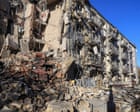
On Sunday, a Russian strike on Chornomorsk injured six people and damaged energy infrastructure, leaving about 41,000 customers without power. Russia struck energy and railway infrastructure in eight regions of Ukraine overnight, said Zelenskyy.
-
Estonia will close all its border crossings with Russia from 1 December after a suspected sabotage attack on a drone maker in the Baltic state over the weekend, which authorities said was ordered by Russia’s GRU military intelligence service. The Estonian prime minister, Kristen Michal, linked the attacks with Estonia’s continuing support for Ukraine. “Russia’s aim is to make us afraid, make us hesitate and weaken our support for Ukraine,” Michal said. Russian Foreign Ministry spokesperson Maria Zakharova was quoted on Sunday saying any closure of the border by Estonia would be another demonstration of “Russophobia”.
-
Warnings from Russia to western diplomats to leave Kyiv or risk being killed were “cognitive warfare”, say European ambassadors, some of whom have spoken to the Guardian’s Luke Harding about why they chose to stay in Ukraine during the war. The EU’s ambassador in Kyiv, Katarína Mathernová, said the threats were part of Vladimir Putin’s strategic goal to destroy the EU. But ambassadors say their continued presence sends a powerful signal of solidarity to Ukraine’s embattled leadership.
-
Prince Harry made a surprise visit to Ukraine over the weekend, meeting wounded veterans and medics specialising in war injuries and telling them: “You’re going to win the war.” In his fourth visit since the war began and his second time in Lviv, he met patients and staff at an orthopaedic clinic treating wounded military personnel and civilians. “We’ve invested in them before they put the uniform on and we must invest with them once the uniform comes off,” he said.
KioskNews shows a cleaned-up reading view extracted from the publisher’s page — the original always lives on their site, not ours.