Indonesia, Malaysia, S’pore commit to keep Malacca, Singapore straits free, open, safe
SINGAPORE - Indonesia, Malaysia and Singapore are building on efforts to ensure the Malacca and Singapore straits remain open and safe to all seafarers, with new tech tools to anticipate risks early and improved incident response initiatives.
The three littoral states and other partners also regularly upgrade infrastructure like navigational aids that guide ships through the straits today, said Transport Minister Jeffrey Siow.
For instance, work to deploy virtual navigational aids – which convey information to ships when physical aids are under maintenance – was completed recently, he added.
There are now more than 50 navigational aids that guide ships through the straits today, and which are partly funded by voluntary contributions, he said.
Siow was speaking at the opening of the two-day Co-operation Forum held at the M Hotel on Aug 25.
In his address, Siow said digital tools and data-sharing are being used to improve situational awareness at sea and on shore. That includes the use of artificial intelligence, which helps to anticipate traffic hot spots and warn vessels about likely collisions.
Regional guidelines to improve coordination for ships in distress, which need a safe location to carry out repairs or discharge cargo, are expected to be finalised within the year.
In recent years, there have been more cargo fires on container ships, said Siow. Singapore is proposing steps that can help the littoral nations tackle the problem.
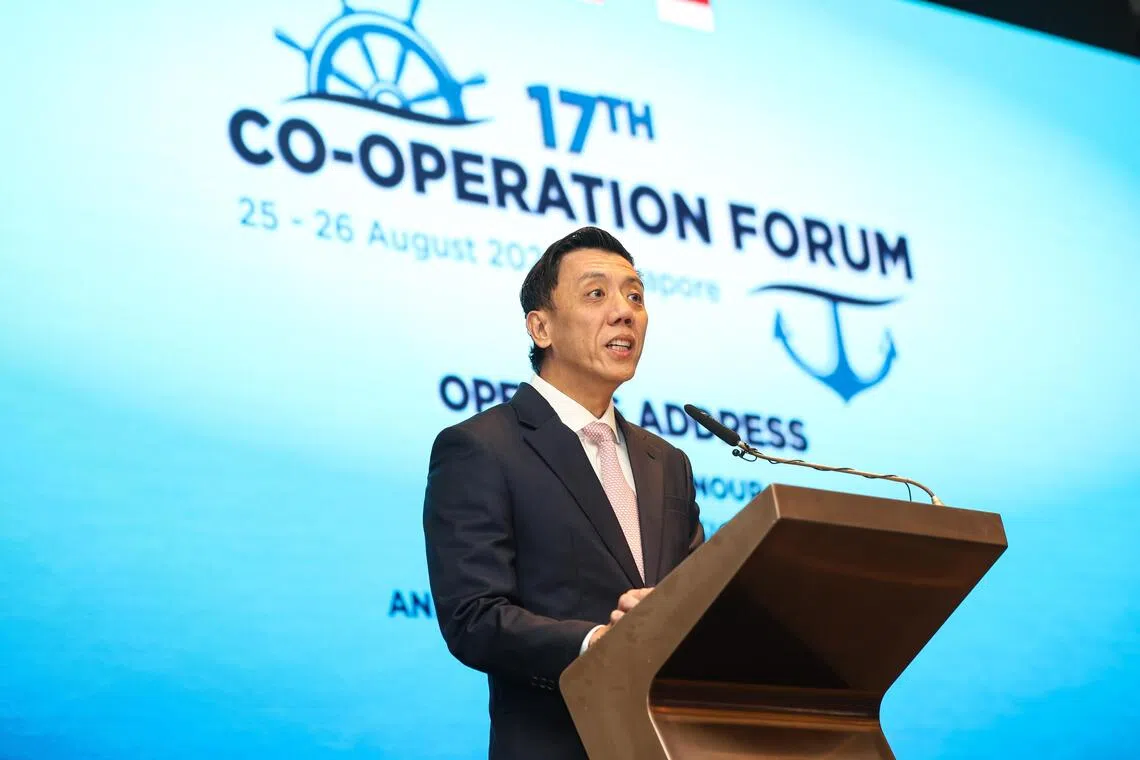
Transport Minister Jeffrey Siow speaking at the 17th Co-operation Forum at M Hotel on Aug 25.
PHOTO: LIANHE ZAOBAO
It will include things like incident management, locating the containers or wrecks, and incident notification.
Siow said: “All these initiatives are important because they address practical risks, bring together officials, experts and industry partners, and build confidence.”
An incident in 1975 crystallised the value of cooperation among the littoral states, he added.
That year, a Japanese vessel called the Showa Maru ran aground near Pulau Sebarok – a small island off the southern coast of Singapore. This resulted in the worst oil spill in the strait at the time, with more than 3,300 tonnes of crude oil discharged into the sea.
Indonesia, Malaysia and Singapore together managed to limit the environmental damage by mounting a swift clean-up operation but the incident prompted them to collaborate and implement new measures to prevent future incidents.
Siow also said open sea lanes cannot be taken for granted. Ship traffic through the Strait of Hormuz, he added, has fallen to less than a tenth of what it was before the Middle East war broke out this year.
The United Nations Convention on the Law of the Sea or UNCLOS guarantees ships the right of passage, but vessels continue to be attacked when they use the Strait of Hormuz, he said.
“In our part of the world, we will endeavour to keep the straits of Malacca and Singapore free, open and safe for international shipping,” Siow added.
The Co-operation Forum is now into its 17th year. It is linked to the Cooperative Mechanism created by Indonesia, Malaysia and Singapore in 2007 to serve as a platform for user states, maritime industry and others to work together on navigational safety and environmental protection in the Malacca and Singapore straits.
This year, over 300 delegates from more than 125 countries and organisations attended the forum, which the three littoral nations take turns to host each year.
Maritime and Port Authority of Singapore (MPA) chief executive Ang Wee Keong, in his speech, said discussions this year will focus on enhancing navigational safety in the straits through the use of technology, preparing for emerging challenges, and safeguarding the marine environment.
New technologies like autonomous vessels make it necessary for the littoral states to consider new regulatory approaches because such challenges require multiple countries to work together, he added.
Former Indonesia foreign minister Hassan Wirajuda, who also spoke at the forum, said it is key that the three littoral states continue their cooperation.
It was also important for the international maritime community to keep the straits safe while maritime and geopolitical challenges evolve, he added.
Hassan, who was involved in talks that led to the setting up of the Co-operative Mechanism in 2007, said it was important for international laws to be respected, and there needs to be a culture of dialogue in managing differences and maintaining regional peace.
More than 25 delegates from the European Union and countries like Australia, China, Greece, Norway, as well as major maritime groups like the World Shipping Council spoke at the forum on the straits and Co-operative Mechanism.
Several speakers touched on how the Middle East conflict and its impact on the Strait of Hormuz have exposed the vulnerability of the global system.
The Malacca and Singapore straits form one of the world’s busiest shipping lanes through which more than 100,000 vessels pass every year. Almost a quarter of global seaborne trade and nearly a third of the world’s oil and gas supply goes through the waterway.
KioskNews shows a cleaned-up reading view extracted from the publisher’s page — the original always lives on their site, not ours.