Unborn fetuses to count toward social housing priority
Unborn fetuses may be counted alongside a family’s minor children when determining priority access to social housing, under new regulations issued by the Ministry of the Interior (MOI).
Earlier this year, Taiwan amended Article 4 of the Housing Act (住宅法) to require that at least 20 percent of social housing units be reserved for couples married for less than two years or those who have children under the age of 18.
Under the amendments, families with more children are given higher priority for the subsidized rental homes.
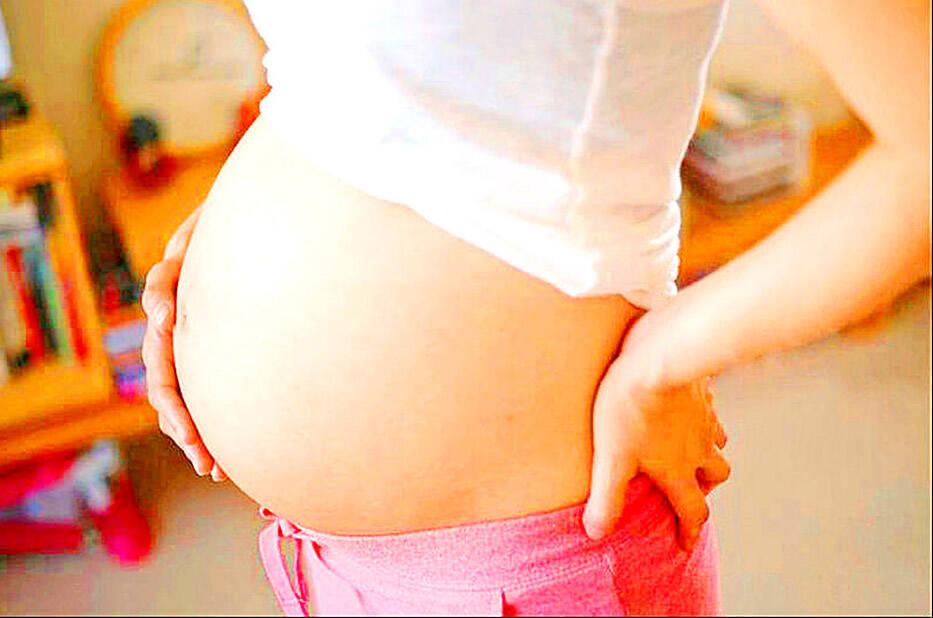
A pregnant woman is pictured in an undated photograph.
Photo: Taipei Times
In implementing regulations published on Nov. 11, the MOI said both minor children and unborn fetuses should be counted when determining a family’s priority for social housing.
To verify a pregnancy when applying for social housing, couples may submit a maternal health handbook, a medical certificate issued by a healthcare institution or other documentation deemed sufficient proof, the MOI said in explanatory notes accompanying the regulations.
A maternal health handbook, commonly known as a “mama handbook” (媽媽手冊), is typically issued between the eighth and 12th weeks of pregnancy.
In the explanatory notes, the ministry said giving expectant families priority for social housing was consistent with government efforts to encourage childbirth.
The rules aim to make it easier for families to raise children and address the housing needs of families with children, the MOI said.
In addition to the 20 percent of social housing units reserved for young families, the Housing Act requires that at least 40 percent be allocated to economically or socially disadvantaged applicants.
The MOI regulations highlight the complex legal status of unborn fetuses in Taiwan.
Under Taiwanese law, a fetus is not generally recognized as a legal person until birth, and abortion is generally allowed with spousal consent up to 24 weeks of pregnancy.
However, fetuses have conditional rights in certain areas of civil law such as inheritance and compensation for damages, provided the child is not stillborn.
KioskNews shows a cleaned-up reading view extracted from the publisher’s page — the original always lives on their site, not ours.