Solar energy producers targeting open US market
By Lisa Wang / Staff Reporter


Solar cell and module supplier United Renewable Energy Co (URE, 聯合再生) yesterday said its US revenue would double next year, mainly benefiting from a market realignment fueled by US solar reshoring policies and crackdowns on Chinese green energy companies.
To capitalize on the new market opportunities, URE is racing to launch a new solar module line through a new joint venture with Sino-American Silicon Products Inc (SAS, 中美晶) in the third quarter of next year, URE said. The new production line is designed with an annual production capacity of 1 gigawatt (GW), it said.
“We have no choice but to expand into the US market — it is the only arena where we hold a competitive edge. Otherwise, we are left to contend with the challenges posed by China,” URE chairman Sam Hung (洪傳獻) said at a news conference yesterday.
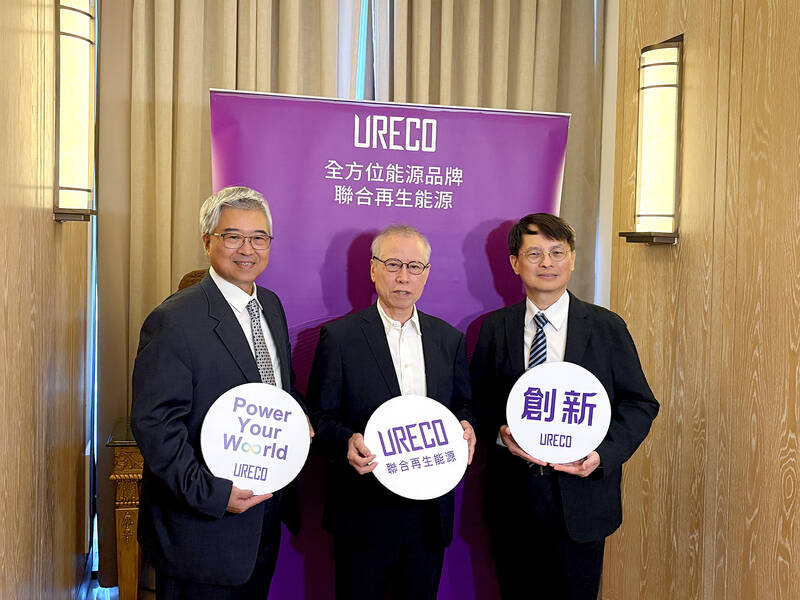
United Renewable Energy Co chairman Sam Hung, center, CEO Richard Chang, left, and Chiang Hao-hsien, solar business group general manager, pose for a photograph in Taipei yesterday.
Photo: Lisa Wang, Taipei Times
Hung’s remarks came as the US administration is tightening restrictions on Chinese clean energy technology by adding minimum import prices from Dec. 4 this year after imposing a 15 percent import tariff and restricting Chinese ownership in subsidized US plants to 25 percent.
In the EU and Japan, URE faces stiff competition from Chinese rivals exporting heavily subsidized solar products, Hung said.
Additionally, the US remains one of the world’s largest solar markets, boasting annual demand of 40GW to 50GW of solar power generation, Hung said.
URE is targeting the non-China market segment, which is estimated to have 30GW to 35GW of demand per year, he said.
“We anticipate the US market to contribute a large portion of the company’s revenue in the future,” Hung said. “The company’s operation is on track.”
This year, the US is expected to account for less than 20 percent of URE’s revenue, URE chief executive officer Richard Chang (張為策) said.
Chang expected revenue from the region to double next year, driven by rapidly-growing demand from the decoupling supply chain and ballooning electricity demand from artificial intelligence (AI) data centers.
To feed the insatiable power hunger of AI data centers, operators are aggressively blending solar energy with other alternative power sources to prevent grid overloads, Chang said.
“Overall, we believe next year will be a much better year for URE in terms of business, supported by strong solar energy demand overseas and at home,” Chang said.
URE is accelerating efforts to expand its product portfolio to include solar modules for low Earth orbit satellites. The company’s satellite solar products are in the research-and-development pipeline, it said.
The space-based solar market is a smaller market with annual demand of less than 10MW a year in the US, URE estimated.
URE swung back to a net profit of NT$1.52 billion (US$47.9 million) in the first half, from a loss of NT$599 million in the same period last year, company data showed. The company attributed the improvement partly to a disposal gain of NT$2.1 billion from selling a solar plant in January.
KioskNews shows a cleaned-up reading view extracted from the publisher’s page — the original always lives on their site, not ours.