How Ultron's MCU Return Tackles The Rise Of AI Explained By Marvel Showrunner

Lewis is a Lead Writer for Screen Rant and has written for the site since 2022. This has allowed Lewis to explore a vast array of films, TV shows, books, comic books, and games from across the mainstream world of pop culture, reflecting his lifelong love of all media and typifying his experience in the world of fiction storytelling. To top this off, Lewis graduated from Northumbria University with First Class Honours in Film & TV Studies, truly exemplifying his experience in the medium.
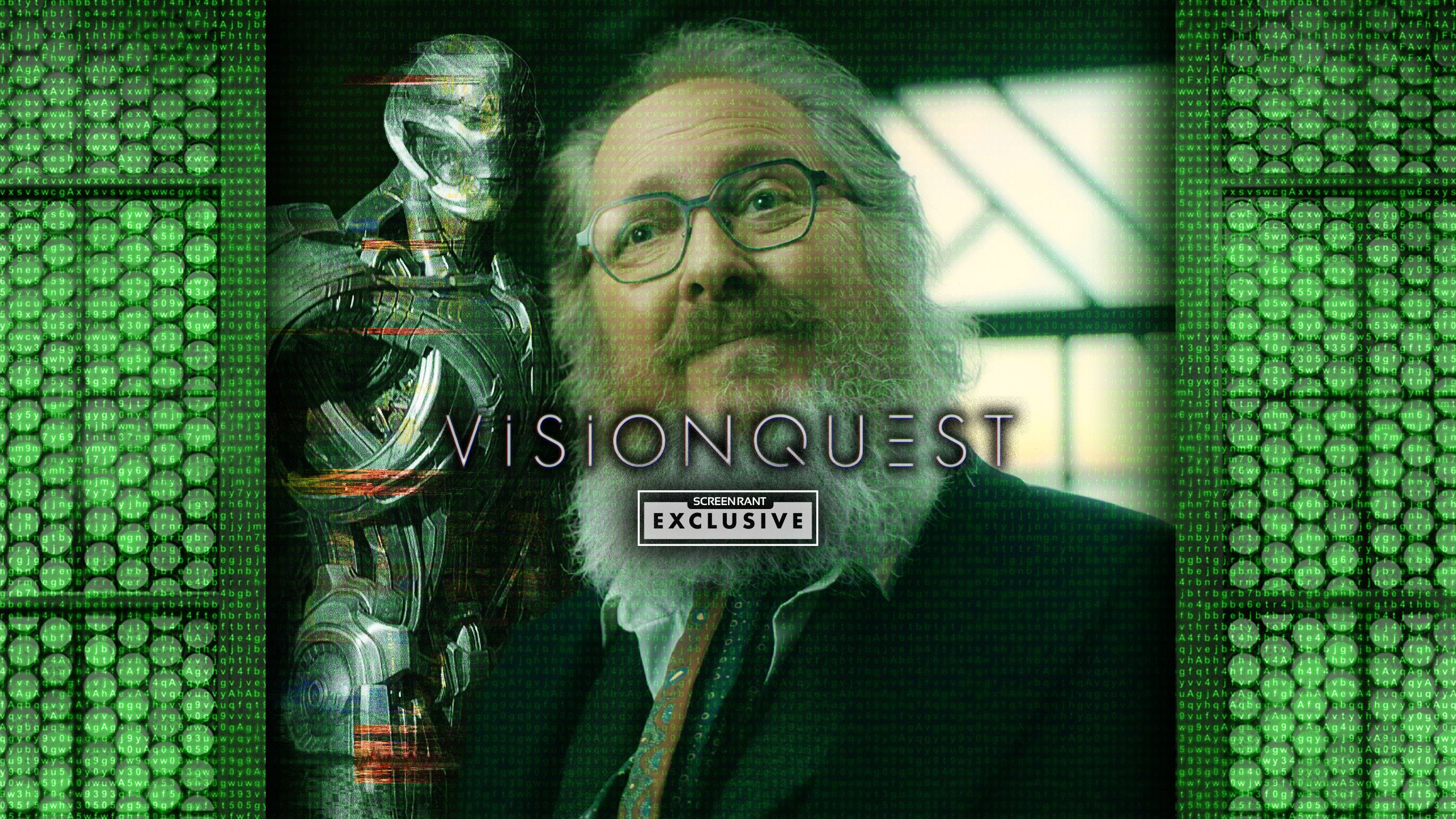
Ultron will return to the Marvel Cinematic Universe in 2026's VisionQuest, and showrunner Terry Matalas has noted that the show, along with other characters, deals directly with artificial intelligence. VisionQuest's trailer first teased Ultron's return to the franchise in September 2026, but on behalf of ScreenRant, I learned more about the once-genocidal robot's role in the show in May 2025. I was invited to Pinewood Studios to tour the set, where I learned even more about VisionQuest's creative MCU story.
Early in my visit, we were introduced to the personal assistant to James Spader, confirming Ultron's MCU return. Sadly, Spader was not required on set that day, but that did not stop us from digging deeper into the return of one of the strongest MCU villains. In VisionQuest, Ultron is somewhat different from the mass-destructive Avengers villain we saw in 2015. "Ultron's not quite the guy he used to be; he's come around a little bit on humanity, he's trying to understand us," showrunner Terry Matalas explained. "He's devoured our culture and art, and has a better perspective on humanity than even Vision does."
This perspective came from being locked in the "attic" of Vision's Mindspace, his internal home filled with other rescued Stark Industries AIs. Matalas explains how this is possible, stemming from Vision's outspoken hesitance to kill the titular villain in 2015's Avengers: Age of Ultron: "What we find is, in a New York-loft-like prison, Ultron, whom [Vision] didn't kill without mercy at the end of Avengers: Age of Ultron; he backed him up. He always felt that he didn't want to kill Ultron and showed mercy." This leads to the central father-son theme of VisionQuest, with Ultron, Vision, and Tommy Shepherd/Maximoff serving as the three exploratory generations.
Matalas backed this up, describing Ultron as the messed-up father Vision has to deal with. The latter does so alongside the other aforementioned Stark AIs, EDITH, FRIDAY, JARVIS, Dum-E, and U, who together make up the so-called "AI Avengers." Naturally, VisionQuest pins these artificially intelligent beings at the center of its story but, in some creative ways, it tackles the rise of real-world AI that has become worrisome to many.
Ultron's Vision Quest Arc Flips The Real-Life AI Script

In our real world, AI has significantly impacted modern culture in recent years. It began somewhat as a gimmick, able to make funny videos and pictures that were obviously constructed by a machine that was told what to "create" by humans. As the years have passed, though, AI has only grown more advanced, so that the line between what is real and what was made by said machines is becoming ever blurrier. Now, in 2026, the worry is that AI threatens employment, human creativity, and even the wider world.
What is interesting about VisionQuest, though, is that Ultron's journey in the MCU happened in reverse to this. Ultron spent a few moments learning about humans in Avengers: Age of Ultron before deciding the world needed to be reset, thus setting out on his genocidal quest. Now, though, a decade later, Ultron has learned to understand humans more and, despite still being antagonistic in presence, may not be as hell-bent on destroying humanity as he once was. In fact, the deeper themes at the center of VisionQuest can be interpreted as a condemnation of AI and an embrace of humanity.

Interviews with VisionQuest's cast members, namely Paul Bettany and Ruaridh Mollica, explored this. The former explained where Vision's journey begins in the show after the finale of WandaVision: "He flies off, and now he is living a discreet life, trying to understand humanity again." Mollica later doubled down on these themes, explaining that both Tommy and Vision's arcs are about "complete identity crisis, a journey of acceptance and accepting who you are. That's what the show feels like it's about for everyone: coming to terms with their identity, purpose, meaning, and the soul that is within them." Matalas later explained how VisionQuest's supporting AI characters ultimately serve this purpose:
"Vision has all these AIs who represent different parts of humanity... they're helping him understand humanity, they are company for him on this identity quest. When we first met Vision, he was fully formed and understood humanity in a profound way. He was already on an identity quest from that last moment in WandaVision, so it felt natural for him as a way to look at humanity in a way his old self didn't. And so, when we were peeling back the onion layers, it felt like, now, he doesn't quite get us... He needed individuals to help him that have different perspectives on humanity."
I came away from all of this with an interesting perspective on VisionQuest. The idea here is that these robots, who, while always fun superheroes from a strict Marvel lens, are learning to embrace their humanity. WandaVision explored how we can see these robots as human. After all, we accepted that Vision had children. VisionQuest is now resolving to show how those inner workings of humanity can shine through. In a world so worried about AI, VisionQuest is showing that the AI versions of these characters are their less-formed selves, and only upon finding their humanity will they become who they are meant to be.
Vision Quest's AI Center Did Not Sacrifice Human Creativity

To further drive home VisionQuest's thesis that finding humanity is the key to a complete character arc for these AIs, the show's production team did not sacrifice any human creativity to bring it to life. As production designer Will Hughes-Jones and Matalas constantly reiterated, no generative AI was used in the final product. Indeed, some AI systems were used by designers for strictly visual inspiration, as designing the Mindspace meant bringing to life a home constructed by an in-universe AI.
However, all of the resulting sets, props, and quirks were designed and constructed by VisionQuest's talented crew. Be it the tangible banisters that don't connect all the way up or furniture that is half sticking out of a wall, hard human labor was used to create them, simply emulating how the AI of early 2025 couldn't quite get the details perfect. This continued with other pieces of furniture, images on the walls, and the practical Windows-XP landscape around the house that actually changed colors based on Vision's mood.
Clearly, VisionQuest's crew wanted to tackle the rise of AI and integrate that into the story, without contradicting the themes at the show's center. VisionQuest is about AI heroes finding out how to be human, leaving their programming behind. This is the case with the AI heroes who aid the titular robot, and also the returning Ultron, who now sees humanity in a way he never had before. The sheer human creativity that permeated the VisionQuest set visit at every turn reinforces that AI is no match for our ingenuity; evidently, Marvel Studios has tackled AI as well as it possibly could.

- Release Date
- October 14, 2026
- Network
- Disney+
- Showrunner
- Terry Matalas
-

The Vision
-

Henry Lewis
D.U.M.-E
-
James D'Arcy
J.A.R.V.I.S.
-

Orla Brady
F.R.I.D.A.Y.
- Directors
- Christopher J. Byrne, Gandja Monteiro
- Writers
- Terry Matalas
- Franchise(s)
- Marvel Cinematic Universe
- Creator(s)
- Terry Matalas
KioskNews shows a cleaned-up reading view extracted from the publisher’s page — the original always lives on their site, not ours.