From Moree schoolgirl to High Court trailblazer and human rights advocate
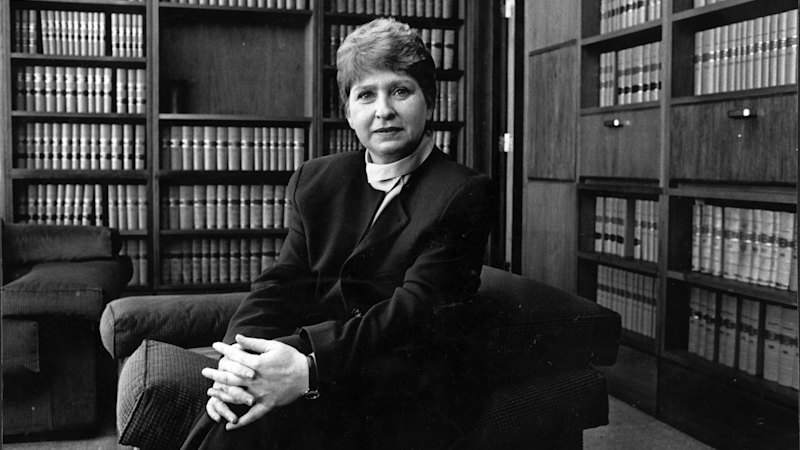
When in 1951 Dr H.V. (Doc) Evatt, then federal opposition leader, stood in the back of a utility in Moree to campaign for a “no” vote in the coming referendum to outlaw communism, he encountered an eight-year-old girl who asked: “Please, sir, what’s a constitution?”
The Doc must have had prescience, or astonishing insight, because he took the child seriously, and after a discussion relating the Ten Commandments to government, he sent her a copy of the Australian Constitution. The little girl, Mary Gaudron, was to grow up to become the first woman appointed to the High Court of Australia and rule on matters relating to that very constitution.
Mary Genevieve Gaudron was born in Moree on January 5, 1943, the eldest of five children of a train driver, Edward Gaudron, and his wife Grace (Bonnie) (nee Mawkes). Mary’s working-class background later would open her up to criticisms that she was “Labor-oriented”. She did have a keen interest in the disadvantaged. But she needed drive, being born in those circumstances, decades before women’s liberation became fashionable. Through her life, Gaudron, feisty and plain-spoken, was to contribute to rectifying most of the problems she was exposed to in her early life, including Moree’s race relations.
Gaudron went to a local convent school, then got a bursary to St Ursula’s, Armidale. One nun recalled her as a “quick-witted girl … determined to make the best of her abilities”. Gaudron achieved a brilliant Leaving Certificate pass, which earned her a Commonwealth Scholarship to study arts/law at the University of Sydney, which she entered in 1959. She took an interest in speleology, the study of caves, and also played the mandolin.
University friends remembered her as “brilliant” or “good fun”. She graduated in arts in 1962 and in February 1963 she married a fellow caver, Benjamin Sidney Nurse. She continued a law course part-time, supporting herself by working as a registration clerk in a legal office.
Gaudron encountered many obstacles. One of her lecturers said she should not take part in a moot court because women were not expected to take the practice of law seriously. But she was scarcely to be put off. Blackacre, the law students’ magazine, paid tribute to “a slight redhead with a temper to match”, and added: “Mary has all the attributes of a thoroughly disconcerting, accomplished debater. She has a keen analytical mind, a magnificent command of language and sheer audacity. Opponents are demolished by a few four-letter words.”
Gaudron gave birth to her first child, Danielle, in 1964 and the following year she topped her final law exams.
Taking out the University Medal, and asked to comment on the award going to a female rather than a male, she said: “The only difference between us is that I sit down to pee!” She lectured for a time on succession law; she got articles despite prejudice among lawyers in favour of male graduates; and she was admitted as a solicitor of the NSW Supreme Court. She was admitted to the bar in October 1968, but she encountered more prejudice when she tried to get chambers on a barristers’ floor, and ended up sharing chambers with pioneering barrister Janet Coombs.
But when she went into action, specialising in defamation, negligence and industrial law, Gaudron drew attention. On one occasion, High Court judge Sir Victor Windeyer admonished her on mispronouncing the name of one Lord Esher, she said: “If his Lordship were present, by whatever appellation, he would realise that I [was] relying on his pronouncement of the law, not the pronunciation of his name!”
In the High Court, Gaudron acted on her own as counsel in an appeal in a defamation case, O’Shaughnessy v Mirror Newspapers, and won. In 1972, she became the first woman to be appointed to the NSW Bar Council. She was retained by the Commonwealth in the second equal pay case, where the Australian Council of Trade Unions, supported by the Whitlam government, challenged the restrictions of the original equal pay decision in 1969 and succeeded in having equal pay extended to work of equal value. In 1974, now with another baby, Julienne, she was appointed deputy president of the Commonwealth Conciliation and Arbitration Commission, her ceremonial welcome to the commission famously interrupted by daughter Julienne’s cry: “Mummy, Mummy!”
In 1979, she sat on the maternity leave case that laid down award standards allowing for a year’s unpaid leave for all full-time and permanent part-time workers.
Gaudron became foundation chair of the NSW Legal Services Commission. In 1980, she resigned from the Conciliation and Arbitration Commission over an issue relating to a colleague, Justice Jim Staples. She then briefly took up a position as visiting fellow at the University of NSW Law School. In 1981, she achieved another first for women by becoming NSW solicitor-general. She also became the first woman in NSW to be appointed a Queen’s Counsel. As solicitor-general, Gaudron had to deal with complexities surrounding Chief Magistrate Murray Farquhar, solicitor Morgan Ryan, magistrate Clarrie Briese and eventually Justice Lionel Murphy, and the fallout from The Age Tapes.
The Australian Law Journal commented on her “outstanding and ingenious advocacy”.
Gaudron, having divorced Ben Nurse, married John Fogarty, with whom she was to have a son, Patrick. She took up a council position at Macquarie University and on a committee at the University of Wollongong dealing with technology and social change. When she was appointed to the High Court on February 6, 1987, her elevation was warmly welcomed by much of the legal profession. But she encountered criticism that she had been too close to Murphy and the Wran government.
Prime minister Bob Hawke had to publicly defend her against opposition criticism of her “Labor connections”. The law profession gossip sheet, Justinian, attributed to her “a melancholy catalogue of sins of omission and commission” and said she had “an emotional disposition inappropriate in a holder of judicial office”.
Undeterred, Gaudron pursued her passion for human rights and her zeal for justice and equality.
This was evident in the Mabo case, where in her joint judgment with Sir William Deane, she said the dispossession of Aboriginal people from their traditional lands was “the darkest aspect of the history of this nation”. Mabo, which found native title did exist in Australia, was followed by other outstanding judgments in human rights cases such as Wik and the Hindmarsh Island trial.
Gaudron made a valuable contribution to the establishment of legal principles in a series of leading cases, particularly in the law relating to discrimination, and she identified equal treatment as a fundamental characteristic of the judicial process. In 1997, she was appointed foundation patron of the Association of Women Lawyers. In 2002, though only 60 and at one time considered to be in the running for chief justice, she announced her resignation from the High Court bench, effective from February 20, 2003, and the following month she became a judge of the Administrative Tribunal of the International Labour Organisation in Geneva.
In 2004, she was a member of an ILO Commission of Inquiry into trade union rights in Belarus. In 2006, the UN’s then-secretary-general, Kofi Annan, appointed her to the Redesign Panel on the N System of Internal Justice. In 2009, Gaudron became vice-president of the Administrative Tribunal of the ILO and in 2011 she became president. She resigned from the ILO in 2012 to care for her husband, who had suffered a cerebral haemorrhage.
Governor-General Sam Mostyn paid tribute to Gaudron on Sunday afternoon, saying her distinguished career had transformed the country’s legal landscape.
“Justice Gaudron brought her fierce intellect, integrity, compassion and a deep commitment to justice to every role she held. Her legacy endures in the Australian legal system and in the many people who continue to follow the path she helped forge.”
Start the day with a summary of the day’s most important and interesting stories, analysis and insights. Sign up for our Morning Edition newsletter.
More:
KioskNews shows a cleaned-up reading view extracted from the publisher’s page — the original always lives on their site, not ours.