North Dakota Court revives woman’s claim over water main flood damage
Court rules unintended property damage from deliberate city actions may still warrant constitutional compensation.
A broken underground water pipe can quickly become a costly nightmare for property owners, particularly when repair efforts bring fresh waves of water into an already flooded building.
In Fargo, North Dakota, a property owner is seeking compensation after a municipal water main failure damaged her building, with the city's response becoming a central issue in the ensuing legal battle. On November 25, 2026, the North Dakota Supreme Court partially revived her lawsuit, allowing one constitutional claim to proceed while leaving several other claims dismissed.
Flooding continued during repair efforts
According to the North Dakota Supreme Court's November 25 decision in Kommer v. City of Fargo, 2026 ND 208, Michelle Kommer and two associated business entities, HighRoad Partners LLC and HighRoad Properties LLC, sued the city over flooding at their property on NP Avenue North in Fargo.The city was notified of the broken water main at 5:50 a.m., and repair crews arrived 20 minutes later, the court said. At 8:04 a.m., workers turned off the main valves after an employee found water in the basement.However, the initial excavation did not reveal the location of the break. Crews subsequently alternated between turning the water supply on and off while attempting to identify the damaged section. A second excavation eventually exposed the break, allowing workers to complete the repair.
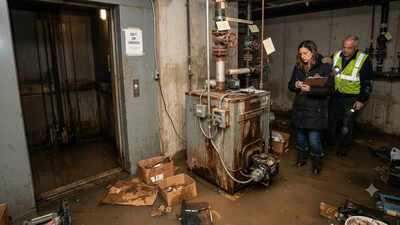
The North Dakota Supreme Court noted that the flooding damaged several parts of the property, including its boiler, elevator and plumbing. Kommer also attempted to remove the accumulated water from the basement.Insurance assurance became another point of disputeThe court's account also describes an assurance made during the repair operation. A crew leader indicated that the city's insurance would cover damage resulting from the water main incident.That expectation was not fulfilled, as the city's insurer ultimately refused to provide compensation.Kommer subsequently pursued five claims against Fargo: negligence, trespass, inverse condemnation, estoppel and deceit. The district court granted summary judgment in the city's favor, prompting her appeal to the state's highest court.
Court distinguishes repair decisions from constitutional property rights
In reviewing the negligence and trespass claims, the North Dakota Supreme Court examined whether Fargo could rely on discretionary-function immunity under state law.According to the court, municipal workers had to weigh several competing considerations before shutting down the damaged water main. Residents may lose water and fire protection if the supply fails. Water circulation could also help crews locate the break with listening equipment, reducing excavation costs and road and business disruption.The North Dakota Supreme Court therefore concluded that decisions about when to stop the water and how to conduct repairs involved policy considerations protected by discretionary immunity.
It upheld the dismissal of the negligence and trespass claims.
Inverse condemnation claim gets a second chance
The most significant development in the November 25 ruling concerned Kommer's inverse condemnation claim.The North Dakota Supreme Court defines inverse condemnation as a legal remedy for property owners when government actions take or damage private property for public use without formal condemnation proceedings or just compensation.The court rejected the district court's ruling that emergency repairs caused the flooding, not a planned public infrastructure project.The North Dakota Supreme Court found Fargo intentionally let water through the broken main and restored it during repairs. These decisions involved providing residents with municipal water and fire protection, public uses.Importantly, the court ruled that the city did not have to intend to damage Kommer's property to claim inverse condemnation. Damage from deliberate government actions, even unintentional, may require constitutional compensation.
Other claims dismissed as case returns to lower court
The North Dakota Supreme Court also rejected Kommer's arguments concerning estoppel and deceit, which stemmed from the crew leader's insurance assurance.The court found that the available evidence did not establish detrimental reliance on that statement. Kommer had continued taking steps to remove the basement water and had contacted a restoration contractor, whose workers used submersible pumps to address the flooding.
She could not demonstrate that the insurance assurance caused her to change her actions or suffer additional losses.In its November 25 decision, the North Dakota Supreme Court affirmed the dismissal of the negligence, trespass, estoppel and deceit claims but reversed the ruling on inverse condemnation.
The case has now been sent back to the district court to determine whether the city's actions directly caused the property's damage and, if so, the amount of compensation that may be owed.The ruling does not establish that Fargo is liable or that Kommer is entitled to a particular payment. Instead, it allows the remaining factual questions surrounding the constitutional property claim to be examined in further proceedings.Image Courtesy: Googler Gemini
KioskNews shows a cleaned-up reading view extracted from the publisher’s page — the original always lives on their site, not ours.