Shackling prisoners giving birth should be a last resort – but it’s happening around Australia anyway
“She was pregnant with twins,” Tahlia Isaac says. “She was meant to be released in 10 days, but she went into labour early.”
Isaac says officers handcuffed her fellow prisoner in the back of a van and took her away.
In her submission to a federal inquiry into shackling during childbirth, she says many woman who have experienced it “still think about the time they gave birth to their child cuffed to the bed, years later”.
“They weep when they describe wanting to cradle their newborn child but only had one available hand to do so,” says Isaac, the founder of Project:herSELF, a not-for-profit supporting formerly incarcerated women.
Lidia Thorpe, the Gunnai, Gunditjmara and Djab Wurrung woman and independent senator for Victoria, has introduced a private member’s bill to prohibit shackling during childbirth.
“No one giving birth is at risk of running away,” Thorpe said in her second reading of the bill. “Anyone who has given birth would agree that to be shackled whilst giving birth would be an incredibly violent and terrifying act.”
There is a patchwork of state and territory laws that state shackling should only be used as a “last resort” or only when “absolutely necessary”, but critics – and Thorpe – say it’s happening anyway.
“People are cuffed to their hospital bed by an arm and a leg in the delivery room, their legs shackled together by a chain,” Thorpe said.
As well as helping women who’ve gone through it, Isaac witnessed it herself when she was in prison. She says the woman who was taken away in the prison van was separated from her child and sent straight back.
“I just remember hearing her scream, just wailing and wailing. I think every woman in that centre was left horrified,” she says.
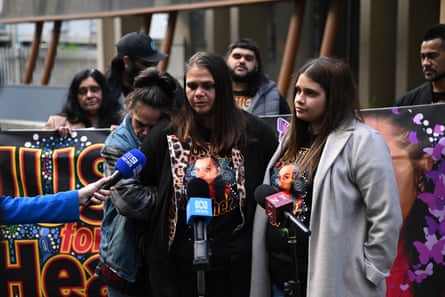
On Wednesday, Thorpe told the Senate about Heather Calgaret, a Yamatji, Noongar, Wongi and Pitjantjatjara woman, and mother of four children.
In 2019, she gave birth while shackled to a hospital bed in Victoria.
Days after the birth, Calgaret’s baby was removed, a decision her family said would have “crushed” her, and her health deteriorated after that.
“In November 2021, Heather died in custody after being administered a high dose of buprenorphine, a drug used to treat opioid addiction. She had no history of opiate use,” Thorpe told the Senate.
“Heather should still be here with us today.
“Her life was precious and her passing was preventable.”
In 2025, the coroner found the removal of her daughter was “pivotal” to Calgaret’s death.
According to an August report from the Australian Institute of Health and Welfare, about one in 10 of Australia’s prisoners are women.
According to the parliamentary library, between 5% and 10% of women in prison are pregnant, and at least half have a history of mental illness or childhood abuse.
Almost half the female prisoners identify as Indigenous.
The only data on giving birth while incarcerated was from 2017, when 25 women gave birth.
Fifteen years ago, the UN general assembly adopted the Bangkok Rules on the treatment of female prisoners, which state that prison should be a last resort for pregnant women and that “instruments of restraint shall never be used on women during labour, during birth and immediately after birth”.
The rules were adopted unanimously by the general assembly. But around the world, they are regularly flouted.
The National Justice Project told the inquiry into Thorpe’s bill that shackling someone during labour and childbirth was “not a grey area”.
“It is a clear breach of settled human rights standards and violates the rights of two people at once: the mother giving birth and the child being born,” the organisation said in its submission.
The Australian College of Midwives has said it was also against the Mandela rules for the treatment of prisoners and shackling was “an unsafe and unnecessary practice that may result in adverse outcomes for women and newborns, perinatal mental ill-health”.
The National Network of Incarcerated and Formerly Incarcerated Women and Girls tells the story of Yannetty*, who was six months pregnant when she was handcuffed and shackled and transported in 40C heat for a medical appointment in 2013 or 2014.
She said she was hot, swollen, frightened of fainting, and frightened for her baby.
“I was not treated like a pregnant woman going to receive medical care. I felt like I was being treated as though I was something dangerous that needed to be bound,” she said.
The chief executive of Sisters Inside, Debbie Kilroy, said shackling during childbirth was “state violence inflicted at the moment a person is most physically vulnerable and in need of care”.
“Aboriginal and Torres Strait Islander women will be disproportionately exposed to this violence because they are disproportionately targeted, criminalised and imprisoned. The practice sits within a much longer colonial history of controlling First Nations women, separating families and denying Aboriginal mothers’ authority over their own bodies and children,” she said.
The Guiding Principles for Corrections in Australia say “instruments of restraint are not used on prisoners … during and immediately following childbirth”.
The same is true for other significant medical conditions, the guidelines say, “unless an individualised assessment identifies a compelling safety risk that cannot be managed by other available means”.
In the ACT, restraints are a “last resort”, and only to be used on a pregnant detainee when “all other efforts have failed”, according to the parliamentary library. In NSW, pregnant prisoners “must not be restrained unless it is absolutely necessary”.
Other states and territories have similar caveats.
If passed, the bill would override those exemptions.
Amelia* only found out she was pregnant when she was strip-searched and put through a scanner once she got to prison. She was cuffed for all her ultrasound appointments, and struggled to roll into the right position because of the handcuffs.
Officials had drawn up her birthing plan, telling her she would be cuffed during labour. She was told she could have a support person with her – then they clarified it would be a prison officer, but she could nominate them.
In the end, she got out about 10 weeks before giving birth.
“The birth, anyway, was traumatic because I’m so scared of needles,” she said.
She was in labour for four days, had three failed epidurals, and got pre-eclampsia.
“Imagine that with cuffs. I do think about it. It’s ridiculous,” she said.
“I’m glad I got to do it the way I did.”
In Australia, the crisis support service Lifeline is 13 11 14. International helplines can be found at befrienders.org
KioskNews shows a cleaned-up reading view extracted from the publisher’s page — the original always lives on their site, not ours.