Jorge Jesus won’t bend, and Cristiano Ronaldo cannot be bent

Some time next week, or next month, Cristiano Ronaldo will reveal his side of the story. Of his latest, dramatic falling out with Portugal coach Jorge Jesus. The coach has offered glimpses of his version in a press conference: that the country’s greatest footballer didn’t suit the tactical demands of the game.
Rumours and speculation have swirled like a juicy whodunit. Spanish journalist and Ronaldo’s close friend Edu Aguirre claims the footballer felt betrayed. There supposedly was a closed-door meeting between the Portuguese football federation, Ronaldo and the coach, in which Jesus apologised to Ronaldo and said he would offer a public apology. Instead, he emphatically defended his decision to not play him against Norway in a press conference, only moments later.
Numerous inside stories, half-truth and half-fiction, will spill out, dividing a country and the footballing universe. But the falling out was imminent, considering the collision of two headstrong, egoistic personalities: the coach who considers himself a supreme force and a footballer who believes he is god’s gift to the sport. Only no one expected the relationship to unravel so fast.
There were hints, when you revisit Jesus’s first press conference, where he said, “I wouldn’t stand up to anyone.” The coach’s methods and his unflinching devotion to his ideals made a clash likely.
Jesus, 72 and with flowing silvering locks, might not be the most fabled tactician of his times. He was a modest footballer, a midfielder whose career had more stops than a shuttle train (13 clubs in 17 years, largely in the lower rungs of the Portuguese league). He was an uncelebrated manager, whose best years were spent with Benfica (2009 to 2015), with stops in Brazil, Saudi Arabia and Turkey, in a career that began when Ronaldo was five. But most players he has managed either love or loathe him. To some, including Pablo Aimar, Fabio Coentrao and David Luiz, he is the greatest coach they have played under.
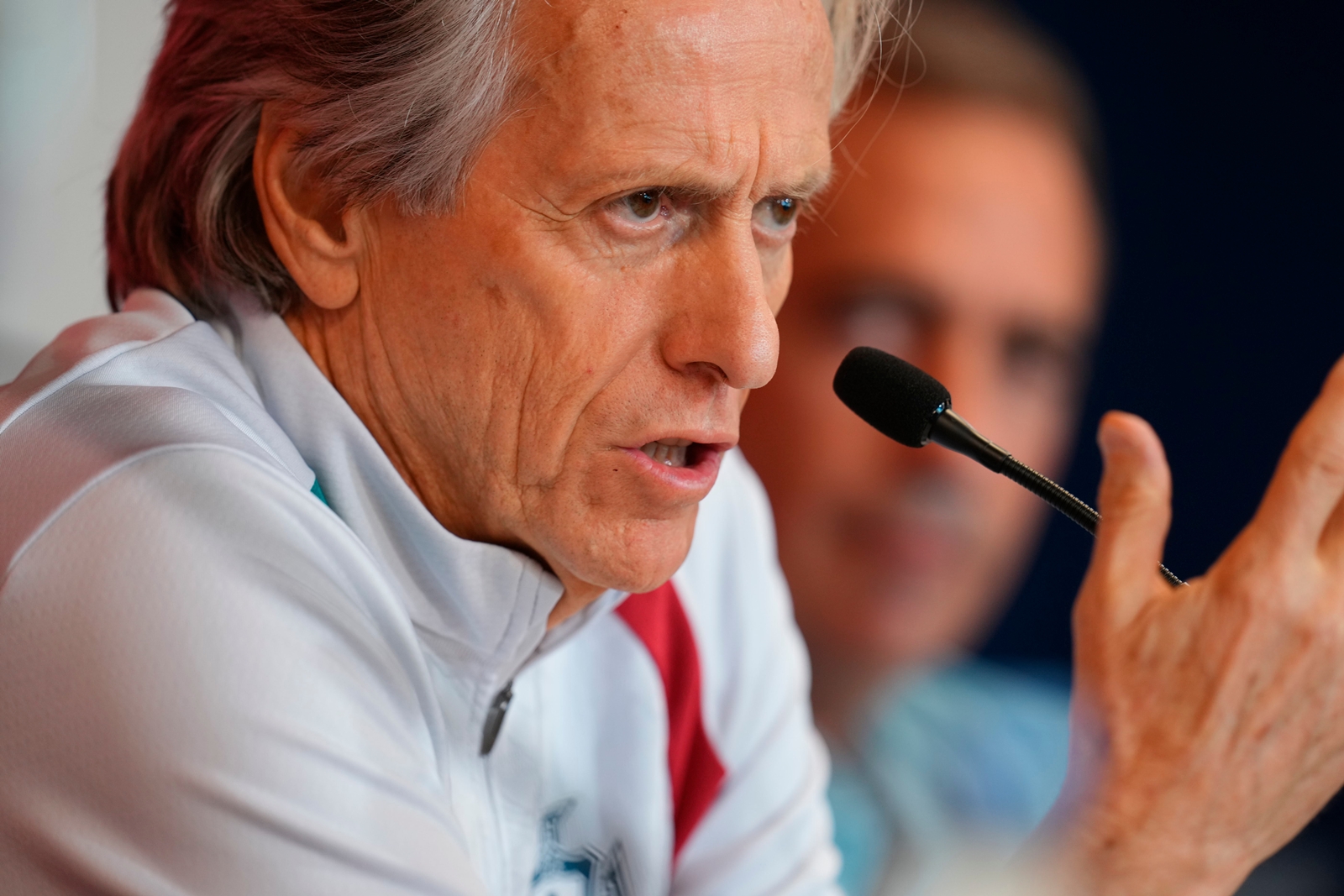 Portugal’s head coach Jorge Jesus speaks during a news conference in Copenhagen, Denmark, Wednesday, Sept. 30, 2026, ahead of their Nations League soccer match against Denmark. (Liselotte Sabroe/Ritzau Scanpix via AP)
To others, he is an autocrat. On his first day at Benfica, he made the players train for four hours without a break, without letting them have a swig of water. He made them train twice a day, would shout and berate, but at the end of the day, former Portugal international Fernando Mendes said, “we knew we had a great friend in him.”
To the players who rebelled, he would say: “Inside the club, only one person gives me the orders. The president. No one else.” Those who revolted against his exhaustive regimen, he ruthlessly relegated to the bench. He was so secretive in his tactics that he revealed them to his assistants only on the morning of the game.
The rigorous methods reaped rewards. Benfica won the league the first year he joined them. In the next six years, the club won two more, in what was their most successful era this century. His tactics shape-shifted, but were always thrilling and intense. He claims he doesn’t follow prototypes. “Some only copy what others do. I don’t. God gave me the opportunity to be a creator,” Jesus once told ESPN Brazil, after guiding Flamengo to five titles in a year.
Story continues below this ad
He has no dogmatic guiding philosophy and swears by no idol, even though he spends hours studying the patterns and principles of all accomplished coaches. But there are core principles, as seen in Portugal’s demolition of Denmark. They hounded the Danes with fluid aggression and heavy counter-pressing, and defended in a compact mid-block. He used three different formations in four games, but they were less tactical decisions than structural ones. Portugal played with a sense of identity that it had seldom shown before.
It was evident why he ignored Ronaldo, and why he could again in the coming matches. He needs pace upfront, he wants his number nine to press aggressively, he demands heavy work off the ball. Ronaldo, at 41, is still a prolific scorer, but he failed to fulfil his off-the-ball shifts in the 67 minutes he played against Wales. Jesus has not shut the door in Ronaldo’s face. After beating Norway on Sunday he said: “There are no bad feelings with Cristiano. For the next call-up, if Cristiano is playing and wants to be with the national team, then why not?” There are shades of the Ronaldo-Erik ten Hag skirmish, but with a more brazen edge.
Perhaps both of them could look into the mirror and see each other. A coach who believes in ultimate supremacy, built on smouldering ego. It’s his burnishing hubris that made Ronaldo, Jose Mourinho would say. It’s the flaming ego that made Jesus too. It reflected in the words that explained Ronaldo’s benching: “I told him I would take him to the bench and that, if I needed him for 30 minutes, he would play. But I saw the game differently, so he didn’t come on. It won’t be Cristiano, or any other player, who changes my ideas as a coach. Never. Neither him nor anyone else. Not even a president. Never. Zero.”
Perhaps Ronaldo’s endgame was written the day the federation chose Jesus to succeed Roberto Martinez, who indulged Ronaldo with disastrous results.
KioskNews shows a cleaned-up reading view extracted from the publisher’s page — the original always lives on their site, not ours.