Iraq opens first Jewish museum as country's ancient community nears extinction
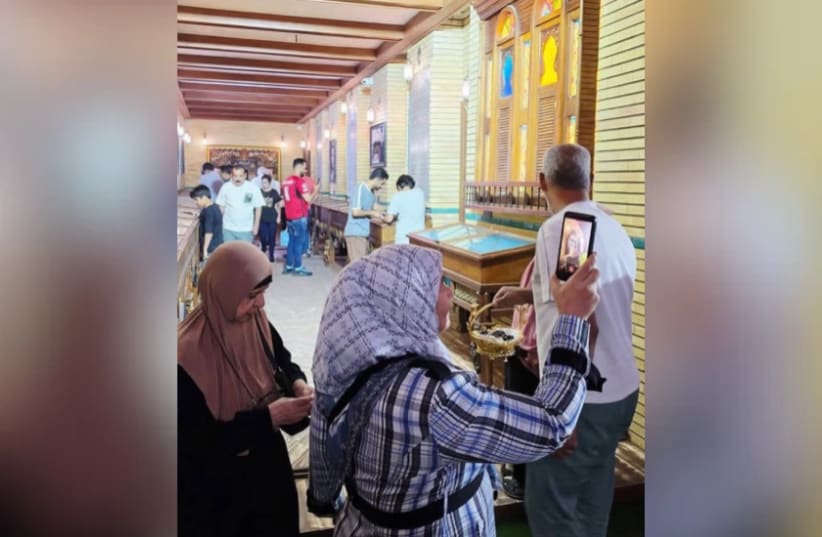
Iraq’s first-ever museum dedicated entirely to Iraqi Jewish history was inaugurated in Baghdad this weekend.
The Jewish Shamash Museum opened on Al-Rashid Street on the site of the historic Shamash School. The prestigious school was established by the Jewish community in 1928 and by 1939 had 900 students. The building no longer housed the Jewish school by 1951, but the school itself continued operating elsewhere until approximately 1973.
The museum is a cultural initiative aimed at reviving Baghdad’s pluralistic history and collective memory. It houses official documents, old school records, and academic certificates belonging to families and students who lived in Baghdad, as well as personal belongings such as family photographs, traditional clothing, household utensils, and religious artifacts.
Permanent screens display recorded interviews and audiovisual material that documents the testimonies and stories of members of the community.
Local news reports indicated that the number of visitors on the first day of the museum’s opening exceeded a thousand people.
From 150,000 to a handful
There are only a handful of Jews left in the country today. There are believed to be between four and six Jews in Baghdad and around 50 Jewish families in Iraqi Kurdistan.
Iraq used to have one of the oldest and most significant Jewish communities in the world, dating back more than 2,500 years to the Babylonian exile. The community peaked in the early 1900s, with Jews making up nearly a quarter of Baghdad’s population. There was an estimated community of between 100,000 and 150,000 Jews in the country before the 1941 Farhud (pogrom), which saw Jewish residents attacked, murdered, and robbed.
Following this, from 1950 to 1951, around 120,000 Iraqi Jews left for Israel in Operation Ezra and Nehemiah.
The community’s last custodians
There is still a Jewish community leadership figure, a woman named Khalida Elyahu, who is referred to as the head of Iraq’s Jewish community. She is a dentist at a health center in Baghdad.
Elyahu serves as the chairwoman of the Administrative Committee for Iraqi Jews, a legally recognized body responsible for administering the Jewish community’s remaining financial affairs, including communal property and religious endowments. It was responsible for the restoration of the shrine of Rabbi Isaac Gaon in the Qanbar Ali neighborhood of central Baghdad in 2025.
According to local Arabic-language Iraqi media, the restoration of the original Shamash School building was also made possible thanks to the same committee.
The Administrative Committee for Iraqi Jews was founded on February 25, 1958, and, according to a January 5 federal court ruling this year, seen by The Jerusalem Post, it remains in force as the sole body responsible for the Jewish community’s financial affairs in Iraq. Nevertheless, it is unclear who exactly commissioned the restoration.
A Jewish school that Jews cannot visit
While local media reported that it was funded by the Jewish endowment, JIMENA (Jews Indigenous to the Middle East and North Africa), a US nonprofit focused on the Mizrahi and Sephardic Jews, suggested another option.
In a statement on Saturday, JIMENA said it had met with “Iraqis leading this preservation work” earlier in October, the implication being that these are non-Jewish Iraqis.
JIMENA said that while it “welcomes” the restoration of the Shamash School and “stands with those who protect Jewish heritage in Iraq,” it “cannot celebrate this moment without asking a difficult question: ‘What does it mean to preserve a Jewish school that Jews cannot visit?’
“Preservation that does not include the descendants of these families risks becoming a display of Jewish absence rather than a restoration of Jewish presence,” JIMENA noted.
KioskNews shows a cleaned-up reading view extracted from the publisher’s page — the original always lives on their site, not ours.