Finding comfort in monsters
In her Kaohsiung exhibition, illustrator and art therapist Huang Wen-yu uses snakes, shadows and fantastical creatures to explore trauma, family ties and emotional recovery
By Julien Oeuillet / Contributing reporter


You would never have guessed that a comic book featuring a giant snake would make you feel warm and safe.
And yet, the art of Huang Wen-yu (黃文妤) speaks to the heart through imagery suffused with monsters and dark shadows.
And that is because Huang is not only a cartoonist and illustrator, she is also an art therapist.
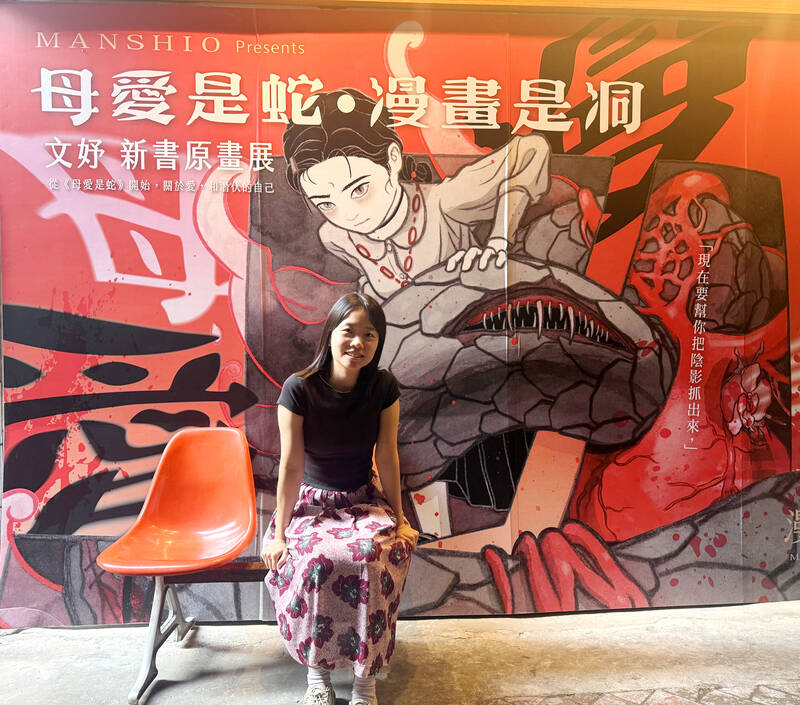
Huang Wenyu in front of her character and her snake-like mother.
Photo: Julien Oeuillet
Under the title “Motherly Love is a Snake,” the show exhibits works from Huang’s books, and is the inaugural exhibition of the newly opened Manshio cafe in Kaohsiung.
“During art creation,” she tells the Taipei Times, “artists have inner changes, their mindset changes while they draw.”
Huang’s art is inspired by her work as an art therapist, which enables her to use images to express trauma and mental health recovery.
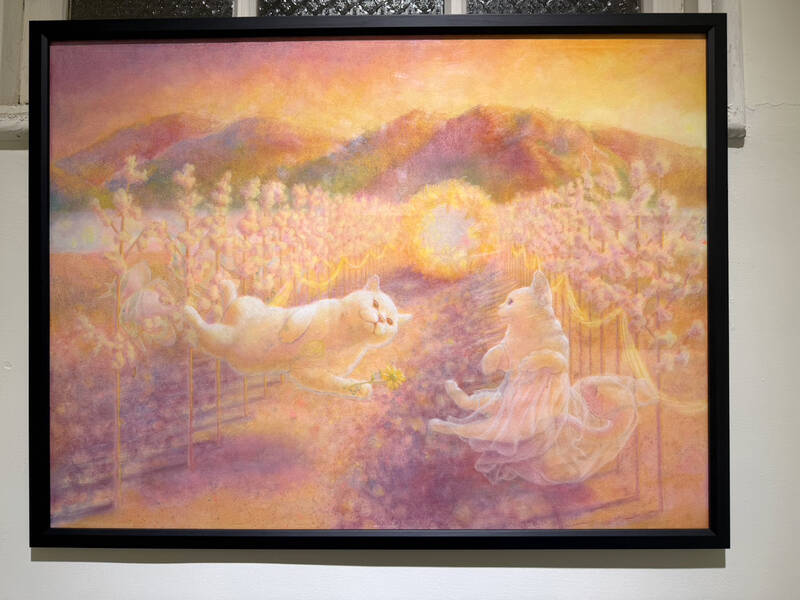
One of Huang Wenyu’s books tells a tale of recovery through the spiritual journey of a cat.
Photo: Julien Oeuillet
Her first book tells the story of a cat with a dinosaur tail, illustrated in large paintings where the cute animal is confronted by monsters and dangerous landscapes.
“The tail symbolizes our inner fears and our suppressed desires,” she says, “this dinosaur will pop out and devour and eat everything.”
The juxtaposition of such an innocent and fragile animal, in realistic drawings, with such dark scenery, allows viewers to connect with the emotional journey towards recovery.
“Every page represents different stages. First it’s in the sea and all is unclear, then there is more awareness of the inner desires which are represented by monsters, I acknowledge and accept them. Then all is sunny and clear. Every page is a different state of mind.”
FLEDGLING DISCIPLINE
Huang says that Taiwanese have little understanding of art therapy, so demand remains low.
“It’s only acknowledged academically and there is no national licence. There are now two academic associations for art therapy, but just above 200 registered art therapists, which is not a lot,” she says.
Huang works with both children and the elderly, and says that art therapy is often the first time in their lives that old people get to express a personal taste, “things as simple as what their favorite color is.”
There is an element of inter-generational tension in Huang’s work.
Further stories focus on a woman using a sort of magic gun to get ghostly shadows out of people.
“In this work,” she says, “I try to get to know how culture affects women, mother-and-daughter relationships.”
Snake imagery also appears in her personal experience working in an institution for children that functions in a similar way to an orphanage.
“The children’s parents can’t take care of them because of domestic violence or drug addiction or incarceration,” she says. “Many of these children have trauma or emotional regulation issues, so I do art therapy for them.”
One little boy who suffered from abuse made a snake out of clay that he used to express anger, pretending to bite her and then putting it to sleep in a box. “This is how he learned to manage his feelings.”
The transmutation of such a frightening image as a snake or spectral shadows or monstrous dinosaurs into a touching and human story invites the audience to see them in a positive light, and thus accept their emotions in a healthy manner.
Huang says she has grown sensitive to the cultural aspect of art therapy.
“Art in Taiwan comes a lot from colonial history,” she says, “Taiwan’s modern art developed during Japanese colonization, when Japan introduced Western oil painting. Art therapy is also a Western idea. Our professors all come from abroad to bring this concept here. I think if we want people to enjoy art therapy more we have to find our art, that relates to our daily life and experience.”
For your information
Exhibition Notes
What: Motherly love is a snake Where: Manshio (漫?) 130-1, Qixian 3rd Rd, Yancheng District, Kaohsiung City (高雄市鹽埕區七賢三路130-1號) When: Until Nov. 16 Open: Friday to Saturday 11am to 1am, Sunday to Monday and Wednesday 4pm to 1am, closed Tuesday and Thursday Admission: Free On the net: on Instagram @wenyu.art
KioskNews shows a cleaned-up reading view extracted from the publisher’s page — the original always lives on their site, not ours.